ET-3200 Digital Trainer · Volume 5
After the ET-3200 — the ET-3400 and the ET-3700
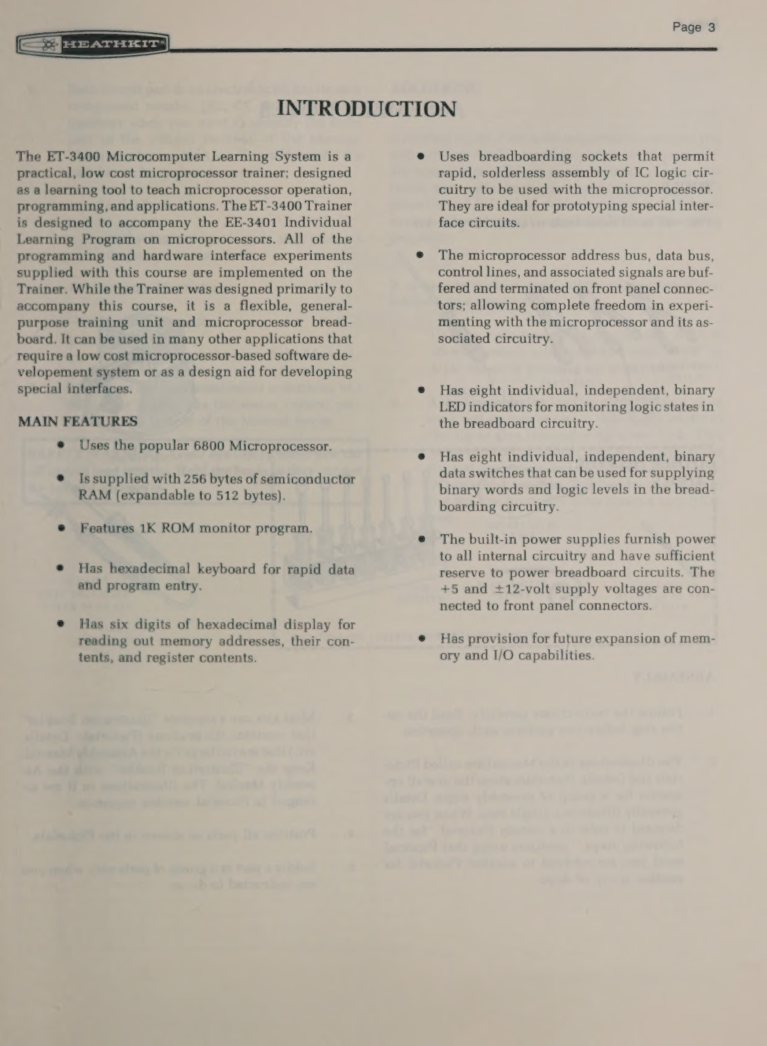
Two later Heath trainers carry the ET-3200’s design forward. The ET-3400 Microprocessor Trainer of 1977 took its switches, indicators, supplies and breadboard and added a small computer. The ET-3700 Digital Trainer of 1987 replaced it directly, with nearly the same panel and a connector for plug-in experiment boards. This volume gives the ET-3400 a substantial section, since it was the next course in the ET-3200 owner’s path, without making it a full dive. The ET-3400’s place in Heath’s computer history (the H8, the choice of processor, the money) is told in the history dive’s volume on Heath going digital and is summarised here only where the trainer line needs it.
5.1 The ET-3400 Microprocessor Trainer
5.1.1 Where it came from
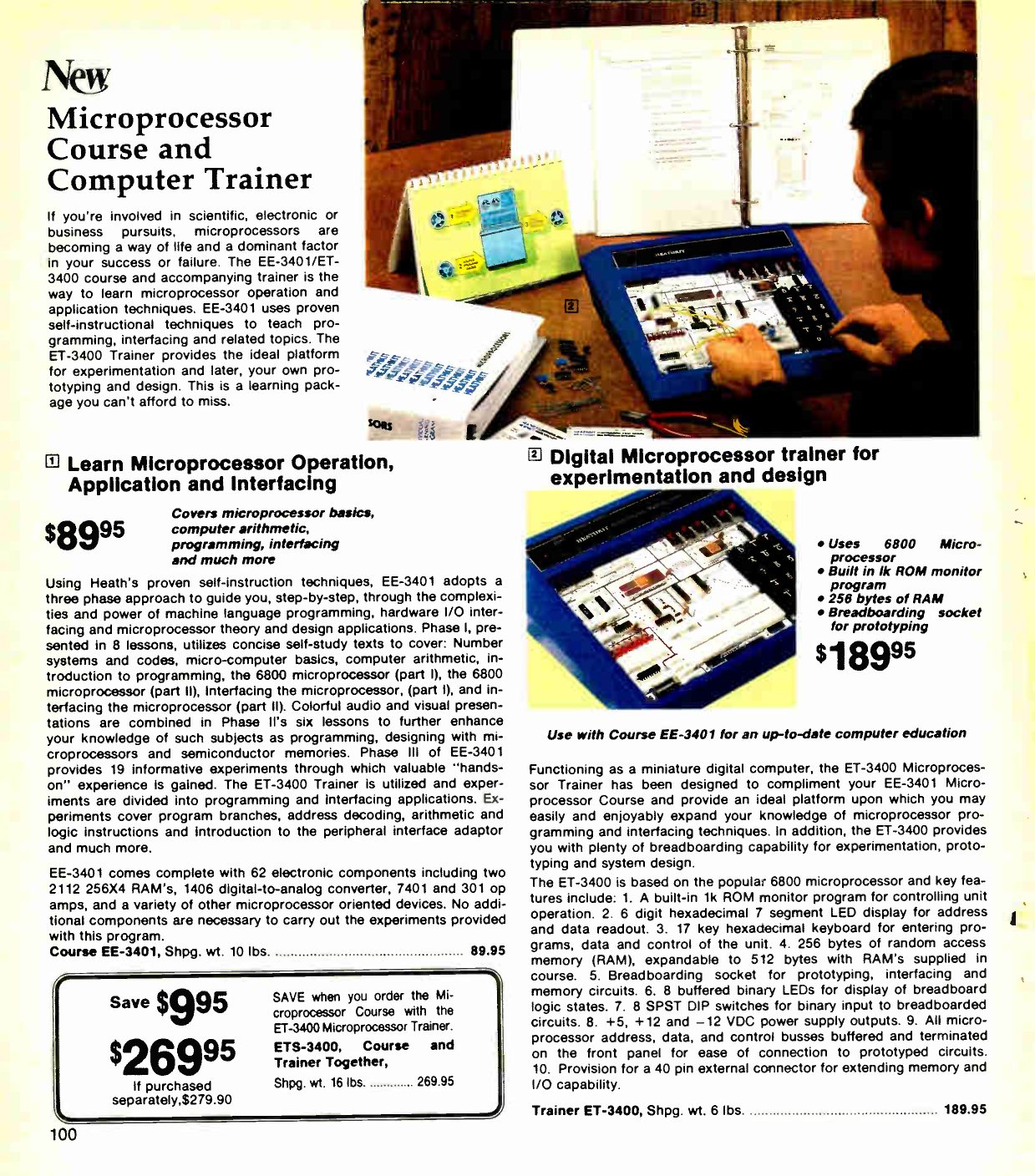
Lou Frenzel, who had founded Heath’s education business, wrote that its first microprocessor product was “a microprocessor trainer and course based on the Motorola 6800”, and that the ET-3400 “was the result and it was a huge success”, because “microprocessors being new to electronics there was an overwhelming need for education” (Frenzel, Electronic Design, 2013). The trainer and its course, EE-3401, appeared as “New” items in the Christmas 1977 catalogue (No. 818). The trainer is pictured on the cover, and the president’s letter called them “a most exciting addition to the Heathkit Educational Series”. The kit cost $189.95, the course $89.95, and the two together $269.95 (Christmas 1977, cover and p. 100). The Fall 1977 catalogue still offered only the ET-3200 for digital work, so the ET-3400’s often-quoted 1976 date is too early.
5.1.2 What it shared with the ET-3200
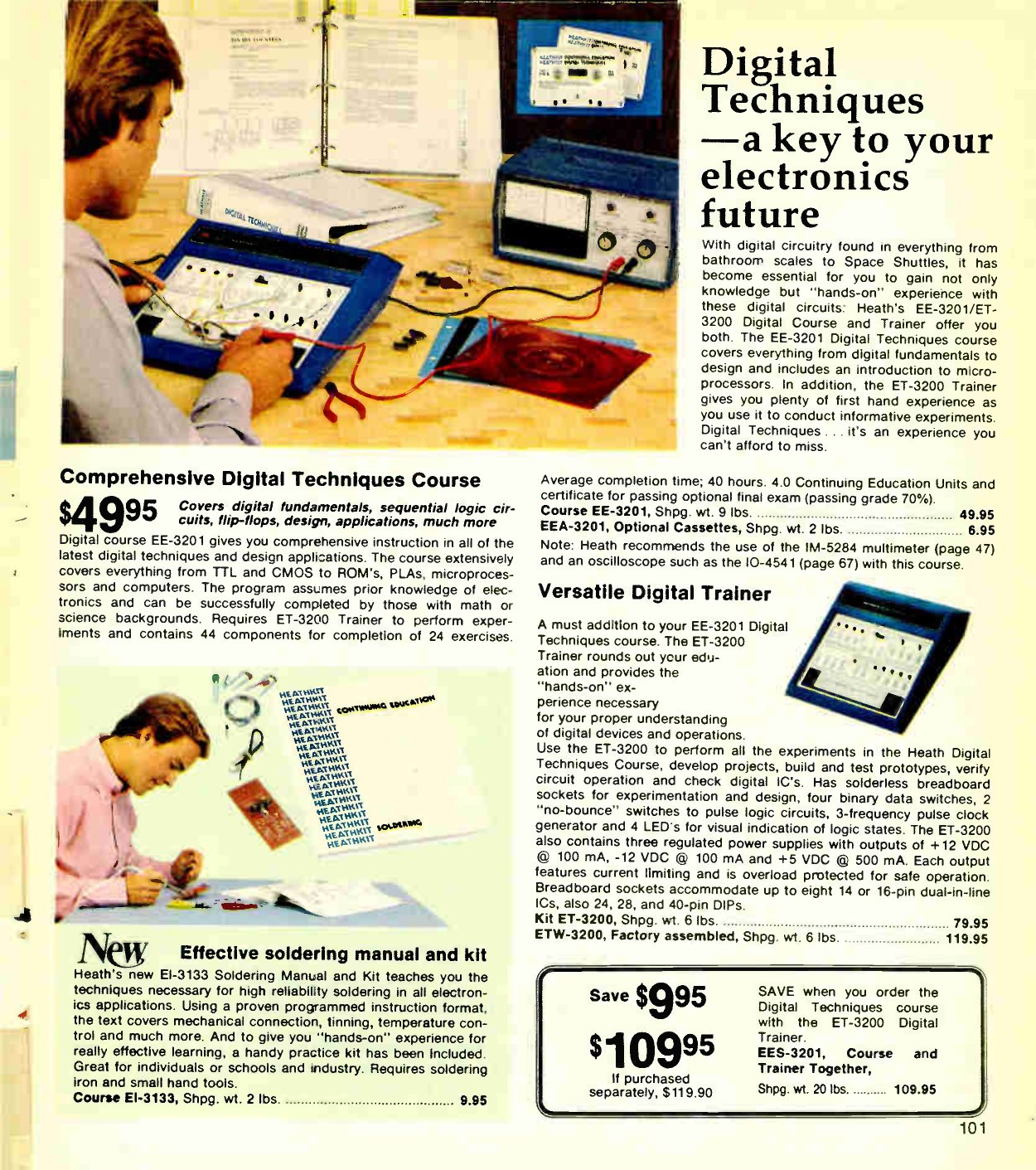
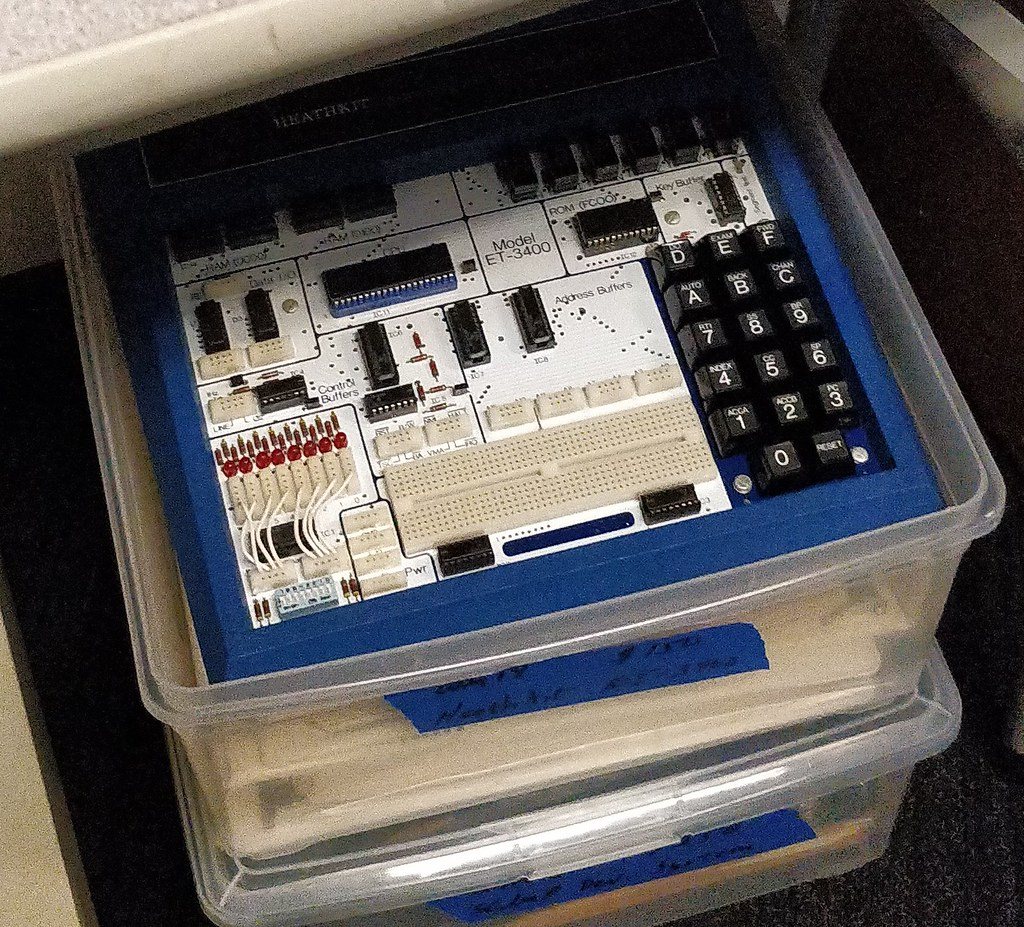
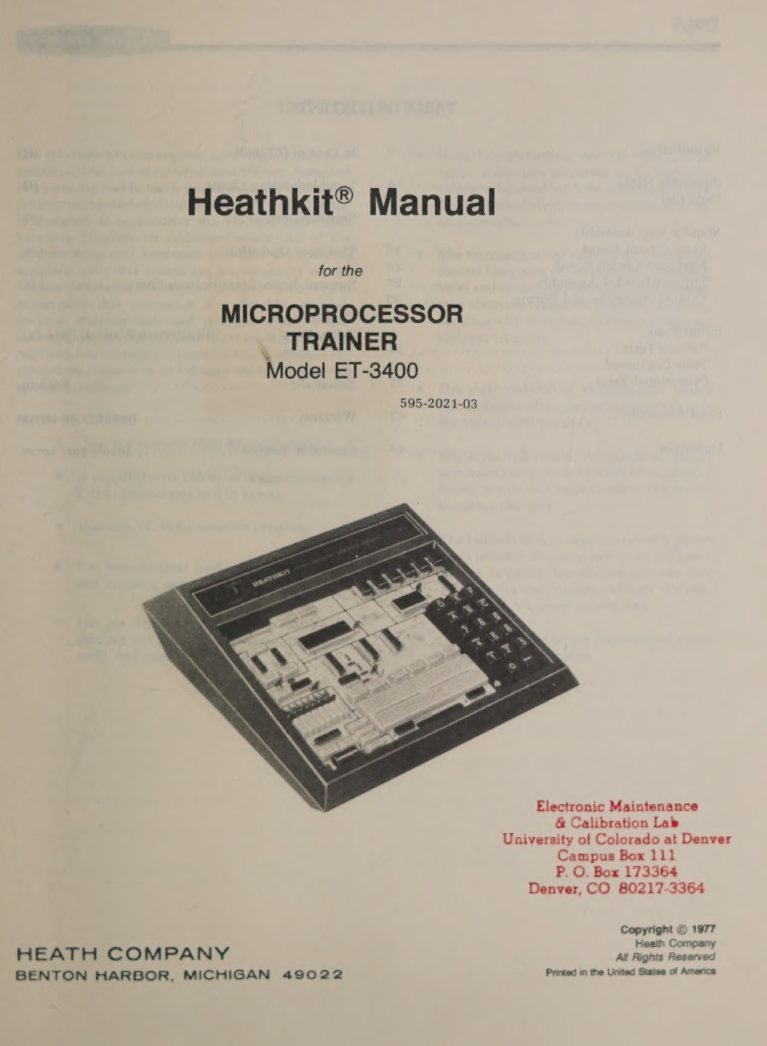
The ET-3400 is built on the ET-3200’s pattern. Its manual gives the cabinet as “12-1/8” wide x 11-3/4” deep x 3-1/2” high” and the weight as 4 lb, identical to the digital trainer. It keeps the ET-3200’s facilities for the student’s own circuits, in larger numbers:
Table 1 — The ET-3400 is built on the ET-3200's pattern. Its manual gives the cabinet as "12-1/8" wide x 11-3/4" deep x 3-1/2" high" and the weight as 4 lb, identical to the digital trainer. It keeps the ET-3200's facilities for the student's own circuits, in larger numbers
| ET-3200 (1975) | ET-3400 (1977) | |
|---|---|---|
| Logic indicators | 4 red LEDs, driven | 8 red LEDs “with separate input terminals”, buffered |
| Input switches | 4 data switches plus 2 debounced logic switches | 8 miniature switches in a DIP package |
| +5 V | 500 mA | 1.5 A total, 0.5 A available at the breadboard terminal |
| ±12 V | 100 mA each | 50 mA each at the output terminals |
| Clock | 1 Hz / 1 kHz / 100 kHz, complementary | none separate; the 6800’s own clock, about 500 kHz |
| Breadboard | one socket, 8 DIPs | breadboarding sockets beside the processor |
| Line-frequency source | yes | no |
| Processor | — | Motorola 6800, 1K ROM monitor, 256 bytes RAM (sockets for 256 more) |
| Display and keypad | — | six 7-segment LED digits; 17-key hexadecimal keypad |
| Bus access | — | address bus, data bus and control lines “buffered and terminated on front panel connectors” |
| Power | 15 W, 3/16 A fuse | 30 W, 3/8 A fuse |
Source: ET-3200 manual, Specifications; ET-3400 manual, 595-2021-03, pp. 3 and 107.
The ET-3400 kept the ET-3200’s facilities because its course needed them. Its manual describes the eight indicators as “for monitoring logic states in the breadboard circuitry” and the eight switches as “for supplying binary words and logic levels in the breadboarding circuitry”. A student who had wired latches and counters on the ET-3200 used the same skills to build address decoders and output ports on the ET-3400. The processor could then drive them. It dropped two things. The debounced logic switches were no longer needed, because the processor could be single-stepped from the keypad. The line-frequency source was dropped too, and timing in the course was done with software loops.
5.1.3 The course: EE-3401
The Christmas 1977 catalogue described EE-3401 as a three-phase programme. Phase I was eight lessons of programmed text: number systems and codes, microcomputer basics, computer arithmetic, an introduction to programming, two lessons on the 6800 and two on interfacing. Phase II was six audio-visual lessons on programming, design with microprocessors and semiconductor memories. Phase III was 19 experiments on the trainer, “divided into programming and interfacing applications”. The course came with 62 components, including two 2112 RAMs (the chips that expand the trainer to 512 bytes) and a digital-to-analog converter (Christmas 1977, p. 100). The Unit 1 text, Number Systems and Codes (595-2039-02, © 1977), is bound into one Internet Archive scan of the trainer manual (ET-3400 manual and training). By 1981 Heath called it “our prize-winning Microprocessor Course”. By 1987 the catalogue said that “this course won an International Award from the Society for Technical Communication” (Winter 1981–82; Fall 1987, p. 62).
The microprocessor series grew as the digital series had. By Christmas 1982 there were EE-3402 Microprocessor Interfacing, EE-3403 Voice Synthesis ($129.95) and EE-3404 Advanced Microprocessor, a seven-unit course on the 6809 with a processor adapter module for the trainer ($99.95). The catalogue names the ET-3400A as the trainer for the EE-3401 and EE-3402 experiments (Christmas 1982, pp. 36–38).
5.1.4 The ETA-3400 accessory and the ET-3400A
In 1979 Heath added the ETA-3400 Microprocessor Trainer Accessory, a companion box connected by ribbon cable. It added memory, a cassette interface, a serial port for a video terminal, and BASIC and monitor programs in ROM, and turned the trainer into a small computer system. The catalogue warned that because “this modification changes the clock frequency of the Trainer, the experiments in the Microprocessor Program using timing loops will be changed”, and recommended finishing the course first (Fall 1979, p. 69; details in the history dive, volume 5).
In the Christmas 1981 catalogue, the same issue that introduced the ET-3200A, the microprocessor trainer became the ET-3400A. At first the catalogue still described an MC6800 with 256 bytes of RAM, “expandable to 512” (Christmas 1981); by Christmas 1982 the copy gives the MC6808 processor with 512 bytes built in. In Winter 1981–82 the kit cost $224.95, the assembled ETW-3400A $329.95, and a 220 V, 50 Hz version (ET-3400-AE) $244.95. The catalogue lists “8 buffered binary LEDs for display of breadboard logic states” and “8 SPST DIP switches for binary input to breadboarding circuits”, the ET-3200 facilities again (Winter 1981–82; Christmas 1982). The ET-3400A outlived every Heath-designed general-purpose computer and was still in the Winter 1991 catalogue (history dive, volume 5).
Table 2 — The ETA-3400 accessory and the ET-3400A
| Catalogue | ET-3400 kit | Wired | Notes |
|---|---|---|---|
| Christmas 1977 | $189.95 | — | launch; EE-3401 $89.95 |
| Winter 1978 | $199.95 | — | ETS-3400 course + trainer $279.95 |
| 1980 (848) | $199.95 | ETW-3400 $275.00 | |
| Winter 1981 | $224.95 | $299.95 | ETA-3400 accessory $175.00 |
| Winter 1981–82 | ET-3400A $224.95 | ETW-3400A $329.95 | copy still MC6800, 256 bytes (expandable to 512); MC6808 and 512 bytes by Christmas 1982 |
| Christmas 1982 | ET-3400A $229.95 | — |
Sources: the catalogues named, World Radio History.
5.2 The ET-3700 Digital Trainer (1987)
The Fall 1987 catalogue introduced two replacement trainers together. The ET-3600 replaced the analog ET-3100B, and the ET-3700 replaced the ET-3200B. Both were built to accept the ET-3567 Backpack accessory, which mounted on the trainer. The copy described the ET-3700 in terms that repeat the ET-3200 almost function for function. It had three regulated supplies “to power both digital and linear circuits”; “a line-frequency square wave (60 or 50 Hz); complementary clock signals of 1 Hz, 1 kHz, and 100 kHz; logic and data switches to control input levels; and four LED logic-state indicators”. The one new feature was “a built-in connector” that “accommodates the ET-3567 Backpack”. It cost $119.95 as a kit and $199.95 assembled (Fall 1987, pp. 58 and 62).
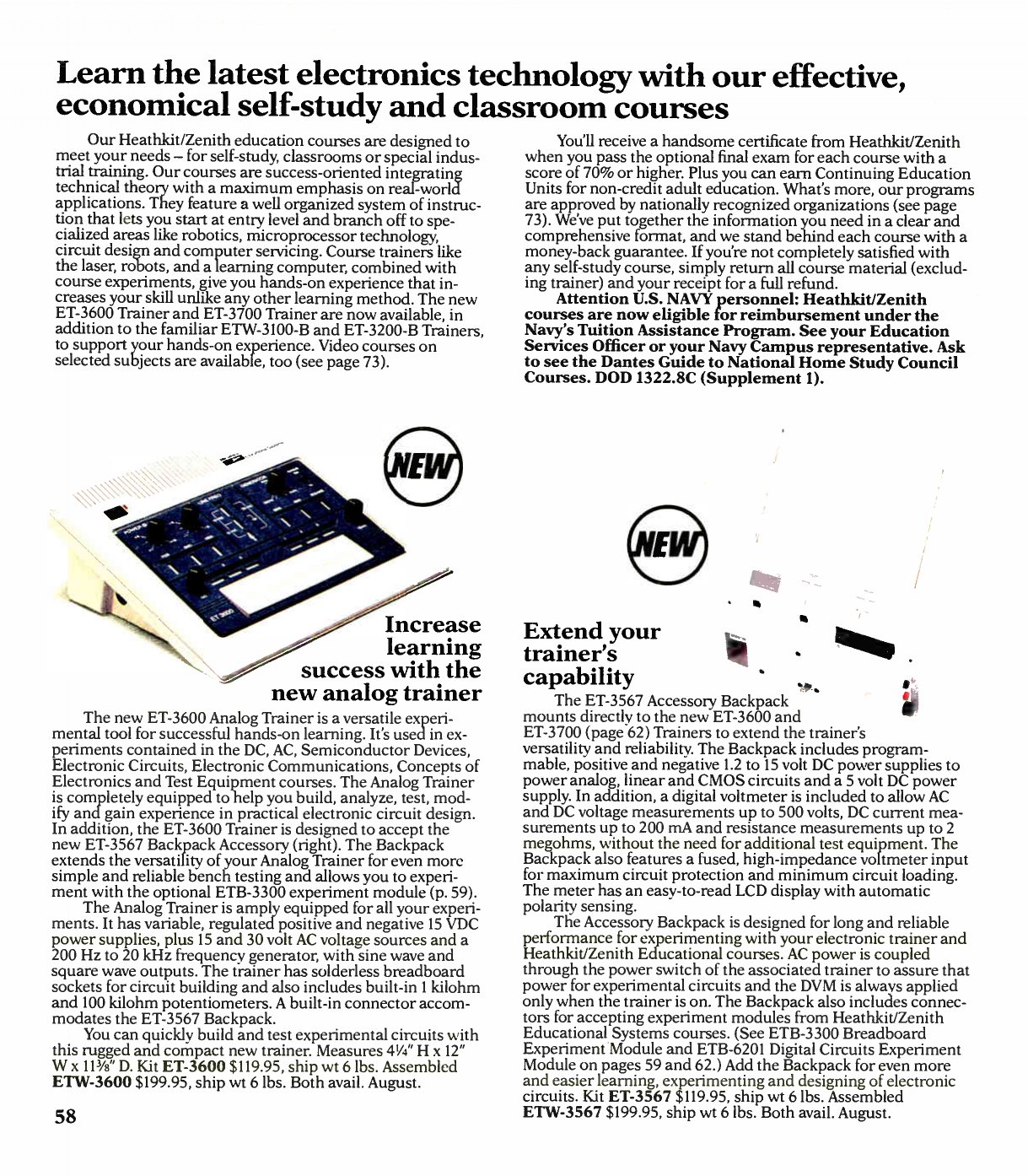
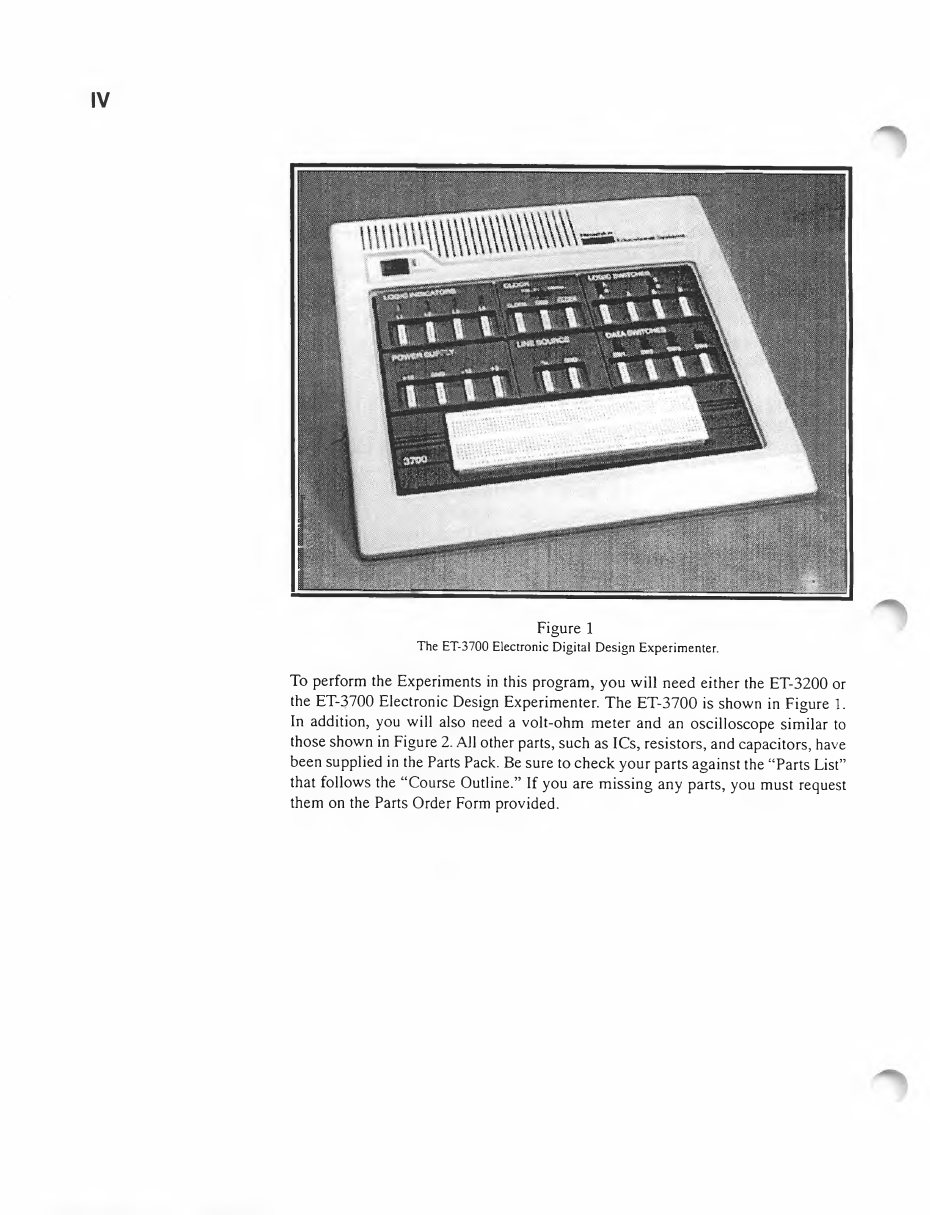
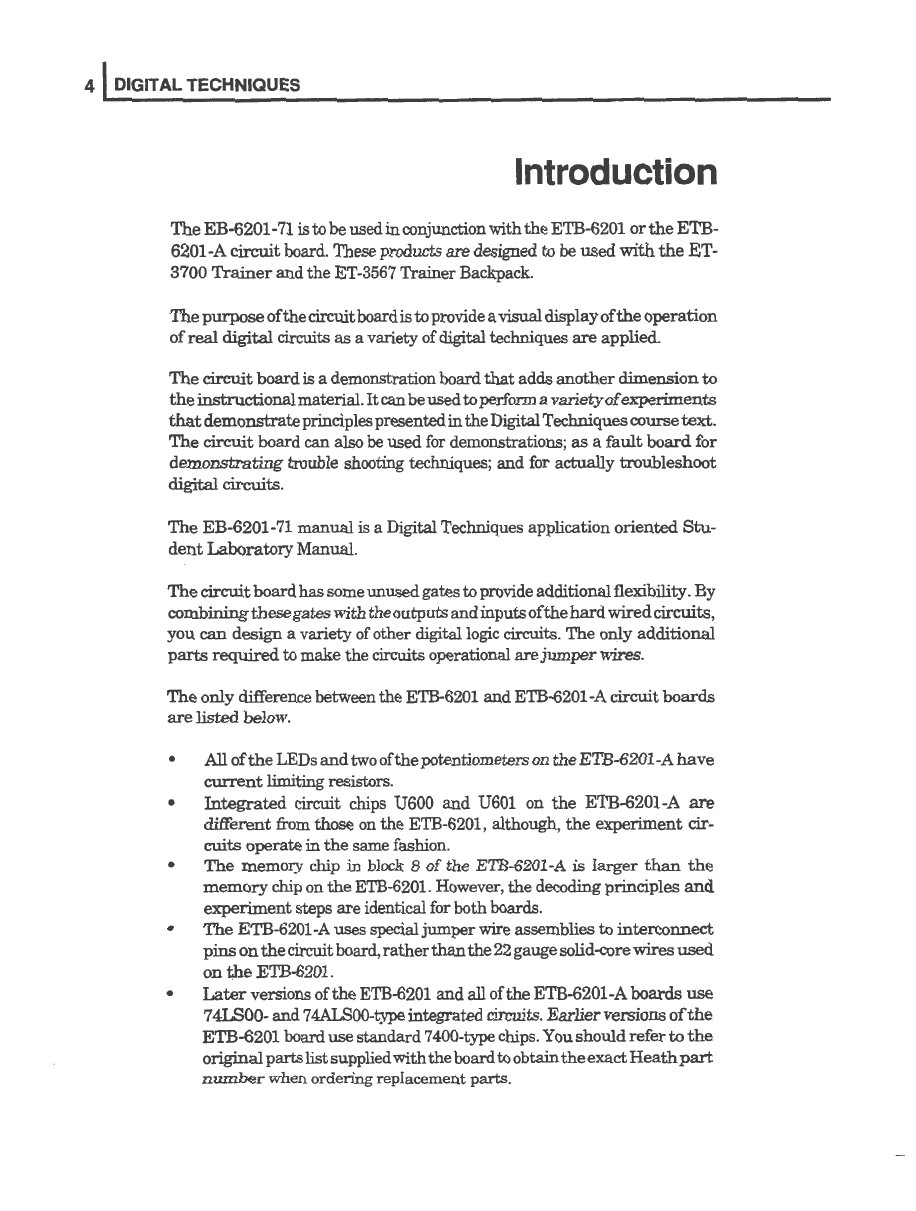
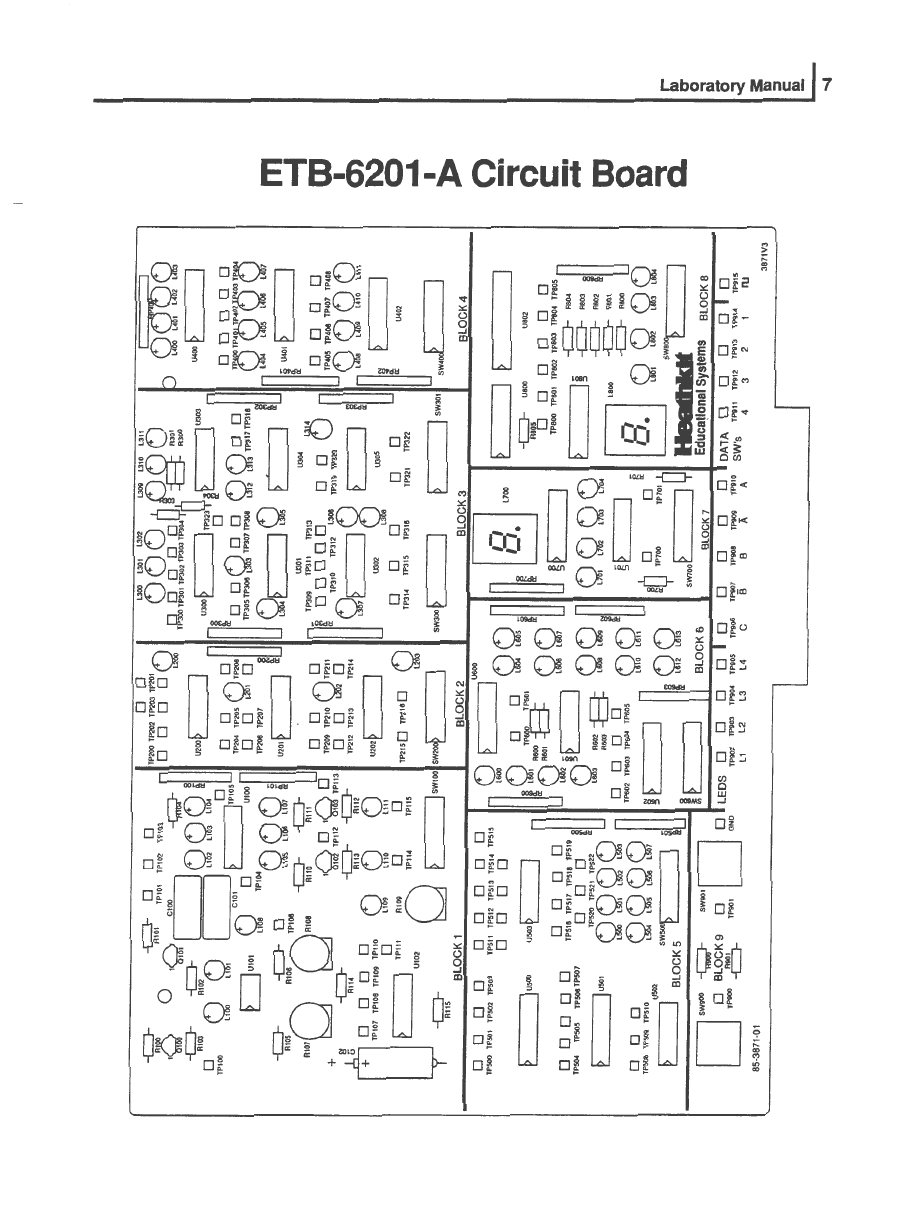
The Backpack changed how the digital course was taught. Heath now sold a pre-wired ETB-6201 Experiment Module ($149.95) that “slides into the Backpack” on the ET-3700. The student used it “to perform the 40 prewired experiments detailed in the student lab manual”, the EB-6201-71 Laboratory Manual ($12.95), with an EB-6201-52 Administrator’s Guide for the instructor (Fall 1987, p. 62). The lab manual explains that the board provides “a visual display of the operation of real digital circuits” and can serve “as a fault board for demonstrating trouble shooting techniques”. It has unused gates so that students can still wire circuits of their own with jumpers (EB-6201-71 Lab Book, p. 4).
The experiment list shows how far the method had moved. The ET-3200 course had the student build every circuit from loose chips. The EB-6201-71 manual’s 40 experiments run from “Discrete Inverters” through “The Versatile 7404”, “The 7476 Up Counter”, “The 7442 Chip”, “Memory Programming”, and a set of troubleshooting experiments on the pre-wired circuits. Later versions of the ETB-6201 board and all ETB-6201-A boards used 74LS00- and 74ALS00-type chips, where the earliest used standard 7400-series parts (EB-6201-71, p. 4).
The ET-3200 was not withdrawn when the ET-3700 arrived. The Fall 1987 course copy told buyers “you’ll use the new ET-3700 Digital Trainer or the ET-3200-B Trainer”, and the textbook kept naming the ET-3200 in its experiments into the 1990s (volume 4). The ET-3700 continued under Heathkit Educational Systems after the kit business closed in 1992. Its manual is on the Tubular Electronics list of Heath titles withheld as still in copyright, as the ETW-3700 (Tubular Electronics).
5.3 The lineage in one table
Table 3 — The lineage in one table
| Model | Year | Role | Relation to the ET-3200 |
|---|---|---|---|
| ET-3100 | 1975 | analog experimenter | twin; same cabinet size, launched in the same catalogue |
| ET-3200 | 1975 | digital experimenter | — |
| ET-3300 | 1976 | laboratory breadboard | larger breadboard with supplies, for prototyping and the advanced analog courses |
| ET-3400 | 1977 | 6800 microprocessor trainer | same cabinet size; ET-3200 switch, LED and supply functions built in |
| ET-3200A | 1981 | digital experimenter | revision: three-wire cord, FCC Class B label |
| ET-3400A | Christmas 1981 | 6800 (6808 by Christmas 1982) microprocessor trainer | revision |
| ET-3200B | 1983 | digital experimenter | revision: line filter, LED pilot, panel fuse |
| ET-3700 | 1987 | digital trainer | direct replacement; same panel functions plus Backpack connector |
Sources
- Frenzel, Lou. “The History of Personal Computers, Part 2: The Heathkit Story.” Electronic Design, 30 December 2013. https://www.electronicdesign.com/technologies/communications/article/21799215/the-history-of-personal-computers-part-2-the-heathkit-story
- Heath Company. Heathkit Manual for the Microprocessor Trainer, Model ET-3400, 595-2021-03, © 1977. Internet Archive (DLARC). https://archive.org/details/manualsplus_11737 ; later printing 595-2021-06: https://archive.org/details/HeathkitManualForTheEt-3400MicroprocessorTrainer ; with EE-3401 Unit 1: https://archive.org/details/HeathkitET3400MicroprocessorTrainermanualTraining
- Heathkit catalogues: Fall 1977, Christmas 1977 (No. 818), Winter 1978, Fall 1979, 1980 (No. 848), Winter 1981, Winter 1981–82, Christmas 1982, Fall 1987. World Radio History. https://www.worldradiohistory.com/Archive-Catalogs/Heathkit_Catalogs.htm
- Heathkit Educational Systems. Digital Techniques Lab Book, EB-6201-71, 595-3813-06. Internet Archive. https://archive.org/details/digital-techniques-lab-book-eb-6201-71
- Heathkit Company, Inc. Digital Techniques, EE-3201A textbook, 1998 printing. https://archive.org/details/ee-3201-a-digital-techniques-individual-learning-system-textbook-1998
- Tubular Electronics, Heathkit manuals page (list of titles withheld as in copyright). https://tubularelectronics.com/?page_id=64
- leighklotz. “Heathkit ET-3400 Trainer.” Flickr, CC BY 2.0. https://www.flickr.com/photos/7417392@N05/42943231735
- Heathkit history dive, volume 5, “Heathkit Goes Digital.” https://heathkit.fubsypoly.com/heathkit/vol-5/
Comments (0)