Robots · Volume 2
HERO 1 in the Catalogue and the Classroom
HERO 1 was in every general Heathkit catalogue from Winter 1983 to Spring 1988, a run of five and a half years. Over that time the robot itself hardly changed, but almost everything around it did. The price came down twice. Accessories accumulated: demonstration ROMs, a radio remote control, memory expansion, a serial port and a BASIC interpreter. The single robotics course of 1983 grew into a family of courses, with classroom editions for schools. This volume follows the robot through the catalogues and into the classroom. The engineering of the machine is covered in the HERO 1 dive on the Robots site.
2.1 Selling a thousand-dollar kit
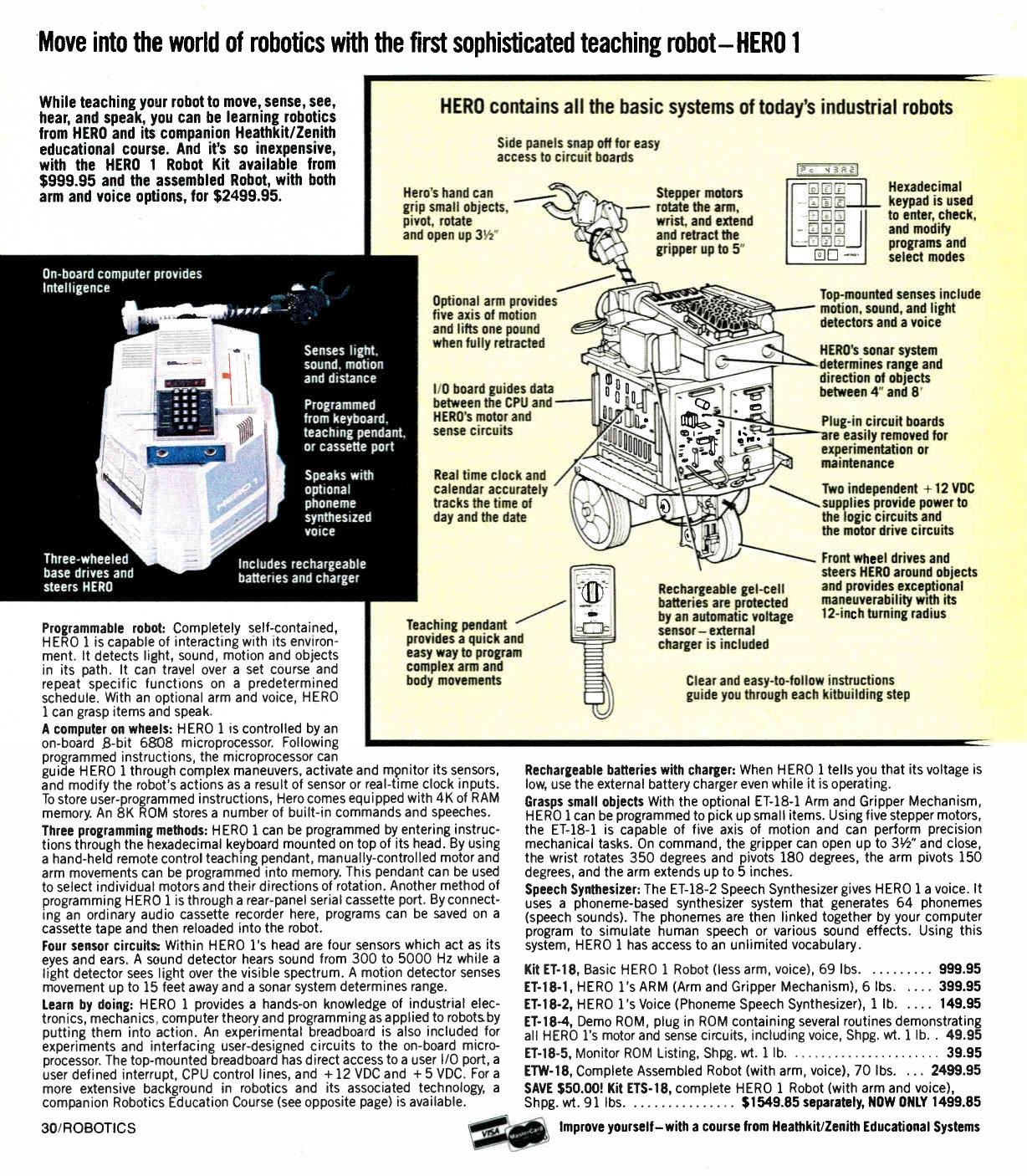
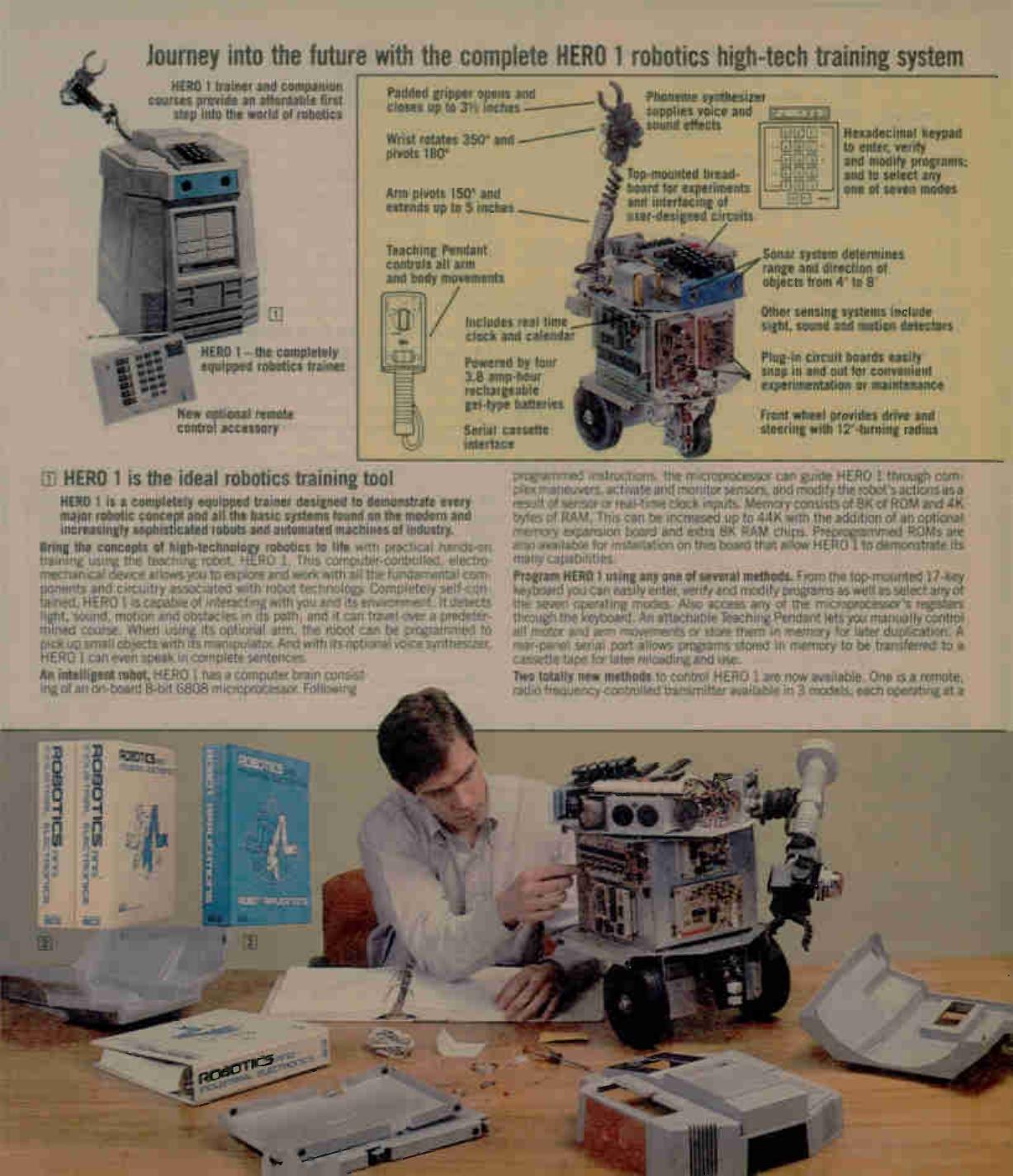
The robot sat in an unusual place in the catalogue. Most Heathkits of 1983 cost less than $200, and the expensive items were computers, amateur transceivers and television sets. HERO 1 was placed in its own “Robotics” section, next to the education courses. The layout said plainly that it was a teaching product. The copy mixed the two appeals. On one side: “You teach it — it teaches you.” On the other: the robot could “guard your home, plant”, detecting intruders and warning them away verbally from a power-saving “sleep” mode.
The catalogue also made a choice unusual for Heath. The assembled robot was offered from the start, at two and a half times the price of the basic kit. Heath’s assembled products were usually a later addition to a kit line, as with the WH17 disk drive or the WH89 computer described in the company history. The robot’s assembled version was part of the launch, because schools and industrial trainers wanted a working trainer, not a building project. The classroom course tables later in the decade specify the ETW-18 assembled robot as the trainer for the classroom edition of the course. In other words, the institutional customer was expected to buy it built.
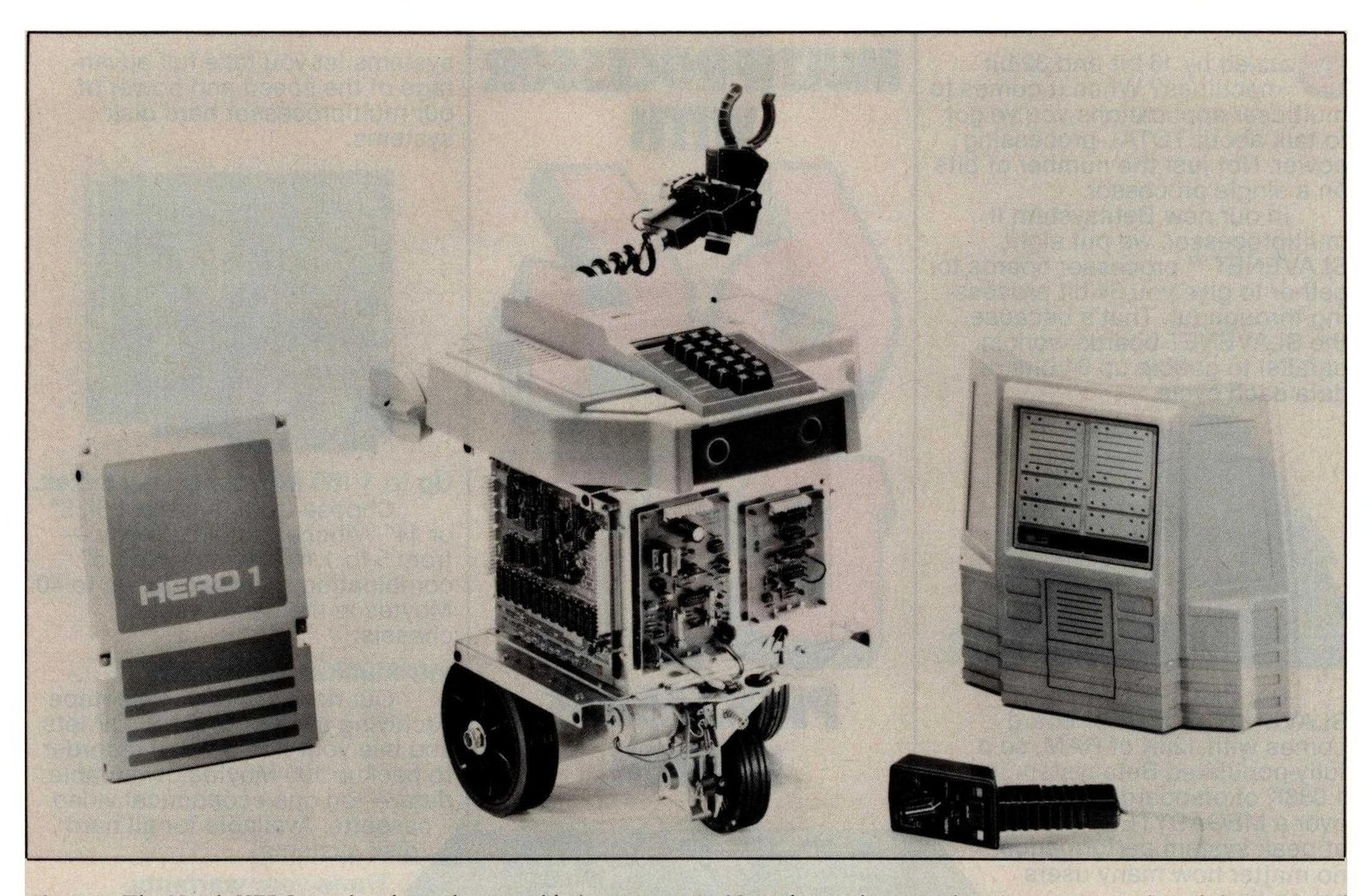
What a kit builder received was substantial. BYTE’s review counts “fourteen printed-circuit boards, three wiring harnesses, and four heavy-duty rechargeable batteries” (Leininger, BYTE, January 1983). The basic kit shipped at 69 pounds and the complete kit at 91 pounds. The CPU board came factory-built and tested, a policy Heath had also followed with the H8 computer.
2.2 Price history
The robot’s prices, read from each catalogue in turn:
Table 1 — The robot's prices, read from each catalogue in turn
| Catalogue | Basic kit (ET-18, later ET-18-A) | Complete kit, arm and voice (ETS-18) | Assembled, arm and voice (ETW-18, later EWS-18) | Assembled, no arm (ETW-18-WA) | Arm kit (ET-18-1) | Voice kit (ET-18-2) |
|---|---|---|---|---|---|---|
| Winter 1983 (No. 860) | $999.95 | $1,499.85 | $2,499.95 | — | $399.95 | $149.95 |
| Fall 1983 (No. 862) | $999.95 | $1,499.85 | $2,499.95 | — | $399.95 | $149.95 |
| Christmas 1983 (No. 863) | $999.95 | $1,499.85 | $2,499.95 | — | not read | not read |
| Winter 1983–84 (No. 864) | $999.95 | $1,499.85 | $2,499.95 | — | $399.95 | $149.95 |
| Spring 1984 (No. 865) | $799.95 | $1,199.85 | $2,199.95 | — | $349.95 | $99.95 |
| Fall 1984 | $799.95 | $1,199.85 | $2,199.95 | — | $349.95 | $99.95 |
| Christmas 1984 | $799.95 | $1,199.85 | not read | $1,699.95 | not read | not read |
| Fall 1985 | $799.95 | $1,199.85 | $2,149.90 (EWS-18) | $1,699.95 | $349.95 | $99.95 |
| Spring–Summer 1986 | not read | $1,299.95 (ETS-18-35/-36, with remote) | $2,149.90 (EWS-18-35/-36, with remote) | $1,699.95 | not read | not read |
| Fall 1987 | $799.95 (ET-18-A) | $1,299.95 (ETS-18-37/-38) | $2,149.90 | $1,699.95 | $349.95 | $99.95 |
| Christmas 1987 | $799.95 | $1,299.95 | $2,149.90 | $1,699.95 | $349.95 | $99.95 |
| Spring 1988 (No. 211) | $799.95 | $1,299.95 | $1,995.00 | $1,499.95 (“Was $1699.95”) | $349.95 | $99.95 |
Sources: the World Radio History scans listed under Sources. “Not read” means the price was not found in that catalogue’s text layer, not that the item was absent. The 1988 figures are from an OCR of a scan with no text layer. The Fall 1987 remote-equipped kits are numbered ETS-18-37 and -38 for the two radio frequencies; in 1986 the same packages were ETS-18-35 and -36.
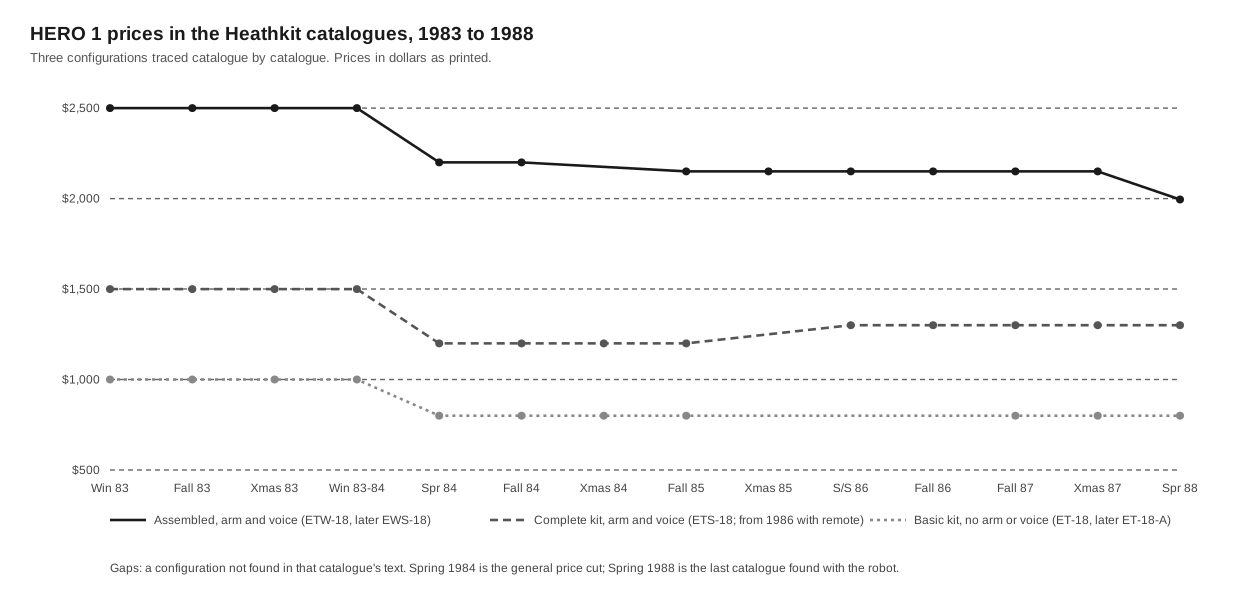
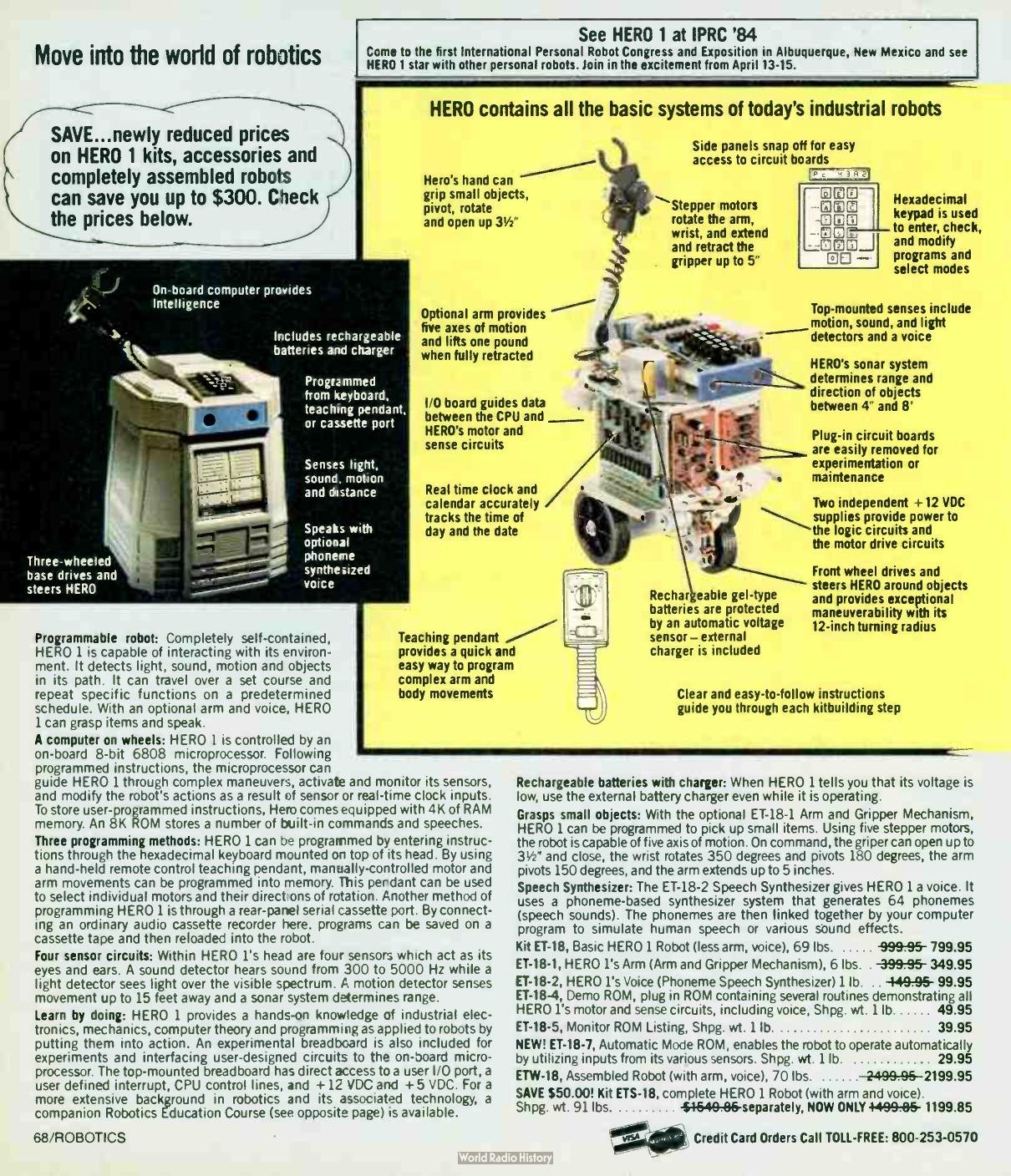
The one real price move came in Spring 1984. The robot page in catalogue No. 865 carried a flash: “SAVE … newly reduced prices on HERO 1 kits, accessories and completely assembled robots can save you up to $300.” The same page announced the robot’s appearance at the International Personal Robot Congress in Albuquerque that April (Heathkit catalogue No. 865, Spring 1984, p. 68). After that the prices were stable for four years. That was unusual for a product of the 1980s, when computer prices fell every season. It suggests that Heath was pricing the robot as a teaching instrument with steady institutional demand, not as consumer electronics.
The retail price was not the only price. Heath ran its usual discount schemes on the robot: Master Builder Club bonus points, “saver” bundles and seasonal specials. In Fall 1985 a buyer who ordered a robot with a remote control could deduct $100 (Heathkit catalogue, Fall 1985, p. 58).
2.3 The accessories
HERO 1 grew by accessories. The table below gives each with the first catalogue in which it was found.
Table 2 — The accessories
| Model | Accessory | First found | Price when found |
|---|---|---|---|
| ET-18-1 | Arm and gripper mechanism (kit) | Winter 1983 | $399.95 |
| ETW-18-1 | Arm, assembled | by Fall 1985 | $549.95 |
| ET-18-2 | Voice (phoneme speech synthesizer) | Winter 1983 | $149.95 |
| ET-18-4 | Demo ROM, “routines demonstrating all HERO 1’s motor and sense circuits, including voice” | Fall 1983 | $49.95 |
| ET-18-5 | Monitor ROM listing | Fall 1983 | $39.95 |
| ET-18-7 | Automatic Mode ROM, “move independently around a room while avoiding obstacles” | Spring 1984 | $29.95 |
| ET-18-35, -36, -37 | RF remote control at 75.43, 75.67 and 75.87 MHz (kit) | Fall 1984 | $299.95 (kit), $399.95 (assembled ETW version) |
| ET-18-6 | Memory expansion board | Fall 1984 | $39.95 to $49.95 |
| ETA-18-6 | 8K × 8 memory expansion RAM chip | Fall 1984 | $24.95 (Fall 1985) |
| ET-18-10 / ETW-18-10 | RS-232 interface | Fall 1984 | $59.95 |
| ET-18-11 | HERO 1 demo cassette | Fall 1984 | $14.95 |
| ET-18-9 | HERO 1 BASIC ROM, “a simple integer BASIC” | Christmas 1984 (“NEW”) | $49.95 (Fall 1985) |
| ETS-18-9 | Expansion system: BASIC ROM, RS-232, memory board and one RAM chip | by Fall 1985 | $179.80 |
Sources: the catalogues for each season, as listed in vol06. The Fall 1984 catalogue swaps the descriptions of ET-18-6 and ETA-18-6. By Fall 1985 the board is ET-18-6 and the chip ETA-18-6, which is how the manuals number them.
Two things stand out. First, the remote control, which arrived in Fall 1984 in three frequency versions, changed how the robot was used. It relayed “all keyboard and Teaching Pendant operations from up to 100 feet away.” It also had an RS-232 connector that “permits a computer to remotely operate the robot” (Fall 1985, p. 58). From 1986 the remote was bundled into the kit and assembled packages. The robot’s manual set on the Internet Archive numbers the remote manual ET-18-3, where the catalogue numbers are -35, -36 and -37 (HERO-1 ET-18 manuals and schematics).
Second, the BASIC path shows how far the robot had moved from its launch design. HERO-1 BASIC required the robot, the memory expansion board, at least one RAM chip, the RS-232 interface, “a terminal or computer with a terminal emulation program” and a serial cable. With all that, the catalogue said, memory could be increased “up to 56K” from the original 4K. In 1983 HERO 1 had been a self-contained machine, programmed from its own head. By 1985 it could also be a peripheral of a personal computer.
2.4 The robotics courses
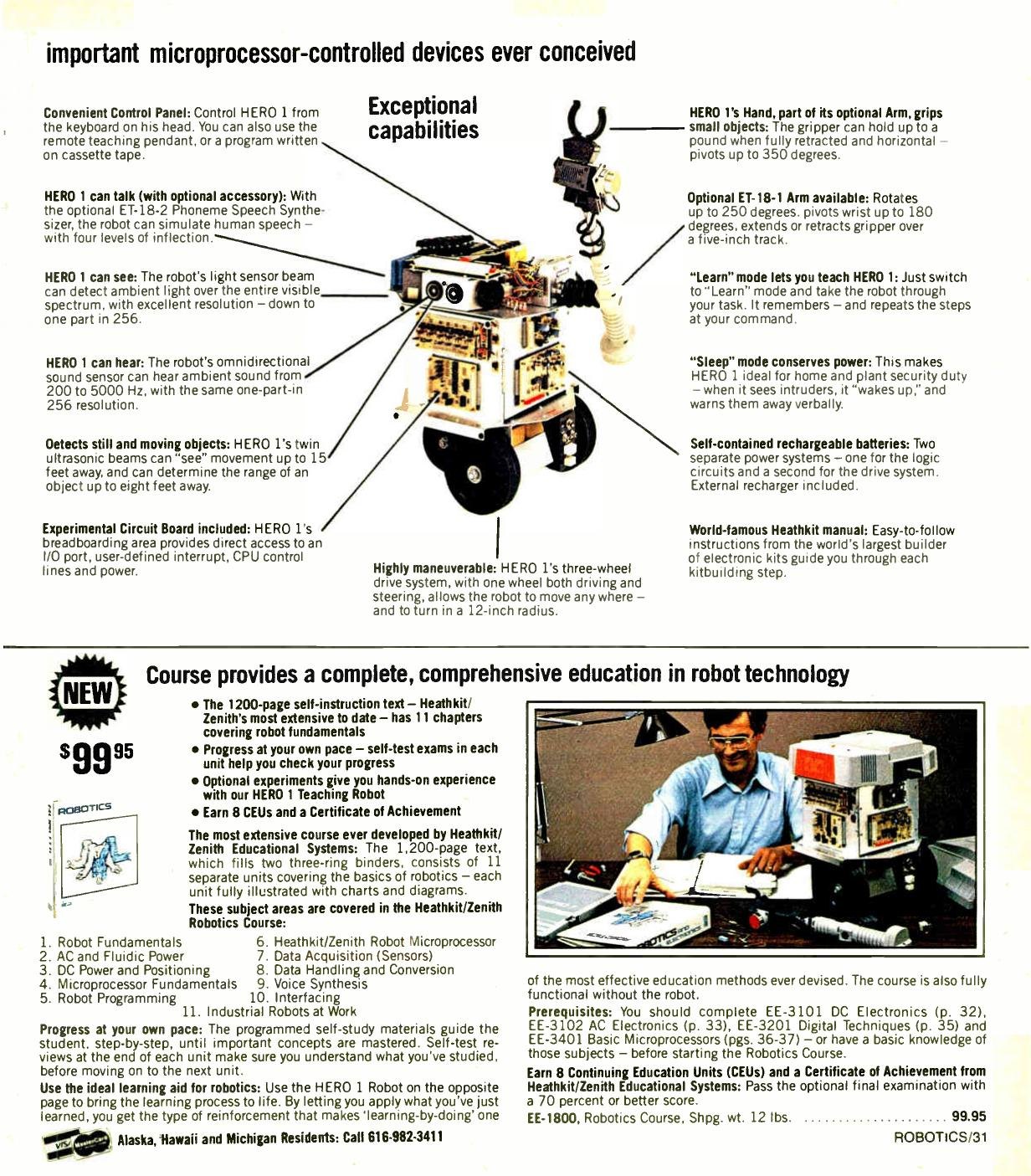
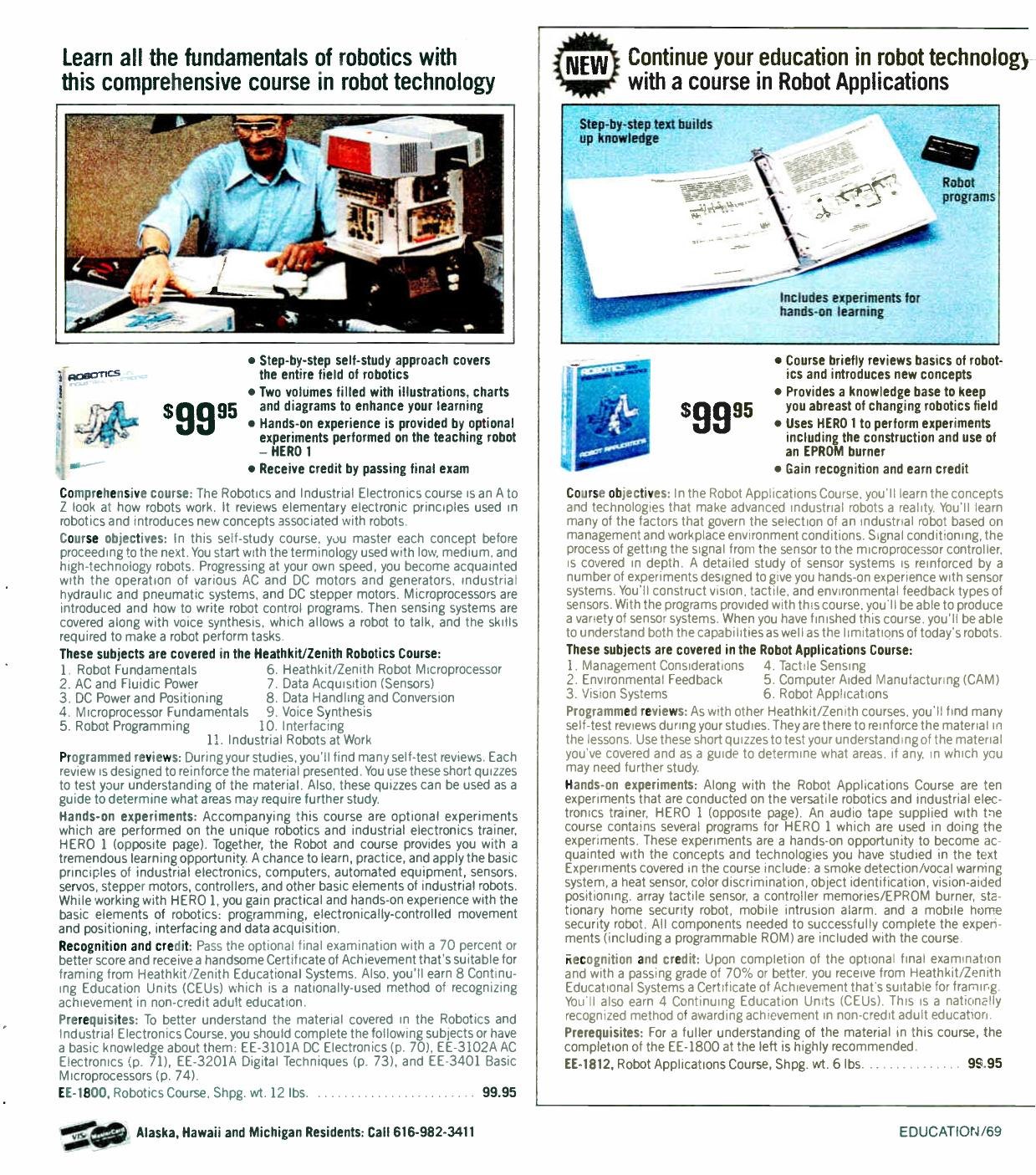
For Heath the course was the product and the robot was its lab equipment. The first course, EE-1800, appeared with the robot in Winter 1983 at $99.95. The catalogue called it “the most extensive course ever developed by Heathkit/Zenith Educational Systems”: a 1,200-page programmed-instruction text in two three-ring binders, divided into eleven units.
- Robot Fundamentals
- AC and Fluidic Power
- DC Power and Positioning
- Microprocessor Fundamentals
- Robot Programming
- Heathkit/Zenith Robot Microprocessor
- Data Acquisition (Sensors)
- Data Handling and Conversion
- Voice Synthesis
- Interfacing
- Industrial Robots at Work
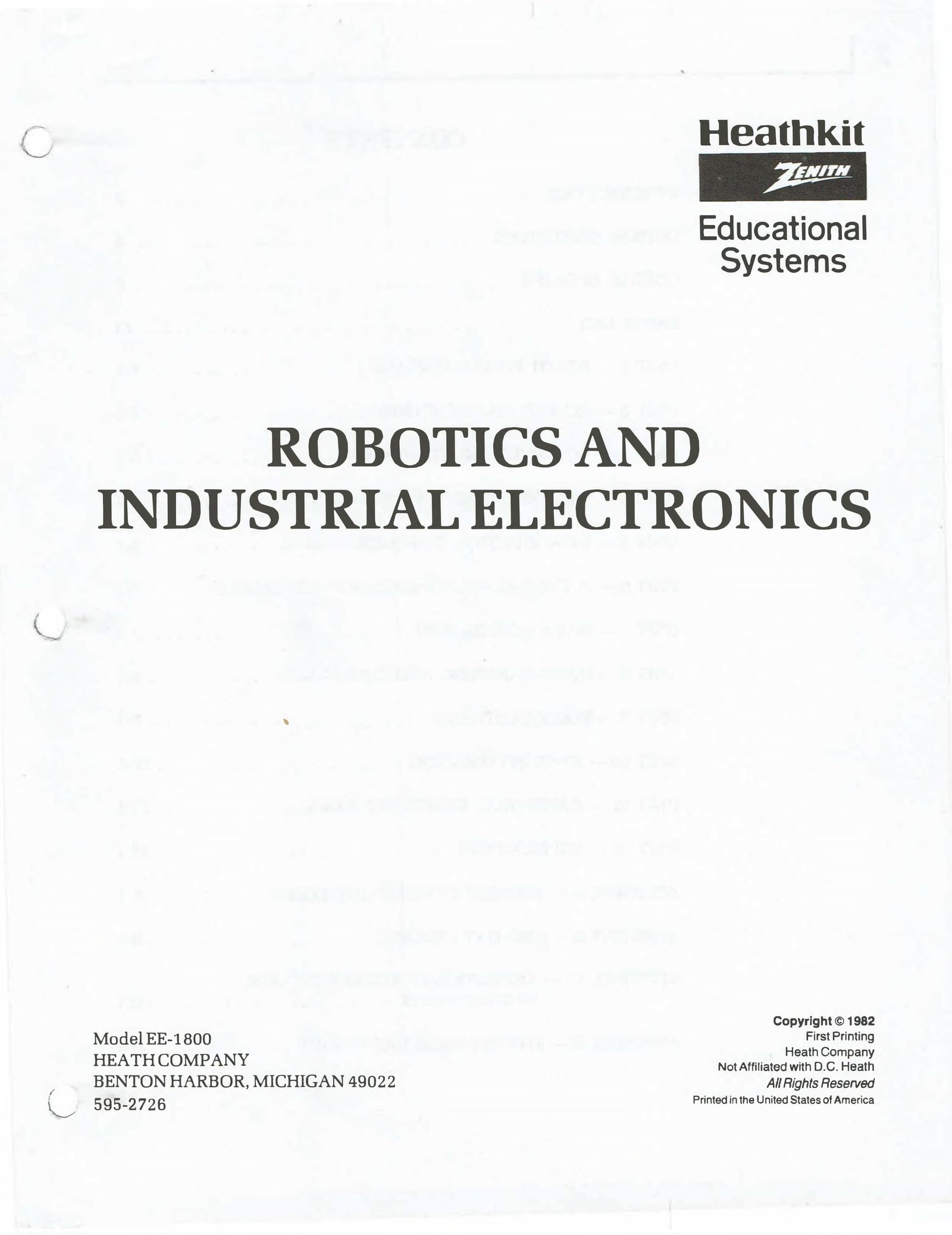
Students who passed the optional final examination with 70 percent or better earned 8 Continuing Education Units and a Certificate of Achievement. The prerequisites were Heath’s DC and AC electronics courses (EE-3101, EE-3102), Digital Techniques (EE-3201) and Basic Microprocessors (EE-3401), “or a basic knowledge of those subjects.” The course was “fully functional without the robot”: its experiments on HERO 1 were optional (Winter 1983, p. 31). The course book on the Internet Archive is titled Robotics and Industrial Electronics, model EE-1800, Heath part 595-2726, “Copyright © 1982 … First Printing” (Internet Archive). By Winter 1983–84 the catalogue used that title too.
A second course followed within the year. EE-1812, Robot Applications, appeared in the Winter 1983–84 catalogue at $99.95. It was aimed at the industrial buyer: its six units were Management Considerations, Environmental Feedback, Vision Systems, Tactile Sensing, Computer Aided Manufacturing, and Robot Applications. Its ten experiments were all run on HERO 1: “a smoke detection/vocal warning system, a heat sensor, color discrimination, object identification, vision-aided positioning, array tactile sensor, a controller memories/EPROM burner, stationary home security robot, mobile intrusion alarm, and a mobile home security robot.” The parts, including a programmable ROM, came with the course, which was worth 4 CEUs (Winter 1983–84, p. 69).
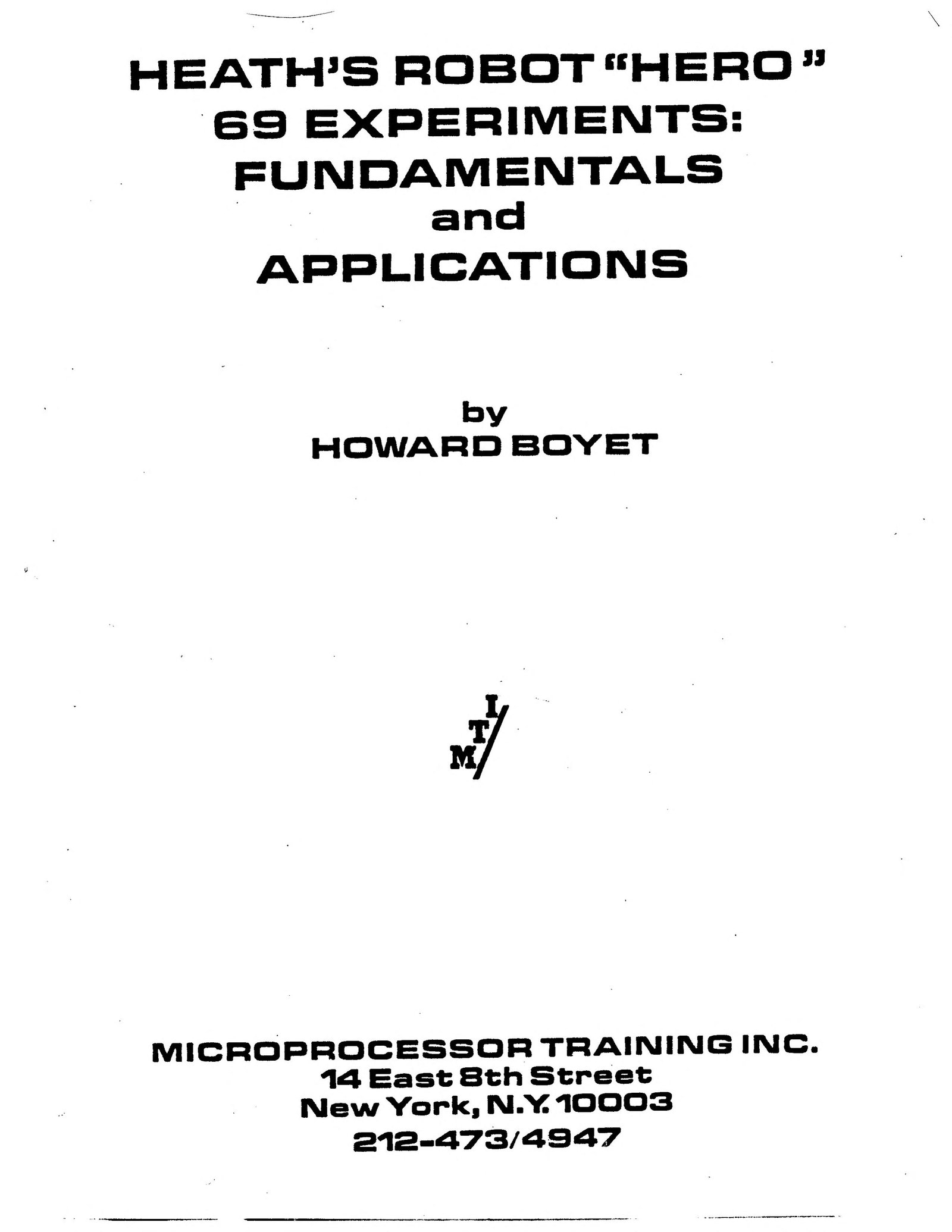
In Fall 1984 Heath added EB-1802, HERO 1 Advanced Experiments ($24.95), described a year later as sixty-one programming experiments that “unlock the power of HERO 1’s Robot Language Interpreter” and the subroutines in the monitor ROM. Wikipedia attributes the book to Howard Boyet. Boyet also published a separate book of experiments, Heath’s Robot HERO: 69 Experiments, Fundamentals and Applications, through his own company, Microprocessor Training Inc. of New York (Internet Archive).
By Fall 1985 Heath was selling the whole programme as one package, EES-1800: EE-1800, EE-1812, EB-1802, the basic robot, the arm and the voice, for $1,374.70 and 111 pounds of shipping weight (Fall 1985, p. 59). The same bundle was still offered in Fall 1987.
2.4.1 Classroom editions
Heath sold its courses in two forms: individual-learning (home-study) kits and classroom editions for schools. The classroom editions split the material into a student text, a workbook, an instructor’s guide and a parts pack. From Winter 1983–84 the classroom course table lists Robotics & Industrial Electronics (EB-1801): text $29.95, workbook $14.95, instructor’s guide $9.95, parts $44.95. The assembled ETW-18 robot is the required trainer. The catalogue called it one of “four new high-technology courses” for “teachers and industrial training directors” (Winter 1983–84, classroom course table). By Fall 1984 Robot Applications (EB-1812) and HERO 1 Advanced Experiments (EB-1802) had classroom editions too, and the table counted “six new high-technology courses.”
This is where most HERO 1s went. Heath published no split between classroom and hobby sales. However, the catalogue structure, the assembled-trainer requirement and the later history of the line all point the same way: schools and training departments were the robot’s steady market. Heath also told buyers that the American Council on Education recommended college credit for several of its courses, and sold examinations for that purpose (Fall 1983, p. 31).
2.5 HERO 1 at work
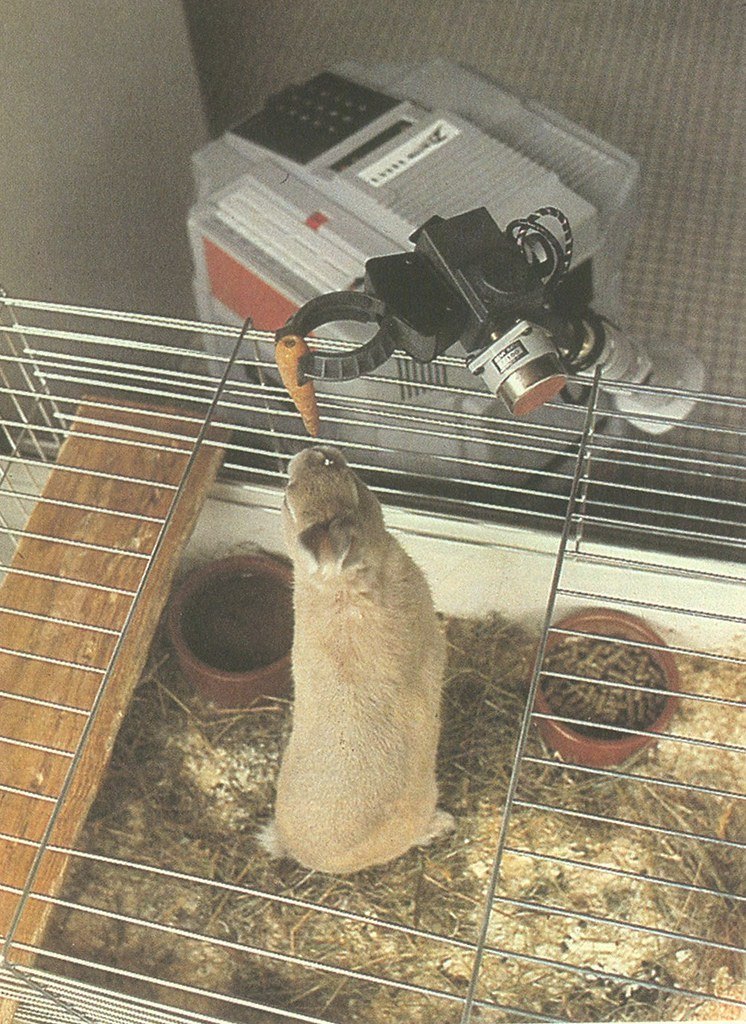
Most period accounts of HERO 1 in use come from the hobby press. The best documented institutional example is a report in Sextant, the independent magazine for Heath and Zenith computer users. It describes the Mankato Area Vocational-Technical Institute in Minnesota, which owned two HERO 1s for the second year of its electronic-instrumentation and control programme. The report opens with a mock advertisement for a weekend security guard, who would be paid only in battery charges. When classes ended, the two robots patrolled the school’s hallways, each covering one side of a square of corridors on a timed schedule arranged so that they would not detect each other. They reported heat, light and noise to a human guard. The instructor, Dennis Holland, said: “We’ve had people try to sneak around HERO, and no one got around him.” He added that “HERO doesn’t replace the security guard; he just aids him.” The school had also just acquired a HERO Jr (David R. Felstul, “HERO on Patrol”, Sextant no. 20, January–February 1986).
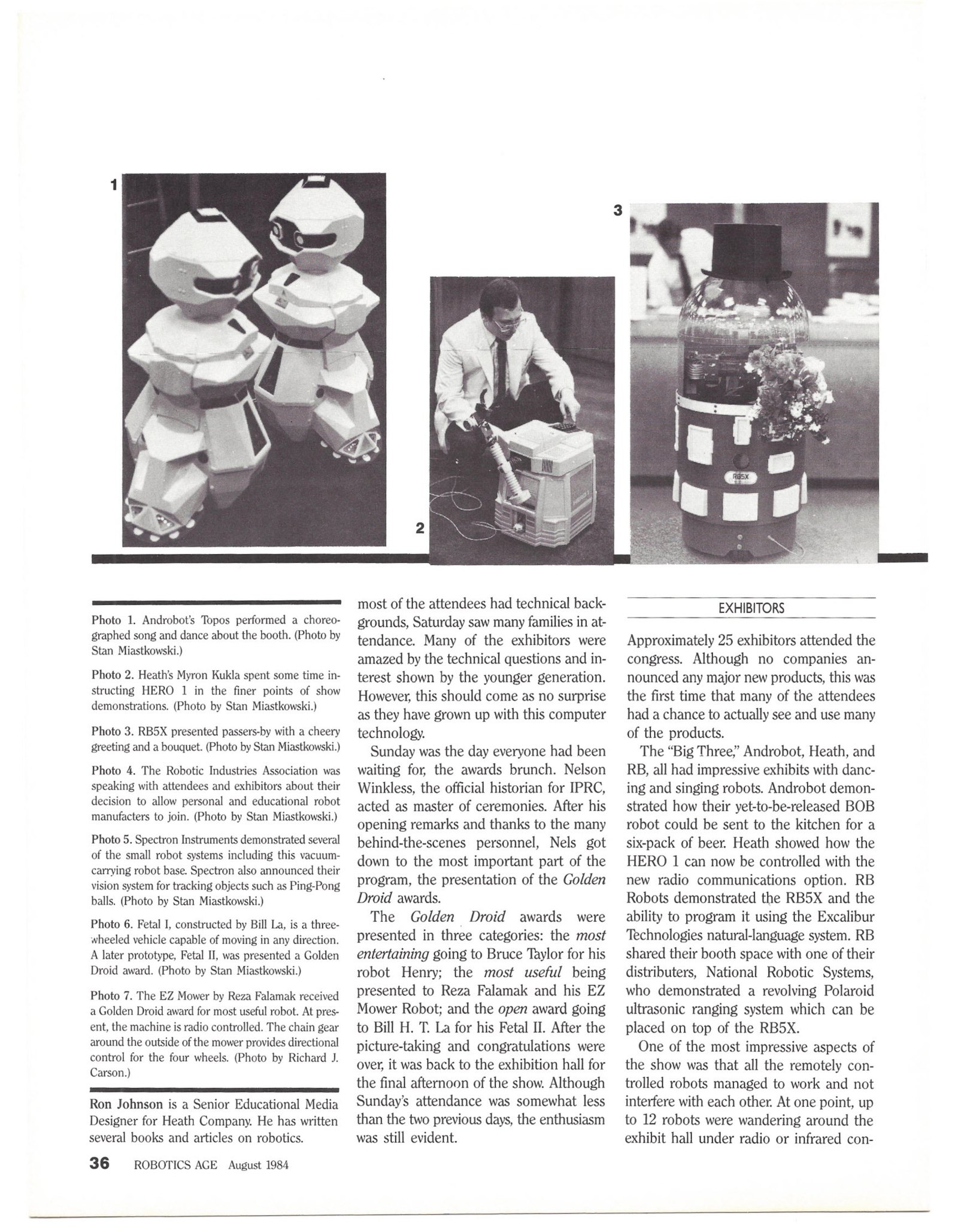
The robot also found a public audience. HERO 1 appeared on NBC’s Today on the day it was launched (YouTube). Heath demonstrated it with its new radio remote at the 1984 personal-robot congress. Wikipedia says it appeared in episodes of the children’s science programme Mr. Wizard’s World. That claim was not checked against a broadcast source for this dive.
2.6 The third-party market
HERO 1 attracted an aftermarket, which no other robot of its generation did on the same scale. This was the clearest sign that it had become a platform. The advertising pages of Robotics Age in 1984 and 1985 carry, among others:
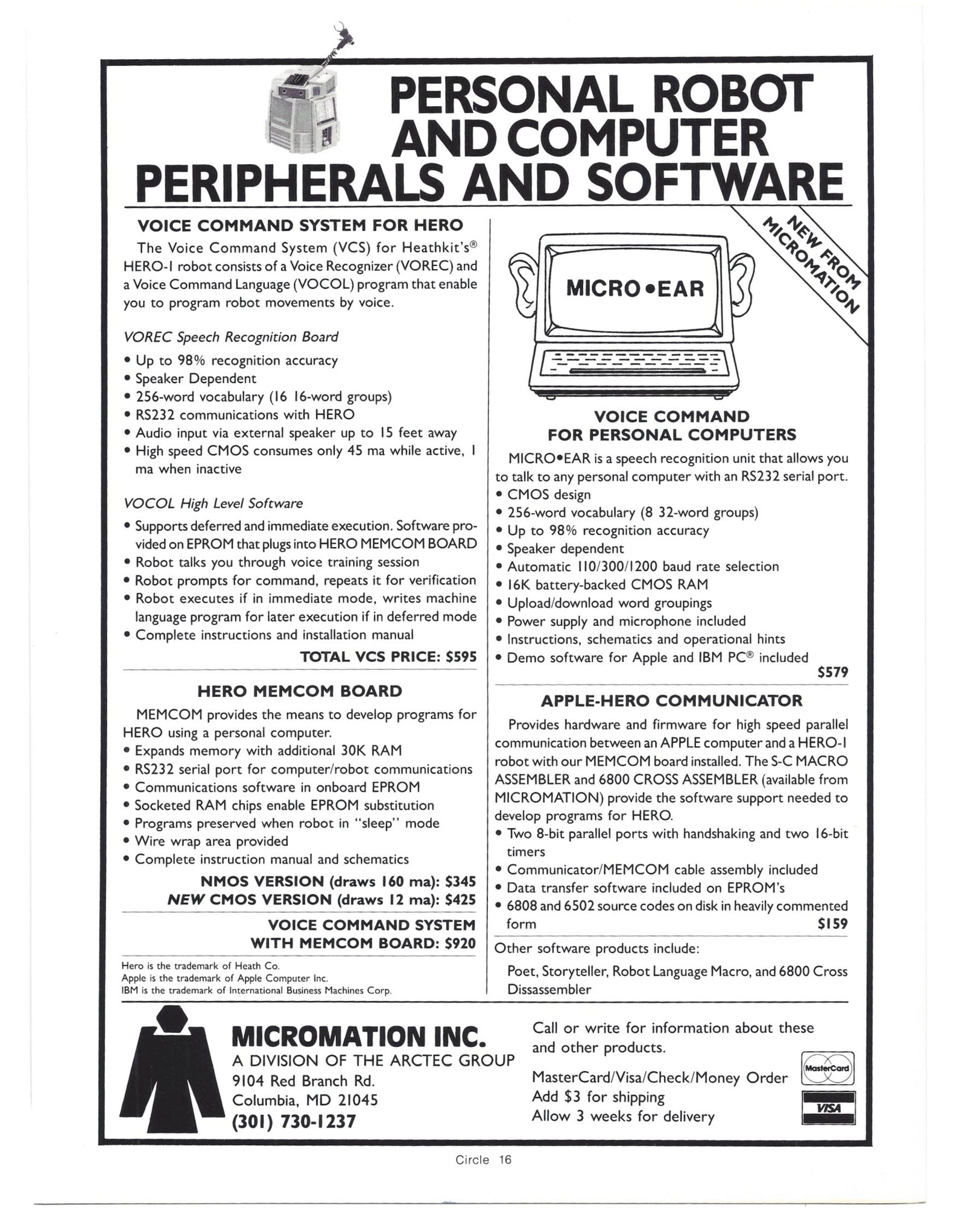
- A Voice Command System for HERO-1 from Micromation Inc. of Columbia, Maryland, “a division of the Arctec Group”, the company whose Arctec Systems later built the Gemini robot. It was a speaker-dependent speech-recognition board (VOREC) with a 256-word vocabulary, linked to the robot by RS-232, with a voice command language (VOCOL) for programming movements, at $595. The same firm sold a HERO MEMCOM board adding 30K of RAM and a serial port for program development on a personal computer, at $345 or $425 (Robotics Age, August 1984, inside front cover).
- A Polaroid rangefinder interface for the ET-18 from Interface Technology, $89 assembled, which extended ranging to 35 feet (same issue, product news).
- ROM personalities from Silicon Technologies of Melville, New York, at $49.95 each. “Demorobo” demonstrated the robot’s abilities; “Abuseramuser” gave HERO “a nasty personality”; “Henny HERO” made it “the king of computer based humor.” The firm also offered a socket extender and a custom EPROM service (Robotics Age, May 1985).
- A DynaComp motherboard kit (HK-100) with 32K memory expansion, serial I/O and wire-wrap cards “to interface your circuit to HERO I” (same issue).
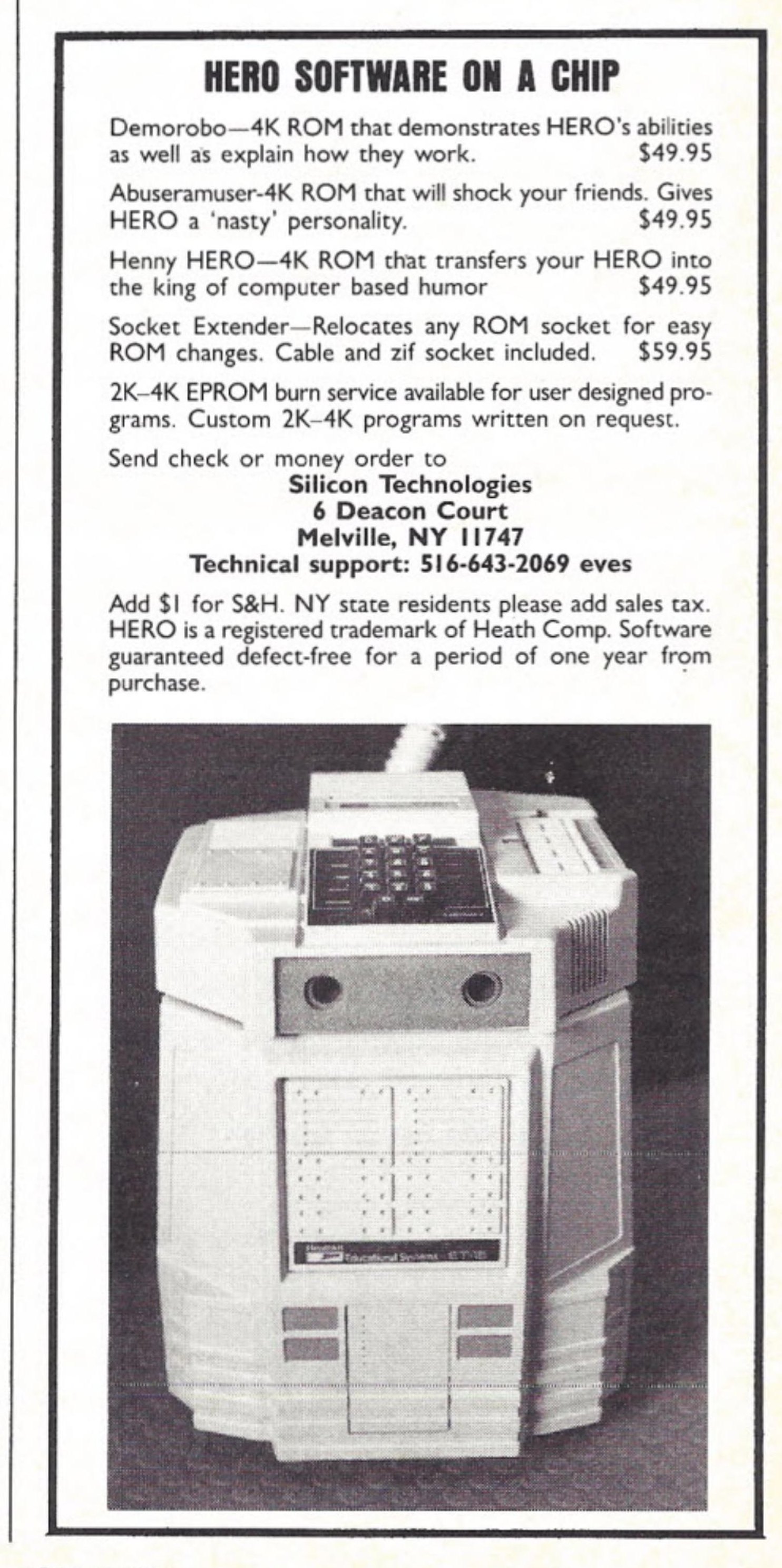
The books followed the same pattern. Mark J. Robillard’s HERO 1: Advanced Programming and Interfacing came out from Howard W. Sams in 1983. The magazine also ran HERO 1 hardware articles, such as one on keeping the robot’s front wheel steering straight, a known weakness of the design. That weakness came up again when Heath designed its next robot.
Sources
- Heathkit catalogues, World Radio History: No. 860, Winter 1983; No. 862, Fall 1983; No. 863, Christmas 1983; No. 864, Winter 1983–84; No. 865, Spring 1984; Fall 1984; Christmas 1984; Fall 1985; Spring–Summer 1986; Fall 1987; Christmas 1987; Spring 1988, No. 211.
- Leininger, Steven. “Heath’s HERO-1 Robot.” BYTE, January 1983. Internet Archive
- Robotics Age, August 1984 and May 1985.
- Felstul, David R. “HERO on Patrol.” Sextant no. 20, January–February 1986. Internet Archive
- Heath Company. Robotics and Industrial Electronics, EE-1800, 595-2726 (1982). Internet Archive
- Boyet, Howard. Heath’s Robot HERO: 69 Experiments, Fundamentals and Applications. Microprocessor Training Inc. Internet Archive
- HEATHKIT HERO-1 ET-18 Robot Manuals and Schematics, Internet Archive.
- Wikipedia, “HERO (robot)”, for the Mr. Wizard’s World claim and the book bibliography only.
Comments (0)