Robots · Volume 5
Collecting and Community
The HERO robots are among the most recognisable Heathkits today, though they were never among the most numerous. A HERO 1 is a common prop in histories of personal computing, in museum cases and in television retrospectives of the 1980s. Surviving robots change hands among collectors, and a small, persistent community keeps them running. This volume describes that afterlife: where the robots are, who supports them, where the documents are, and what owners do with them now. Model-by-model restoration advice is covered in the acquisition volumes of the three robot dives on the Robots site (HERO 1, HERO Jr, HERO 2000), and is not repeated here.
5.1 How many, and how rare
No Heath production figure for any of the robots has been found. The numbers usually quoted come from Wikipedia: about 14,000 HERO 1s “across eight years,” about 4,000 HERO Jrs and about 3,000 HERO 2000s, plus about 50 HE-RObots (Wikipedia, “HERO (robot)”). They are not cited to any Heath document, and the company history dive already flags the HERO 1 figure as unverified (Heathkit goes digital). They should be treated as orders of magnitude.
The catalogue record gives some support to that order. HERO 1 was listed for over five years and was sold into a school market with multi-unit classrooms. HERO Jr was listed for two years and discounted steeply. HERO 2000 was listed for two years at a price that confined it to institutions. On that evidence HERO 1 is the most common survivor, HERO Jr the next, and HERO 2000 the scarcest of the three. The Robot Arm Trainer, in the catalogue for about six months, is scarcer still.
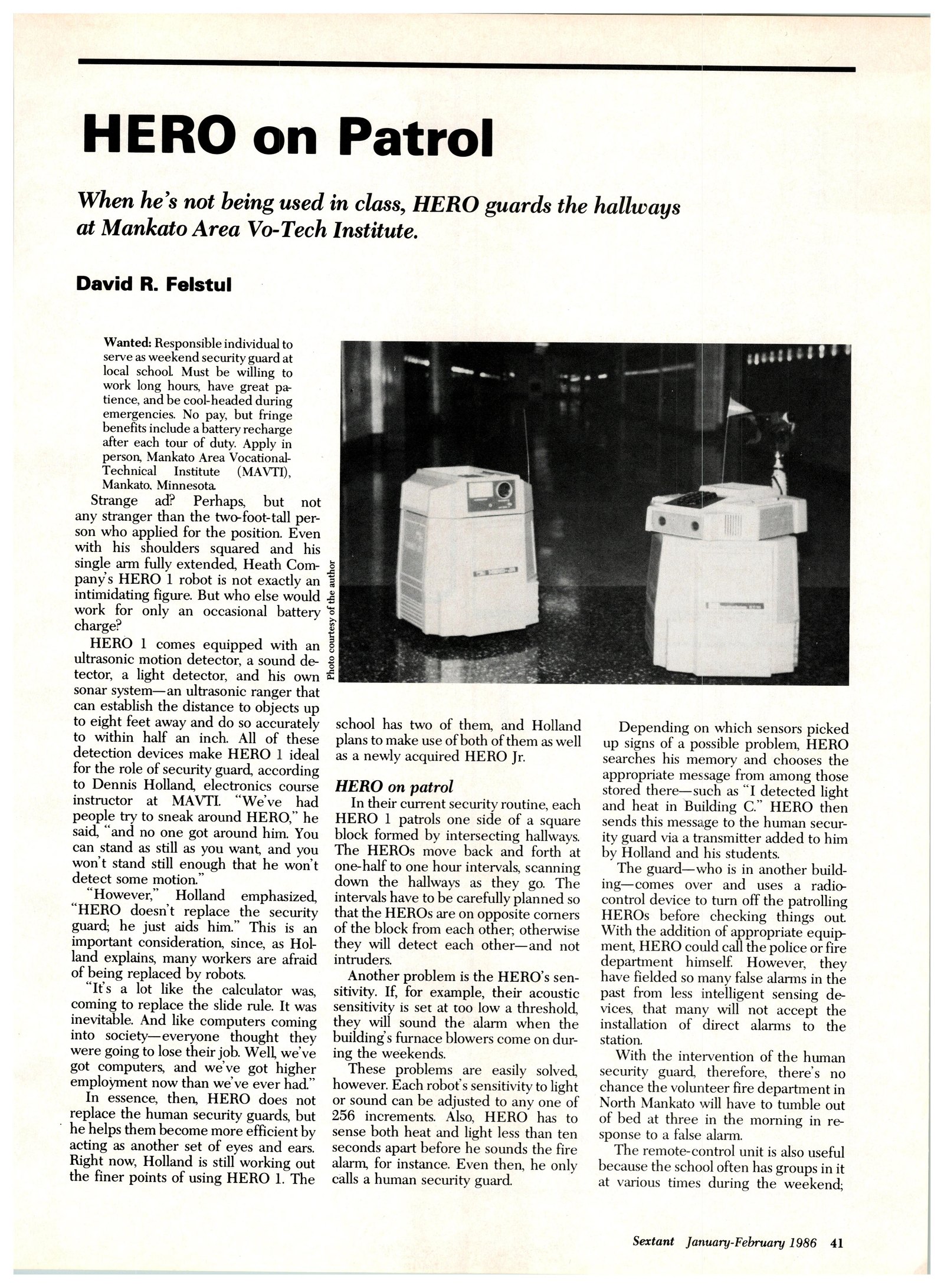
Many surviving robots come from schools. The robots were sold as classroom trainers, often assembled, and many were eventually written off by colleges and vocational schools. This is reflected in the provenance collectors report. VintageComputer.ca, for example, describes a HERO 1 from Saskatchewan originally owned by a school teacher who built it from a kit (VintageComputer.ca).
5.2 Where they can be seen
HERO robots are regularly shown in computer-history exhibits, usually as the representative 1980s personal robot:
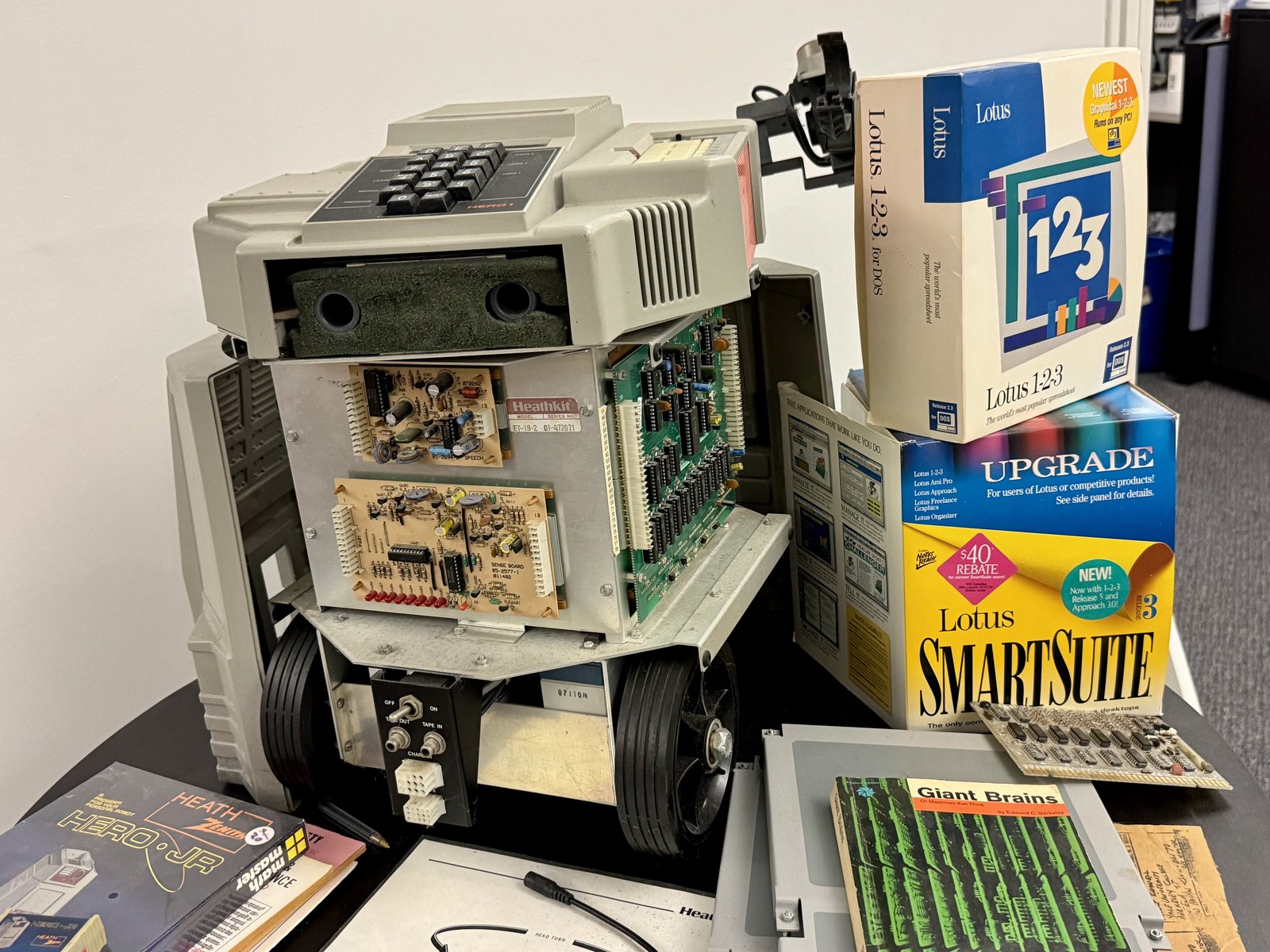
- The System Source Computer Museum displays a HERO 1 with its panels off and its arm fitted (photograph above).
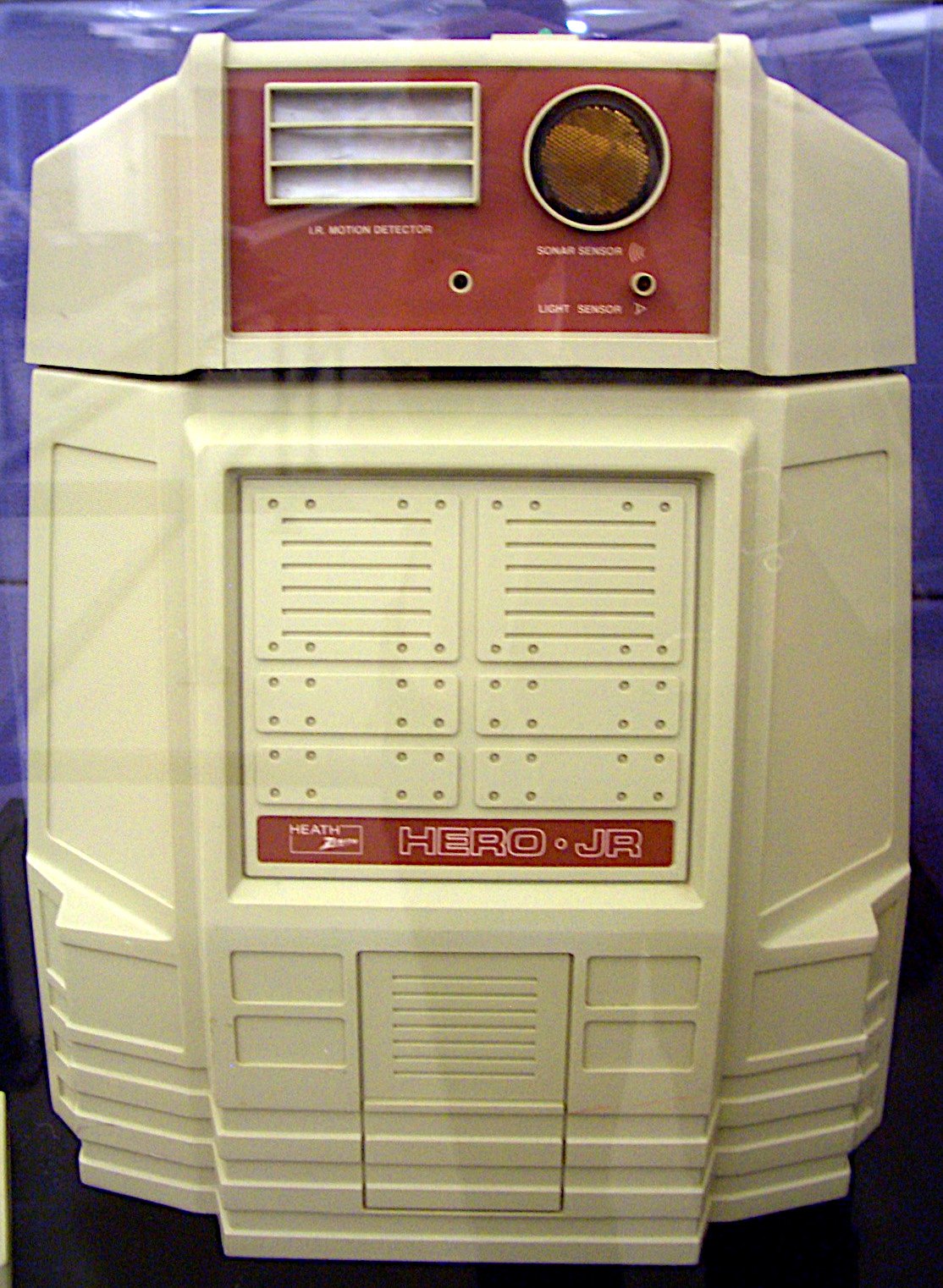
- A HERO Jr and an RB5X were photographed by the same visitor in the same museum setting, a pairing of two of the “Big Three” of 1984. The photographs are on Wikimedia Commons (HERO Jr, RB5X). The HERO Jr file is dated “1982” in its title, two years too early for the robot.
- In St. Joseph, Michigan, the Heritage Museum and Cultural Center showed a HERO 1 beside a Heathkit television at its Heath history evening in August 2015 (company history, vol. 7).
- The Computer History Museum in Mountain View catalogues HERO 2000 documentation among its holdings, according to the sourcing notes of the HERO 2000 dive.
_(469403066).jpg)
_(469402802).jpg)
5.3 The people and places that support them
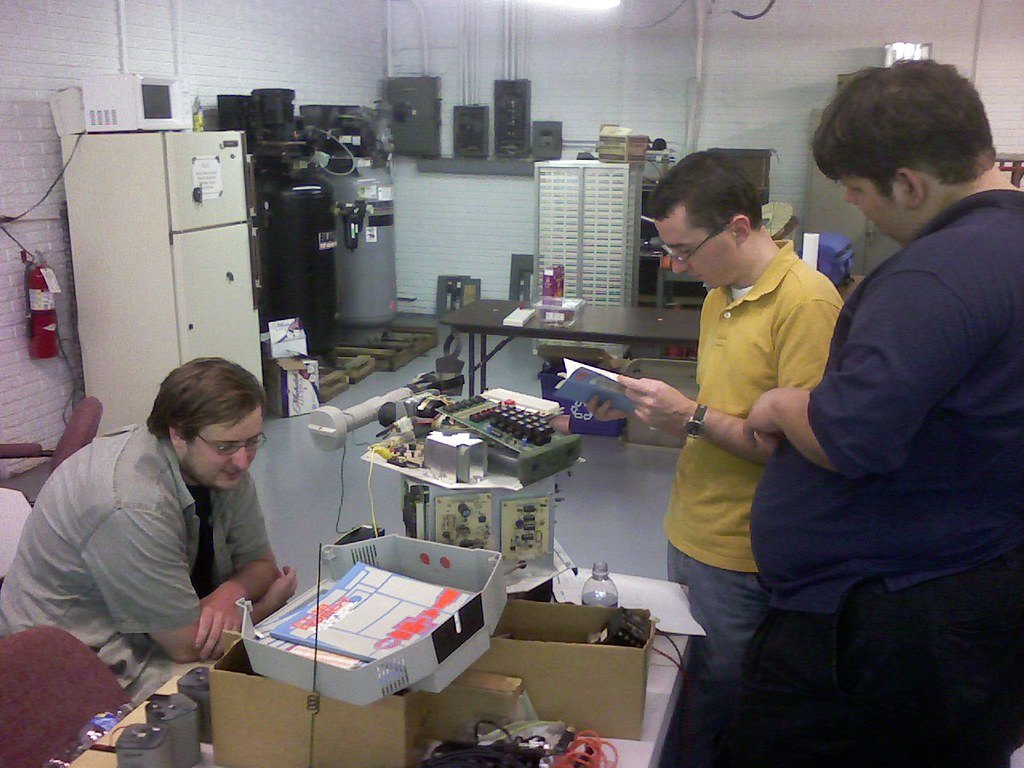
Robot Workshop. The most important single resource is Robot Workshop, which bought the remaining HERO parts and rights from Mobile Ed Productions in 2002. Mobile Ed had bought Heathkit’s remaining inventory in 1995. Robot Workshop sells original new-old-stock parts and reproduction parts, carries out repairs, and offers upgrades for all four HERO products: memory expansion, remote controls, speech boards, disk-controller boards and custom cartridges for HERO Jr. It also publishes repair tips. Its collection includes prototype parts and original Heathkit test fixtures (Robot Workshop, “HERO Robots”). For a restorer it is the nearest thing to a factory service department.
The Hero Web Source. Donnie V. Savage’s site, hero.dsavage.net, is the oldest HERO reference on the web. It went up in 1996 and holds FAQs, documentation and software for all three robots, including a transcribed HERO 2000 specification sheet and the 8088 instruction set. It also has a “SwapShop” where owners list robots and parts wanted and for sale. Savage states plainly that he is “not a company” and sells nothing (The Hero Web Source). Make sent readers to the site for HERO build information in 2008 (Make:, 28 February 2008). The three robot dives on the Robots site draw heavily on its FAQ.
The Old Robot’s Web Site. theoldrobots.com has illustrated pages for each HERO, with specifications, accessory lists and manual images (The Old Robots, “Heathkit Hero Robots”).
Mailing lists and forums. Savage’s site refers to a HERO list server, and Robot Workshop’s page to a “HERO User group” on Yahoo Groups. Both kinds of list have since closed, and the community now meets on groups.io. Its main group, herobots, describes itself as a replacement for the lists that are no longer operating, and as a place for discussion and a repository for the whole HERO series: HERO 1 (ET-18/ETW-18), HERO Jr (RT-1/RTW-1), HERO 2000 (ET-19/ETW-19) and the Robot Arm Trainer (ETS-19-32/EWS-19-32) ([email protected]). A second group, hero-owners, is also active on the same platform ([email protected]). The model numbers the community uses match the catalogue convention: the plain number is the kit and the W marks the assembled robot.
5.4 The documents
The robots are unusually well documented online. That is partly because Heath documented them so thoroughly, and partly because the community has scanned almost everything. The main collections on the Internet Archive are:
- HERO 1: a single item, HEATHKIT HERO-1 ET-18 Robot Manuals and Schematics, with thirty files. It holds the user’s guide, the assembly manual (ET-18A), the technical manual (ET-18A) with two errata, the arm (ET-18-1), voice (ET-18-2), remote-control (ET-18-3), utility ROM (ET-18-4), memory expansion (ET-18-6), automatic mode ROM (ET-18-7) and HERO-1 BASIC (ET-18-9) manuals, the illustration booklets and the four schematic sheets.
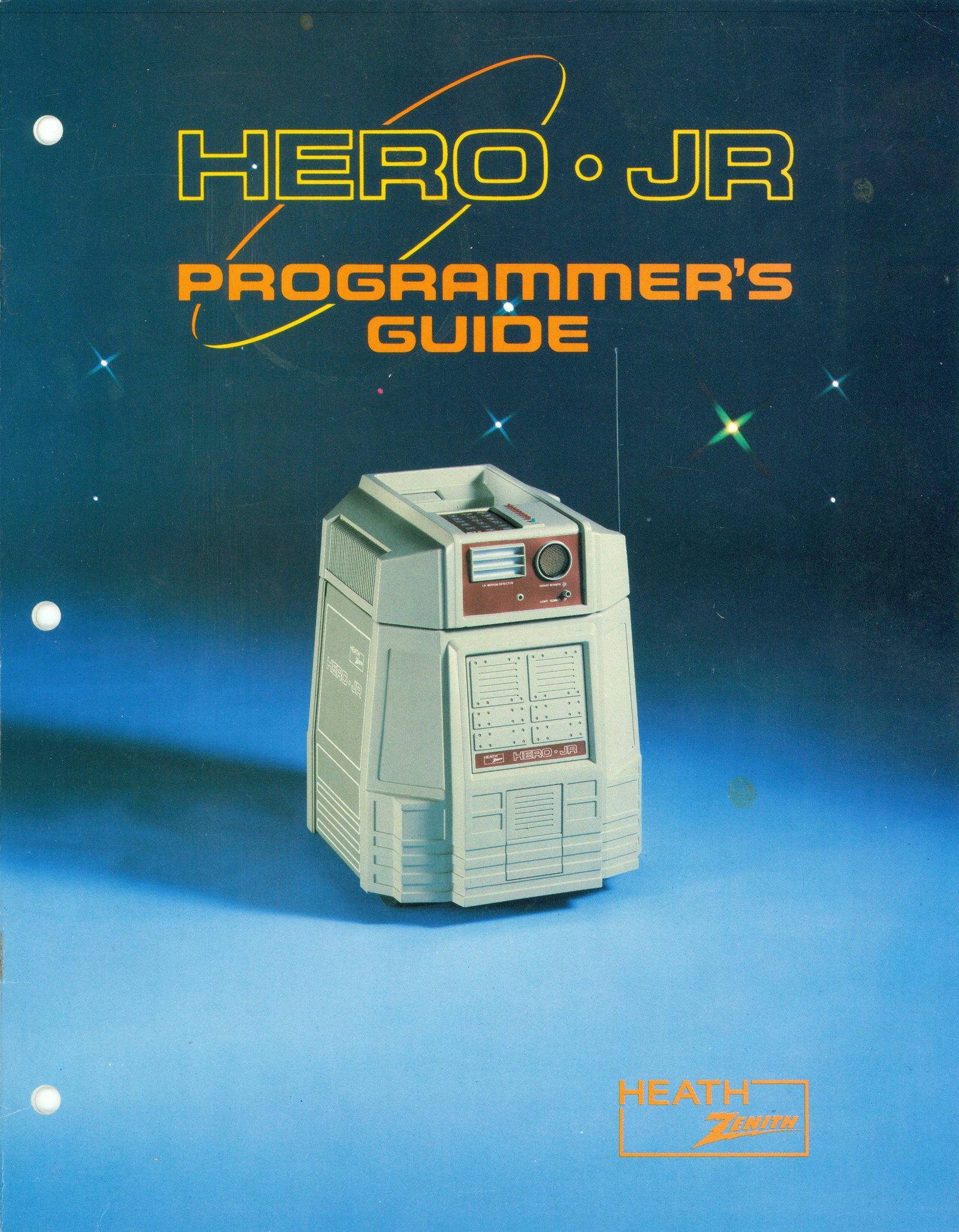
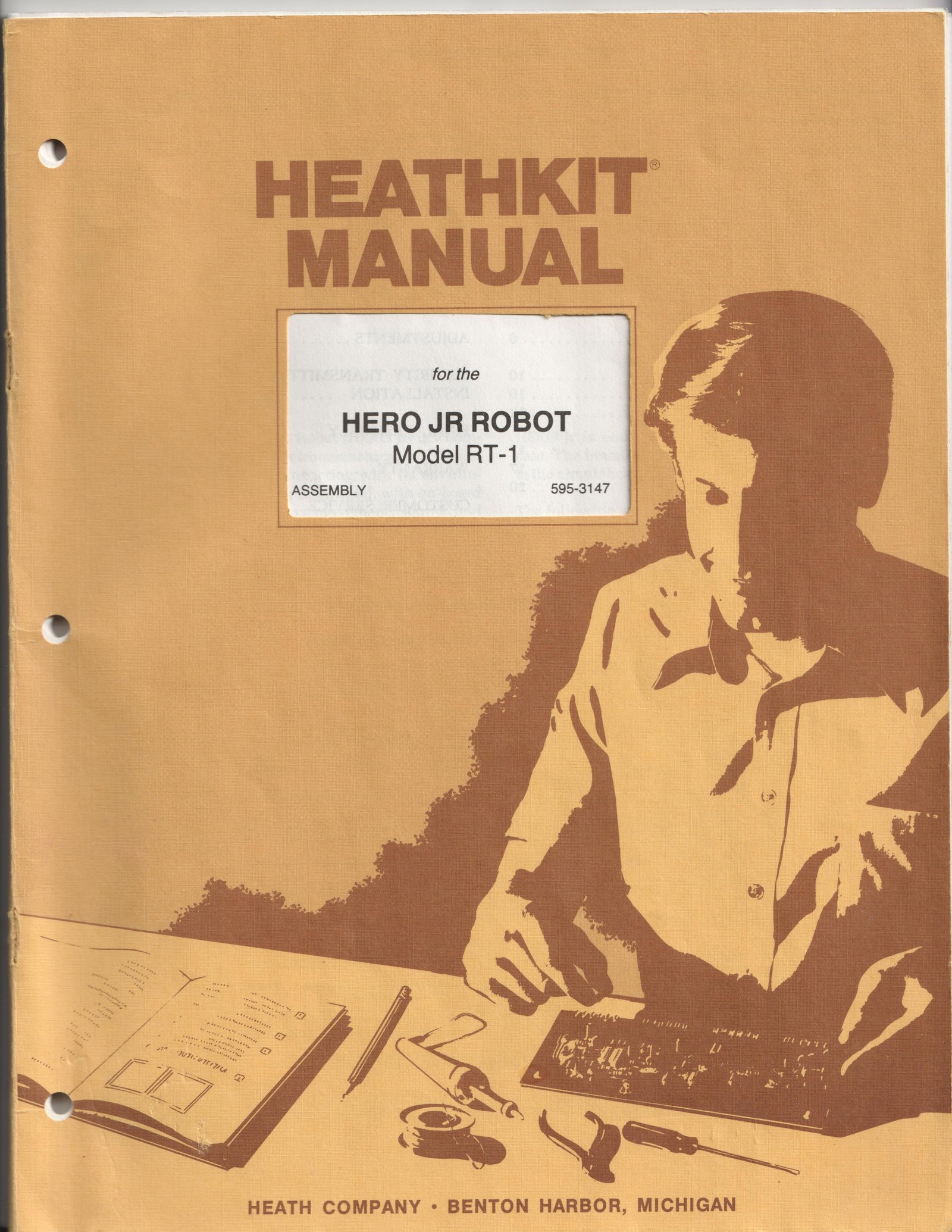
- HERO Jr: separate items for the Owner’s Guide, Programmer’s Guide, assembly manual, 595-3147, technical manual, 595-3271, and the accessory manuals (remote control, RS-232, cartridge adapter, infrared motion detector), an HJPL speech dictionary, errata and kit inserts. There is also a set of HERO Jr ROM images.
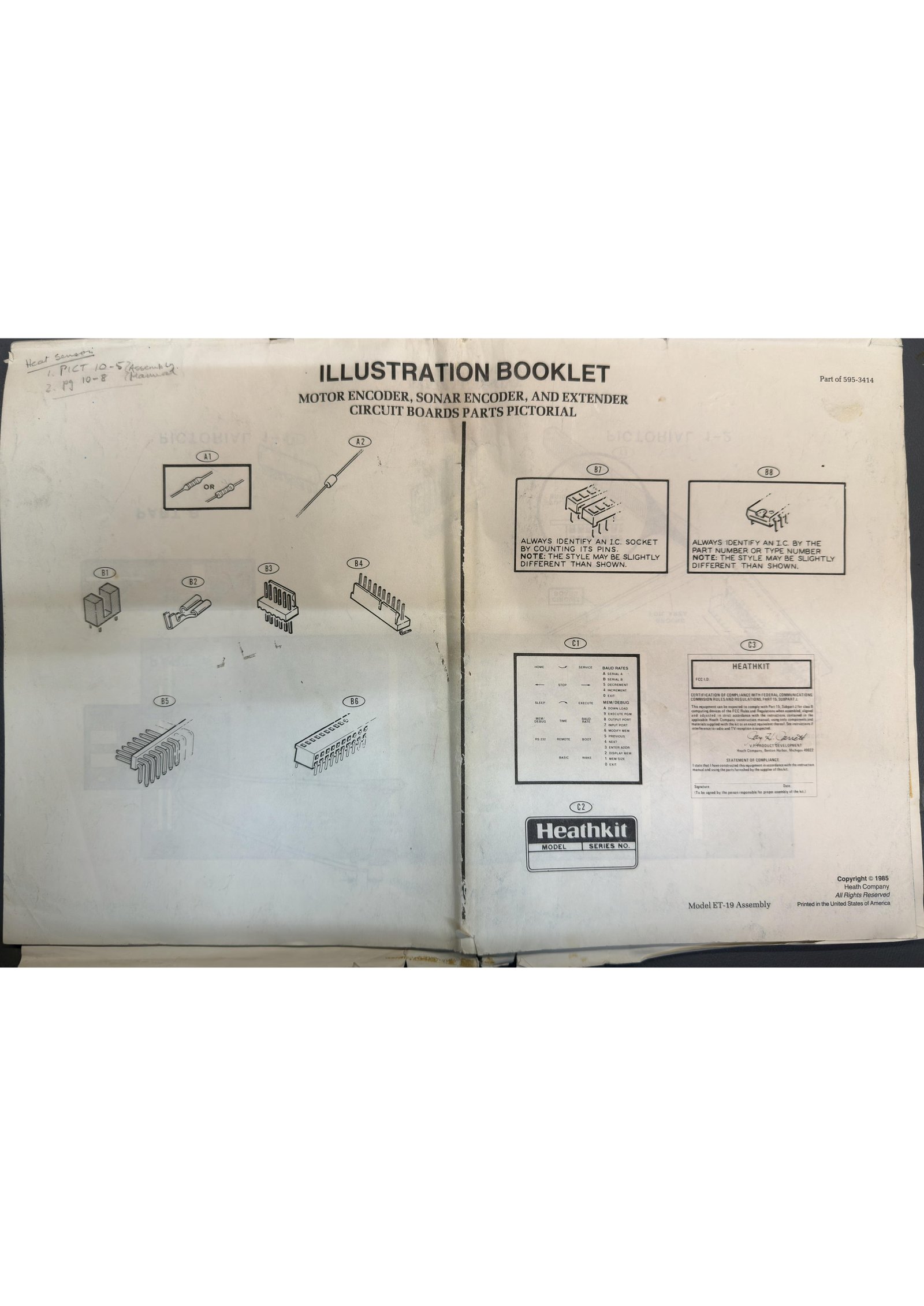
- HERO 2000: the illustration booklet, 595-3414, the schematic diagrams, 595-3416 and the service IC data. No complete scan of the HERO 2000 assembly or technical manual was found; the HERO 2000 dive notes the same gap.
- Courses: EE-1800 Robotics and Industrial Electronics and Boyet’s 69 experiments. A 1985 HERO 1 robotic-language compiler is also held.
The full list, with part numbers and the data needed for the site’s hosting decision, is in the Reference volume. Every HERO document whose text was checked carries a Heath copyright notice: the EE-1800 course (1982) and four HERO Jr manuals (1984). All the HERO documents were published after 1978, so under the project’s rule they are linked here, not hosted.
5.5 Printed parts
The plastic parts of the HERO robots were moulded, and several of them, especially the arm’s wrist and gripper, break easily. Since about 2011 owners have published 3D-printable replacements. The Internet Archive’s mirror of Thingiverse preserves a representative set:
- a HERO 1 gripper and wrist connection (2013);
- a HERO 1 keypad replacement (2013);
- a HERO 1 shoulder repair (2013);
- a HERO 1 body panel (2018);
- wrist body and wrist cover parts (2019);
- a HERO Jr battery bracket for a 12 V, 10 Ah replacement battery (2023);
- and a Nerf gun mount for a HERO (2011).
The battery bracket is typical of the practical side of ownership. The original gel cells are long dead in any surviving robot, and owners fit modern sealed lead-acid packs, with printed brackets to hold them.
5.6 Rebuilds and upgrades
Some owners restore the robots to original condition. Others use the shell as a body for new electronics. Two projects covered by Hackaday show the two tendencies:
- In 2012 an owner known as FR3DDY connected a HERO 1 to Wi-Fi. He used a serial programming interface kit and a thrift-shop wireless router running OpenWrt, so that the robot could be driven from Python instead of the keypad. The keypad, the write-up said, was “exactly as awful as it sounds” (Jeremy Cook, “Wireless Upgrade For A Heathkit HERO 1 Robot”, Hackaday, 9 September 2012).
- In 2020 Scott Baker bought a HERO Jr on eBay that arrived “with no electronics.” He rebuilt it around an ATmega328 microcontroller and a Raspberry Pi, with 3D-printed mounts for a webcam and sensors (Al Williams, “Rebuilding A Hero (The Robot, Not The Sandwich)”, Hackaday, 5 November 2020).
Both approaches are possible because of the choices described in this dive. The HERO 1 was open by design, with its bus on a breadboard on the robot’s head and its serial link, so it can be interfaced without cutting anything. The HERO Jr, which Robotics Age criticised in 1984 for having no hardware expansion opening, is more often gutted and rebuilt.
5.7 Value
This dive does not quote market prices. Sales are few and irregular, and condition and completeness vary widely: whether a HERO 1 has its arm, voice and pendant, whether a HERO Jr has its remote and cartridges, whether a HERO 2000 has its arm and console. Wikipedia’s remark that HERO Jr units have sold for about $100 is a single uncited data point. The one general observation that the sources support is that completeness counts for more than cosmetics, because the accessories are the parts most often lost.
Sources
- Robot Workshop, “HERO Robots”.
- Savage, Donnie V. The Hero Web Source.
- The Old Robot’s Web Site, “Heathkit Hero Robots”.
- [email protected]; [email protected].
- VintageComputer.ca, “Heathkit Hero 1 (ET-18) Robot”.
- Hackaday: Cook, 9 September 2012; Williams, 5 November 2020.
- Cunningham, Collin. “Heathkit HERO”, Make:, 28 February 2008.
- Internet Archive collections as linked in the text.
- Wikipedia, “HERO (robot)”, for the production estimates only.
Comments (0)