DX-100 Transmitter · Volume 1
Overview
In the winter of 1955 the Heath Company, which had spent eight years selling oscilloscopes, voltmeters and a $29.50 novice transmitter by mail, announced a 100-pound amateur transmitter with a built-in VFO, a built-in modulator and three built-in power supplies for $189.50. The Heathkit DX-100 was the largest and most expensive kit the company had ever offered, and it changed what a Heathkit was understood to be. Until then a Heathkit was a bench instrument or a beginner’s rig. The DX-100 was a complete station transmitter of the sort that a well-off amateur bought factory-wired from Collins or E. F. Johnson, sold instead as a carton of parts and a 60-page manual, at roughly two-thirds the price of the wired competition. It sold in numbers that paid for Heath’s advertising pages in QST and, on one account, for the graduate engineers the company hired next. Seventy years later it is still on the air: the DX-100 and its successor the DX-100B remain among the commonest rigs on the amateur AM nets on 160, 80 and 40 metres.
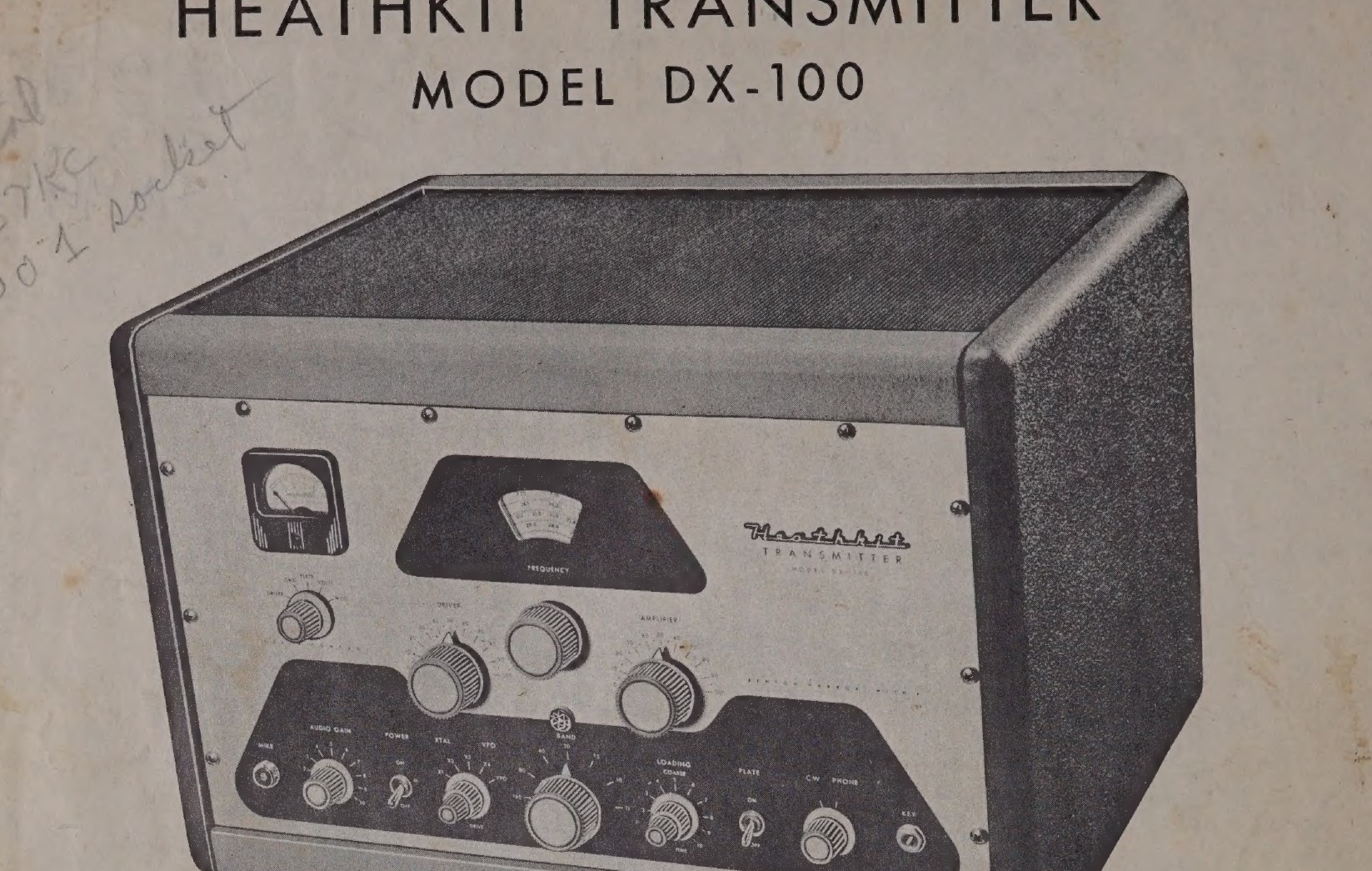
This dive documents the DX-100 as a machine and as a kit: where it sat in Heath’s line, how the circuit works stage by stage, what building it was actually like, how it is tuned and operated, how it is restored, and what the surviving documents say. The Heath Company’s own story - the 1926 aircraft kits, the 1947 oscilloscope, Daystrom, Schlumberger, Zenith and the end of the kits in 1992 - is told in the site’s history dive, and the DX-100’s place in the company’s finances is covered in its Daystrom volume. Those are not retold here.
1.1 What it is
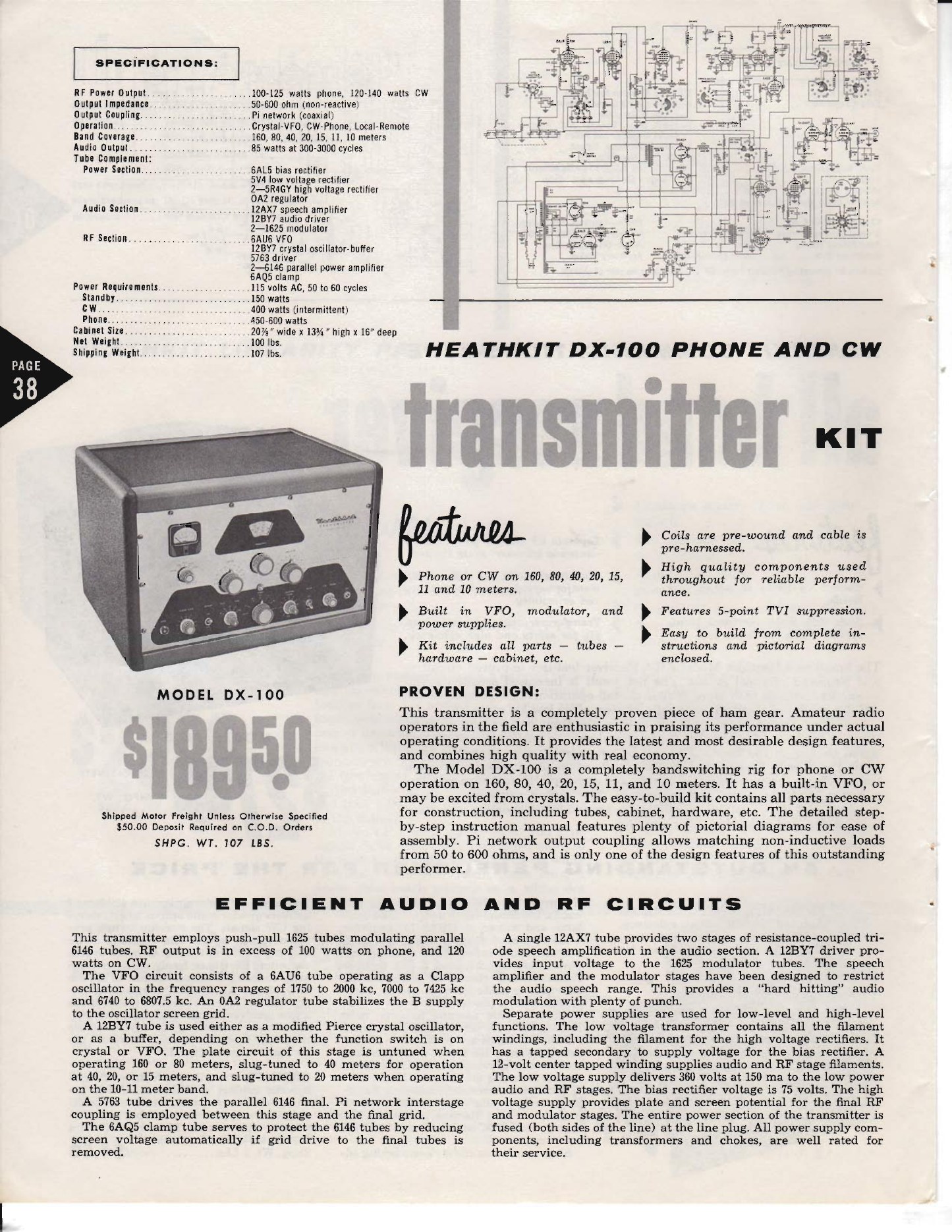
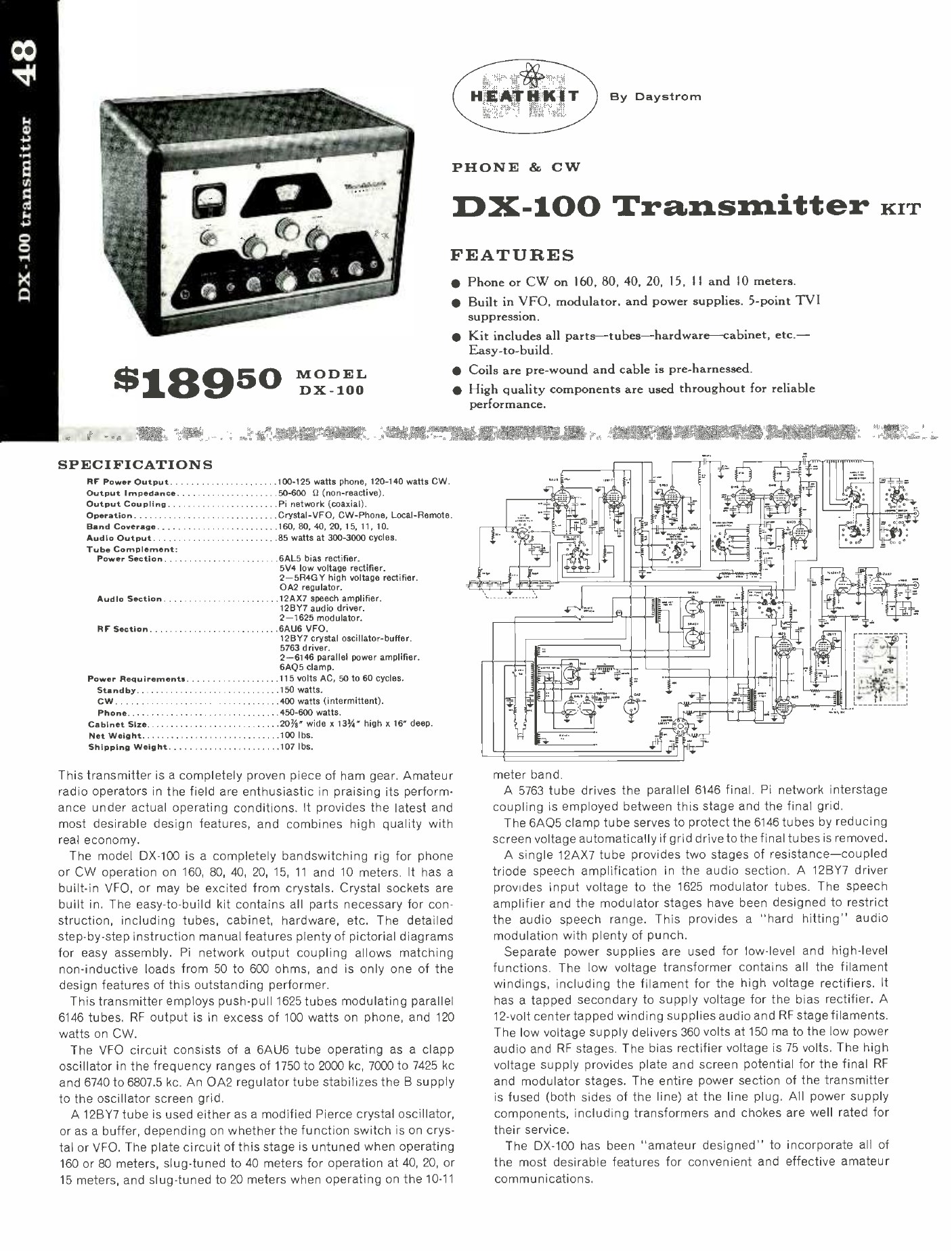
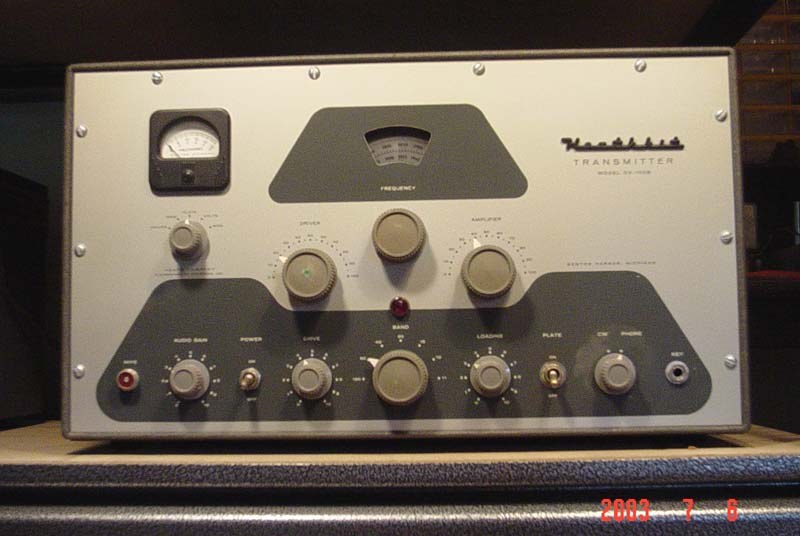
The DX-100 is a bandswitching AM and CW transmitter for the amateur bands from 160 through 10 metres, including the 11-metre band that was still an amateur allocation in 1955. Everything needed to put a signal on the air is inside one cabinet: a variable-frequency oscillator, sockets for four crystals, a chain of radio-frequency amplifiers ending in a pair of 6146 beam tetrodes in parallel, a speech amplifier and a pair of 1625 modulator valves that plate-modulate the final, and three power supplies. The catalogue’s summary was that “the only external requirements are an antenna, ground, and key or microphone” (1956 catalogue, p. 38).
Two numbers explain most of the rig. The first is the power: a pair of 6146s running at about 740 volts gives 100 to 125 watts of carrier on phone and 120 to 140 watts on CW, according to the assembly manual’s specification page. The second is the weight: 100 pounds net, 107 pounds packed, most of it in two potted transformers, two filter chokes and a modulation transformer. High-level plate modulation of a 100-watt carrier needs an audio amplifier of roughly half that power, and iron of that rating is heavy. The DX-100 therefore arrived by motor freight, with a $50 deposit required on cash-on-delivery orders.
Table 1 — What it is
| Headline specification | DX-100 (1955) |
|---|---|
| Modes | AM phone and CW |
| Bands | 160, 80, 40, 20, 15, 11 and 10 m, single-knob bandswitching |
| Frequency control | built-in VFO or any of four panel-selected crystals |
| RF output | 100-125 W phone, 120-140 W CW |
| Output circuit | pi network, coaxial, 50-600 ohm non-reactive |
| Audio output | 85 W, 300-3000 c/s |
| Valves | 15, including 2 x 6146 in the final and 2 x 1625 in the modulator |
| Power | 115 V AC; 150 W standby, 400 W CW, 450-600 W phone |
| Cabinet | 20 7/8 in wide x 13 3/4 in high x 16 in deep |
| Weight | 100 lb net, 107 lb shipping |
| Price | $189.50, kit only, shipped motor freight |
The specification table is taken from the assembly manual (DLARC scan, p. 66); the price and shipping arrangements from the 1956 catalogue. Catalogue copy consistently quoted the more modest “in excess of 100 watts on phone, and 120 watts on CW” rather than the manual’s upper figures.
1.2 The announcement, March 1955
The DX-100 was announced in Heath’s mid-winter flyer for 1955, a 12-page newsprint supplement whose opening line was “Again we are proud to announce the mid-winter release of additional Heathkits.” The transmitter takes page 3 under the banner “Brand New… EQUIPMENT”, with the note “Available after March 15th” and a shipping weight of 120 pounds, express only. The price was already $189.50 (Winter 1955 flyer, p. 3).
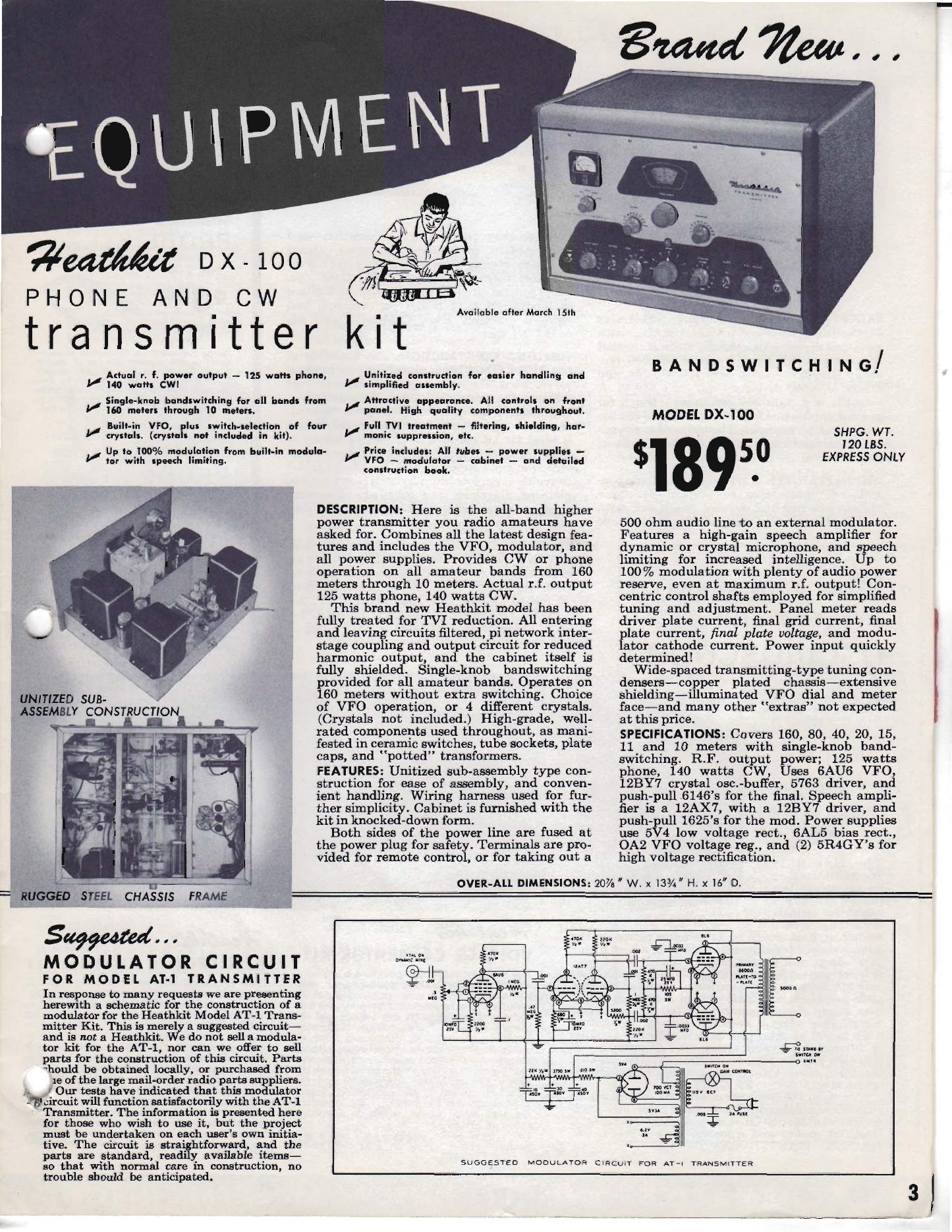
The launch copy is worth reading closely, because two of its claims did not survive into the catalogues. It gives “Actual r.f. output 125 watts phone, 140 watts CW” - the top of the range the manual would later quote as a band - and it describes “push-pull 6146’s for the final”. The 6146s are in parallel, not push-pull, in every manual and every later catalogue; the flyer is simply wrong. The shipping weight of 120 pounds also fell to 107 pounds once the kit was packed for motor freight rather than express.
The flyer’s feature list is the design brief in miniature: single-knob bandswitching on all bands including 160 metres without extra switching; a built-in VFO plus four crystals; up to 100 per cent modulation from a built-in modulator with speech limiting; unitised sub-assembly construction with a wiring harness; and “full TVI treatment - filtering, shielding, harmonic suppression”. Television interference was the dominant amateur anxiety of 1955, and Heath’s answer to it is built into the mechanical design of the rig, not bolted on.
1.3 Where it sat in the line
Heath’s amateur transmitters formed a ladder, and the DX-100 sat at the top of it for four years.
Table 2 — Where it sat in the line
| Model | In the catalogue | Input or output | Price | Position |
|---|---|---|---|---|
| AT-1 | 1951 | 25-30 W input, CW only | $29.50 | the first Heath ham transmitter |
| DX-20 | 1958 | 50 W input to a 6DQ6A, CW only | $35.95 | novice CW |
| DX-35 | 1956 | 65 W CW input, 50 W phone peaks | $56.95 | novice/general, screen modulation |
| DX-40 | 1958 | 75 W CW input, 60 W controlled-carrier phone | - | the DX-35’s successor |
| DX-100 | 1955 | 100-125 W out phone, 120-140 W CW | $189.50 | flagship; plate-modulated AM |
| DX-100B | 1958-59 | as DX-100 | $189.50 | restyled, SB-10 ready |
| TX-1 “Apache” | 1959 | 150 W phone, 180 W CW input | $229.50 | the flagship after the DX-100B |
Prices and dates are “in the catalogue by”, taken from the catalogues themselves: AT-1, DX-35 and DX-100 together on one page of the Summer 1956 flyer; the DX-20 at $35.95 and the DX-40 in the 1958 catalogue, where the DX-40’s price did not survive the scan’s text layer; the DX-100-B, SB-10, TX-1 and RX-1 in the 1959 catalogue.
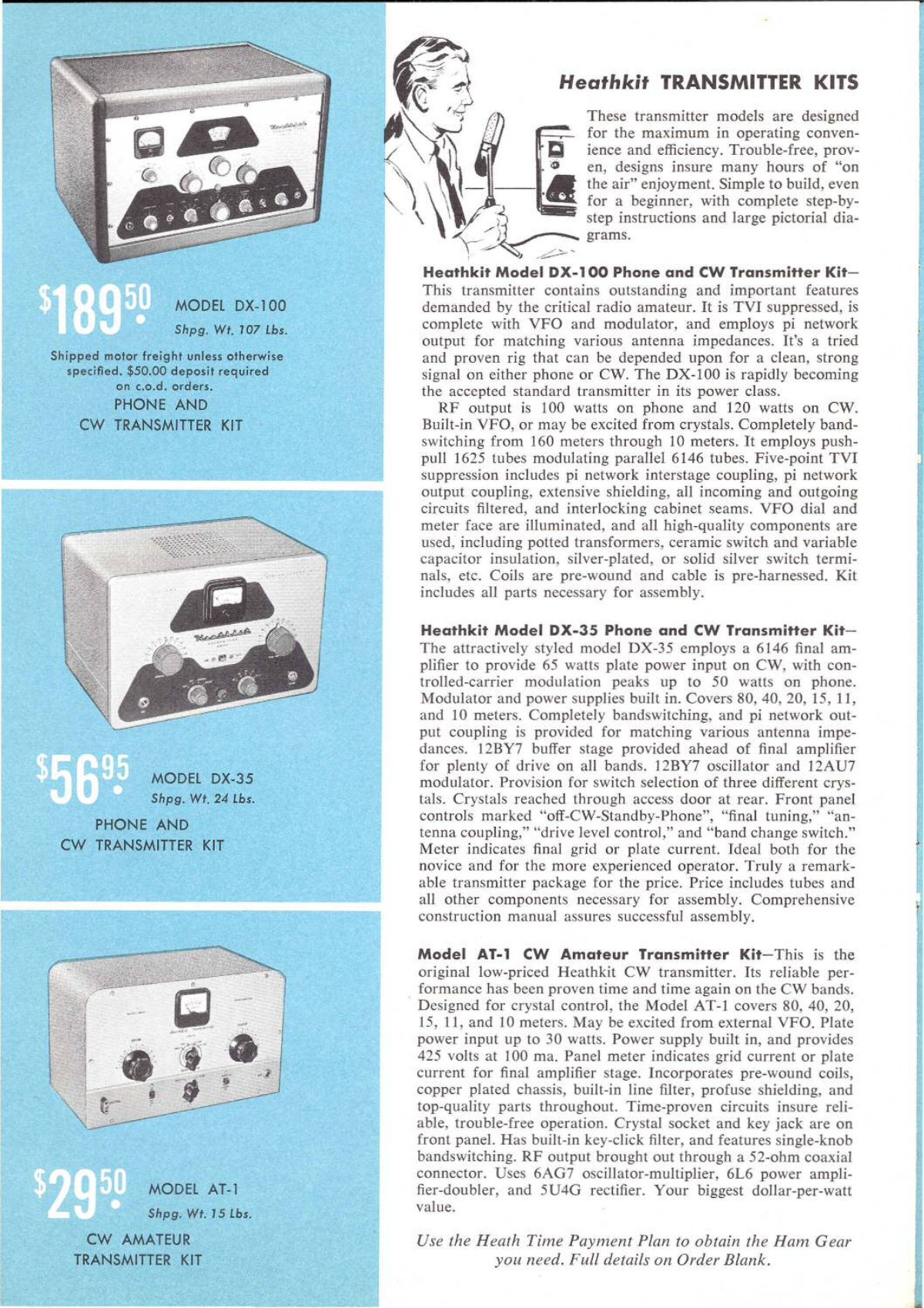
The difference between the DX-100 and the rigs below it is not only power. The DX-35, DX-40 and DX-60 used screen or controlled-carrier modulation, in which the carrier level falls with the audio; the DX-100 uses high-level plate modulation, in which the whole plate supply of the final swings with the speech waveform. That takes a real audio amplifier - here 85 watts of it - and it is what gives the rig its reputation for talk power on AM. Bob Eckweiler, who borrowed one in 1960 after using a DX-40, put the difference plainly: with three times the audio power in the sidebands, contacts were easier to make and hold when conditions were poor (Heathkit of the Month #8).
1.4 The DX-100B, 1958
The revision arrived with a manual dated 15 March 1958 and carrying the Heath number 596-213 (DX-100B manual). The 1959 catalogue sells it as “the time-proven, outstanding performance of the Heathkit model DX-100 transmitter, add new, modern styling and circuit improvements”, at the same $189.50 (1959 catalogue, p. 44).
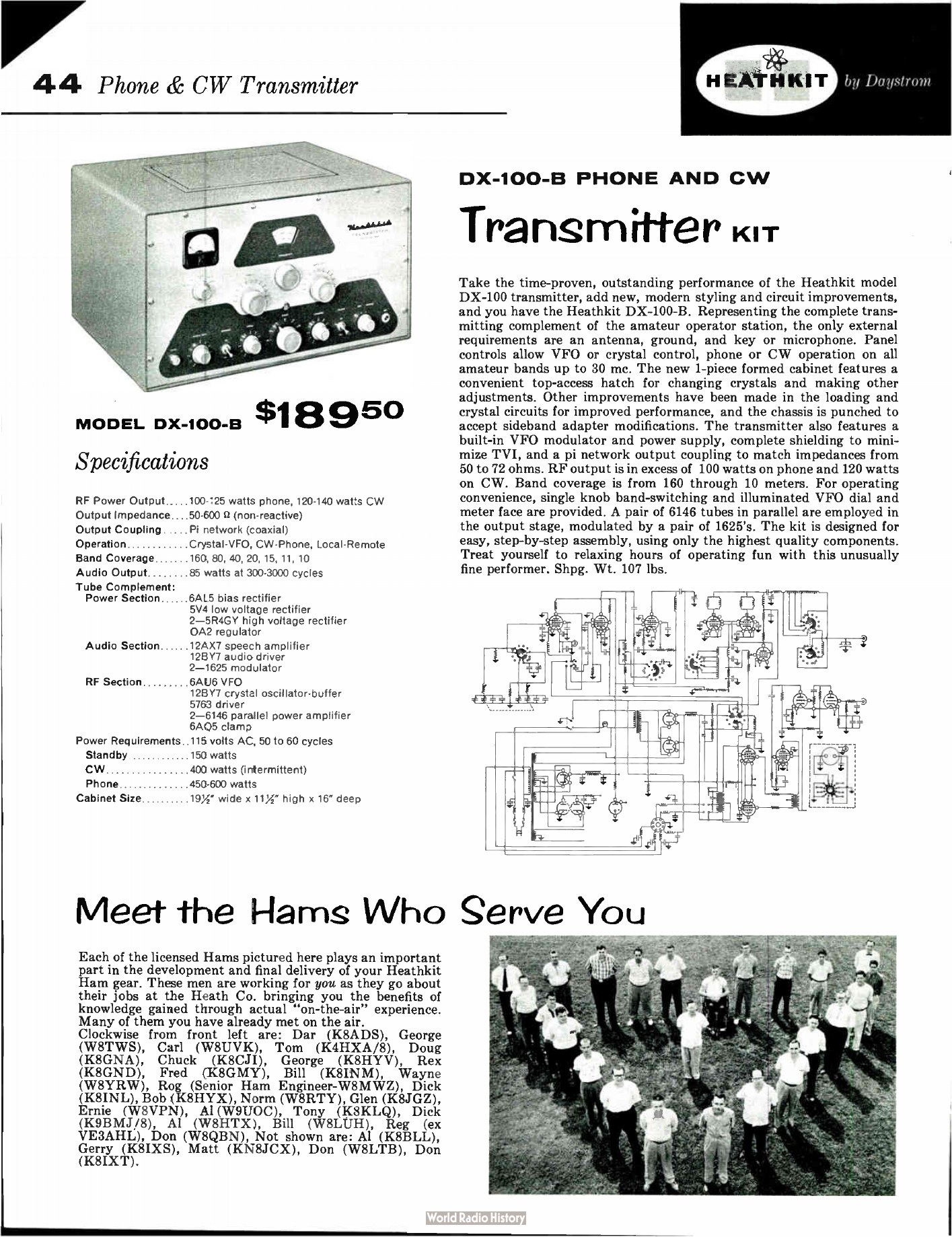
The changes are all mechanical or ergonomic; the valve line-up and the specification table are identical. The two dual-concentric controls disappear from the front panel: the crystal-VFO switch moves inside the cabinet, reached through a hatch in the top, with one crystal socket instead of four, and the stepped coarse loading switch with its fine vernier is replaced by a single geared control driving a larger variable capacitor. The knocked-down cabinet that the builder assembled from panels becomes a one-piece welded 16-gauge shell, perforated on bottom, rear and top, finished in baked crackle grey, and it is 19 1/2 inches wide by 11 1/2 high rather than 20 7/8 by 13 3/4. The knobs gain a triangular pointer in place of a line (DX-100B manual, p. 3; Eckweiler).
The single most consequential change is invisible from the front: the B chassis leaves the factory punched for the connectors and wiring that the SB-10 sideband adapter needs. Single sideband was arriving, and Heath was building the hooks for it into an AM transmitter.
Eckweiler dates the DX-100 to 1955-57 and the DX-100B to 1957-60, and notes that no DX-100A was ever made. The catalogues shift those boundaries a little: the plain DX-100 is still the only version listed in the 1958 catalogue at $189.50, and the DX-100B manual is dated March 1958, so the changeover looks like 1958 rather than 1957. The DX-100B is gone from the May 1961 catalogue, where the Apache has risen to $239.95 and the DX-60 covers the low end (1961 catalogue).
1.5 Variants
Table 3 — Variants
| Variant | Years | Distinguishing features |
|---|---|---|
| DX-100 | 1955-58 | four front-panel crystal sockets on a dual-concentric switch; coarse/fine loading controls; builder-assembled knocked-down cabinet, 20 7/8 x 13 3/4 x 16 in |
| DX-100B | 1958-60 | crystal switch and single socket inside a top hatch; one geared loading control; one-piece welded cabinet, 19 1/2 x 11 1/2 x 16 in; chassis pre-punched for the SB-10 |
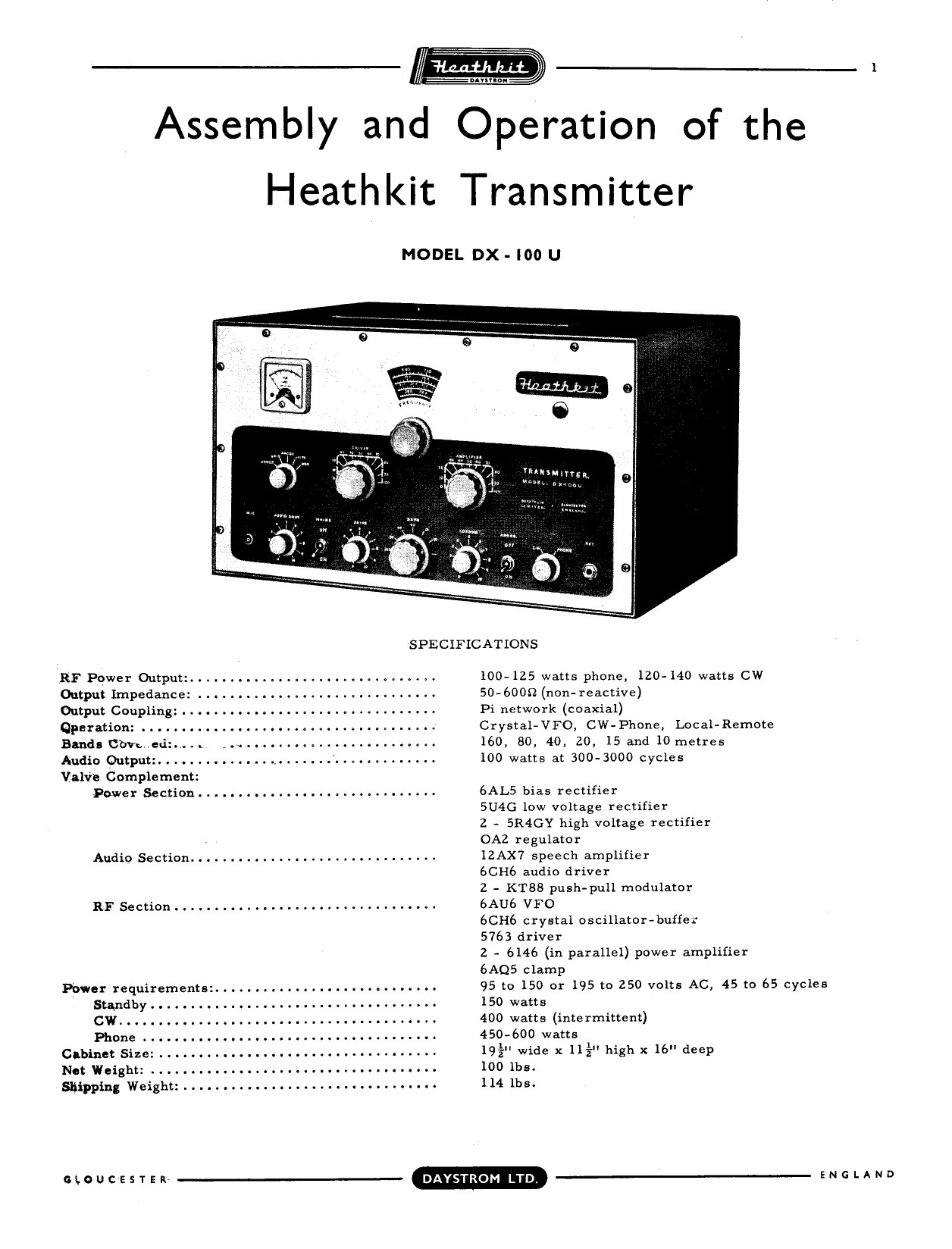
| DX-100U | late 1950s | built by Daystrom Limited, Gloucester, England, for 95-150 or 195-250 V mains; 5U4G low-voltage rectifier, 6CH6 buffer and audio driver, KT88 modulators, 100 W audio; no 11-metre position; 114 lb shipping |
| ”DX-100A” | - | never existed |
The export model is the least documented of the three and the most different. Its manual, priced at 21 shillings and published by Daystrom Limited of Gloucester, lists a valve complement that departs from the American rig at four points: a 5U4G in place of the 5V4 low-voltage rectifier, 6CH6 valves in place of both 12BY7s, and a pair of KT88s in place of the 1625 modulators, rated at 100 watts of audio rather than 85. The band table drops 11 metres. The cabinet dimensions match the DX-100B (DX-100U manual, p. 1, VMARS archive).
1.6 Who it was for
The catalogue is explicit about the intended buyer, and about a second one it did not want to exclude. The 1956 entry closes with the note that the transmitter “may be operated CW by novices if xtal excitation and reduced loading is practiced” - a nod to the novice power limit, since a novice licence in 1955 permitted 75 watts input. The main market was the general or advanced-class operator who wanted a full-gallon-adjacent AM station without building from a magazine article or paying Johnson’s or Collins’s prices. Brueschke and Mack record that Heath arrived at the design by reverse-engineering the E. F. Johnson Viking II, which sold for about $100 more, and that the DX-100’s success let Heath hire graduate engineers and stop reverse-engineering other makers’ products (AWA Review 32).
The price is worth putting in context. At $189.50 the DX-100 cost more than six DX-35s, and Heath sold it on time payments: the Christmas 1956 flyer offers it at $18.95 down and $15.92 a month, and the 1958 catalogue notes that any order of $90 or more qualifies for the time-payment plan, naming the DX-100 as the example (Christmas 1956 flyer; 1958 catalogue).
1.7 What replaced it
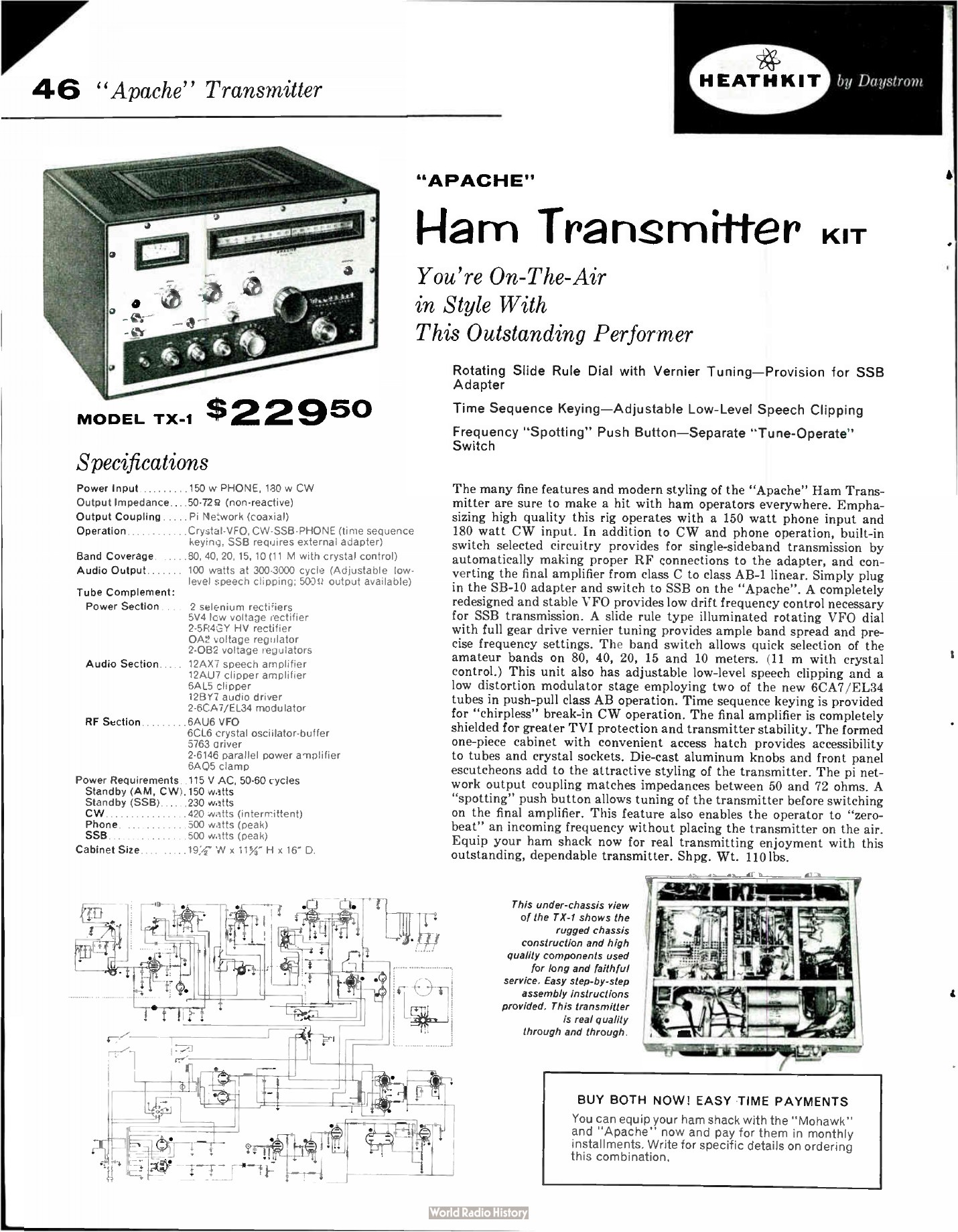
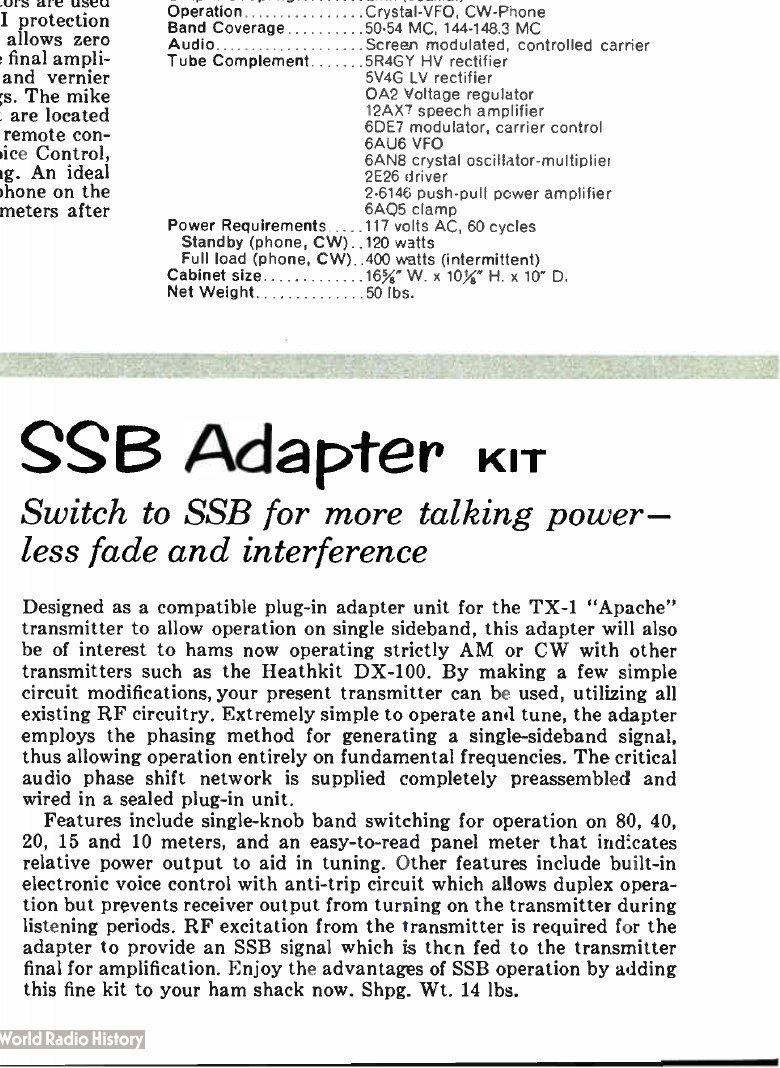
The DX-100B’s successor as Heath’s flagship was the TX-1 “Apache” of 1959, at $229.50, with a matching RX-1 “Mohawk” receiver at $274.95. The Apache is a restyled and re-engineered machine rather than a warmed-over DX-100: a slide-rule rotating dial with vernier drive, time-sequence keying for chirp-free break-in, adjustable low-level speech clipping, EL34 modulators, and - the point of it - factory wiring for the SB-10 sideband adapter, with the final switching from class C to class AB1 linear at the flick of the mode switch (1959 catalogue, pp. 46-47).
The line that runs DX-100 to SB-301/SB-401 in popular retellings is loose. The DX-100’s direct successor is the Apache; the SB series of 1964 is a clean-sheet single-sideband system, and the SB-301 and SB-401 are revisions of it. What the DX-100 did hand on to the SB line was commercial: the money and the reputation that made a Collins-class Heathkit thinkable.
Sources
- Heathkit mid-winter 1955 flyer, p. 3 (the launch announcement). World Radio History
- Heathkit 1956 catalogue, pp. 38-39. World Radio History
- Heathkit Summer 1956 flyer, p. 14, and Christmas 1956 flyer. Summer · Christmas
- Heathkit 1958 catalogue, pp. 48-49. World Radio History
- Heathkit 1959 catalogue, pp. 44-47. World Radio History
- Heathkit May 1961 catalogue. World Radio History
- Assembling and Using Your Heathkit Transmitter Model DX-100 (assembly manual). DLARC scan, Internet Archive
- Assembly and Operation of the Heathkit Transmitter Model DX-100B, 596-213, copyright 1958, dated 3/15/58. Internet Archive
- Assembly and Operation of the Heathkit Transmitter Model DX-100U, Daystrom Limited, Gloucester. VMARS manuals archive
- Bob Eckweiler, AF6C, “Heath DX-100 HF AM/CW Transmitter”, Heathkit of the Month #8, OCARC, 2008. w6ze.org
- Ken Brueschke and Michael Mack, “The History of the Heath Companies”, AWA Review 32 (2019). Internet Archive
- Heathkit Virtual Museum, DX-100 and DX-100-B pages. DX-100 · DX-100-B
- Mark Bell, K3MSB, DX-100B restoration pages. k3msb.com
Comments (0)