HERO 1 (ET-18) · Volume 1
Overview — The Heathkit Educational Robot
1.1 What it is
The HERO 1 is a self-contained, mobile educational robot introduced by the Heath
Company in 1982. Its name is an acronym — Heathkit Educational RObot —
and that name states its purpose plainly: the machine was built to teach robotics,
not to perform useful work. An onboard Motorola 6808 microprocessor drives the
whole platform, which carries a sonar ranging sensor, light, sound, and motion
detectors, an optional manipulator arm, and an optional speech synthesizer, all
programmed from a hexadecimal keypad set into the top of its head (Wikipedia,
“HERO (robot)”; hero.dsavage.net HERO FAQ).
Heathkit sold the HERO 1 in the two forms that defined the company: as a solder-it-yourself kit (ET-18) and as a factory-assembled robot (ETW-18). Heath’s catalogue lists “Kit ET-18, Basic HERO 1 Robot (less arm, voice)” at $999.95 and “ETW-18, Complete Assembled Robot (with arm, voice)” at $2,499.95, with a third package, the complete kit with arm and voice (ETS-18), at $1,499.85 (Heathkit catalogue No. 862, Fall 1983, p. 30). Some secondary sources, including the HERO FAQ, give the two numbers the other way round; the catalogue numbering is used throughout this dive. Building the kit was itself part of the education — the buyer assembled the drive train, the sensor boards, and the microprocessor system, then learned to program the result (ET-18 Assembly Manual, in the factory manual set).
The robot’s place in Heath’s wider robot line — the catalogues, the prices, the courses and the successors — is told in the Robots History.
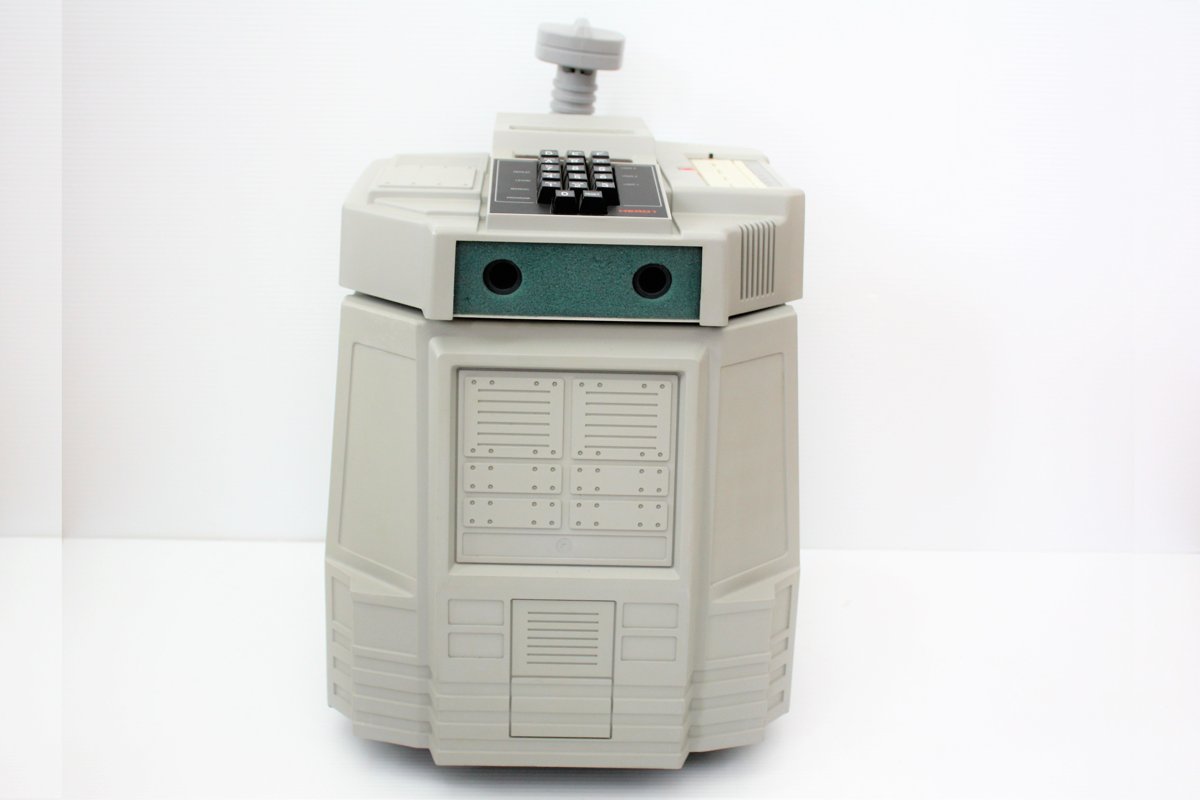
The robot stands 20 inches tall, measures 18 inches in diameter, and weighs about 39 pounds with its accessories fitted (HERO FAQ; theoldrobots.com). It rolls on three wheels — two fixed at the rear and one steerable drive wheel at the front — and runs from an internal pack of four gel-cell rechargeable batteries replenished by an included 120/240 VAC charger (HERO FAQ). A head that rotates through 350° aims the sensor cluster and the arm, giving a stationary HERO 1 a near-complete view of its surroundings without moving its base (HERO FAQ; Wikipedia).
1.2 Headline facts
Table 1 — Headline facts
| Attribute | Value | Source |
|---|---|---|
| Full name | HERO 1 — Heathkit Educational RObot | HERO FAQ; Wikipedia |
| Model numbers | ET-18 (kit, less arm and voice), ETS-18 (kit with arm and voice), ETW-18 (assembled, with arm and voice) | Heathkit catalogue, Fall 1983, p. 30 |
| Project start / launch | October 1979 (unverified) / 1 December 1982; first catalogued Winter 1983 | Wikipedia; Robots History |
| Launch price | $999.95 basic kit / $1,499.85 complete kit / $2,499.95 assembled | Heathkit catalogue, Fall 1983, p. 30 |
| Units sold | ~14,000 over ~8 years (unverified; no Heath figure found) | Wikipedia |
| Line supported until | 1995 | Wikipedia |
| CPU | Motorola 6808, 8-bit, 1 MHz | Wikipedia; HERO FAQ; makezine.com |
| RAM | 4 KB (two 6116 static-RAM chips) | HERO FAQ; catalogue (“4K of RAM”) |
| ROM | 8 KB (“An 8K ROM stores a number of built-in commands and speeches”), occupying E000–FFFF | Heathkit catalogue, Fall 1983, p. 30; HERO FAQ |
| Drive | Three wheels; two fixed rear, one steerable front drive wheel (DC motors) | HERO FAQ |
| Motion control | Seven stepper motors plus the DC drive | HERO FAQ |
| Head | Rotates 350° | HERO FAQ; Wikipedia |
| Sonar | 4 inches to 8 feet | Wikipedia; HERO FAQ |
| Light detector | Visible spectrum into the infrared | Wikipedia; HERO FAQ |
| Sound detector | 300–5000 Hz per Heath’s catalogue (200–5000 Hz per Wikipedia and the HERO FAQ) | Heathkit catalogue, Fall 1983, p. 30; Wikipedia; HERO FAQ |
| Motion detector | Up to 15 feet | Wikipedia; HERO FAQ |
| Arm (optional, ET-18-1) | 5 axes + gripper, ≈16 oz lift | HERO FAQ |
| Speech (optional, ET-18-2) | Votrax SC-01 phoneme synthesizer | Wikipedia; HERO FAQ |
| Power | Four gel-cell batteries; 120/240 VAC charger | HERO FAQ; theoldrobots.com |
| Dimensions / weight | 20” high × 18” dia, ~39 lb with accessories | HERO FAQ; theoldrobots.com |
A note on the ROM. Wikipedia describes the HERO 1’s firmware as a 2 KB monitor ROM. Heath’s own catalogue contradicts that: “Hero comes equipped with 4K of RAM memory. An 8K ROM stores a number of built-in commands and speeches” (Heathkit catalogue No. 862, Fall 1983, p. 30), and later catalogues repeat “8K of ROM and 4K bytes of RAM” (Heathkit catalogue, Fall 1984, p. 58). BYTE’s January 1983 review also gives 8K. The 8 KB figure matches the HERO FAQ’s memory map, which places the ROM across the full E000–FFFF window. Throughout this dive the firmware is called “the robot monitor”, and the exhaustive memory map is left to the ET-18 Technical Manual (see Vol. 2).
1.3 The machine in use
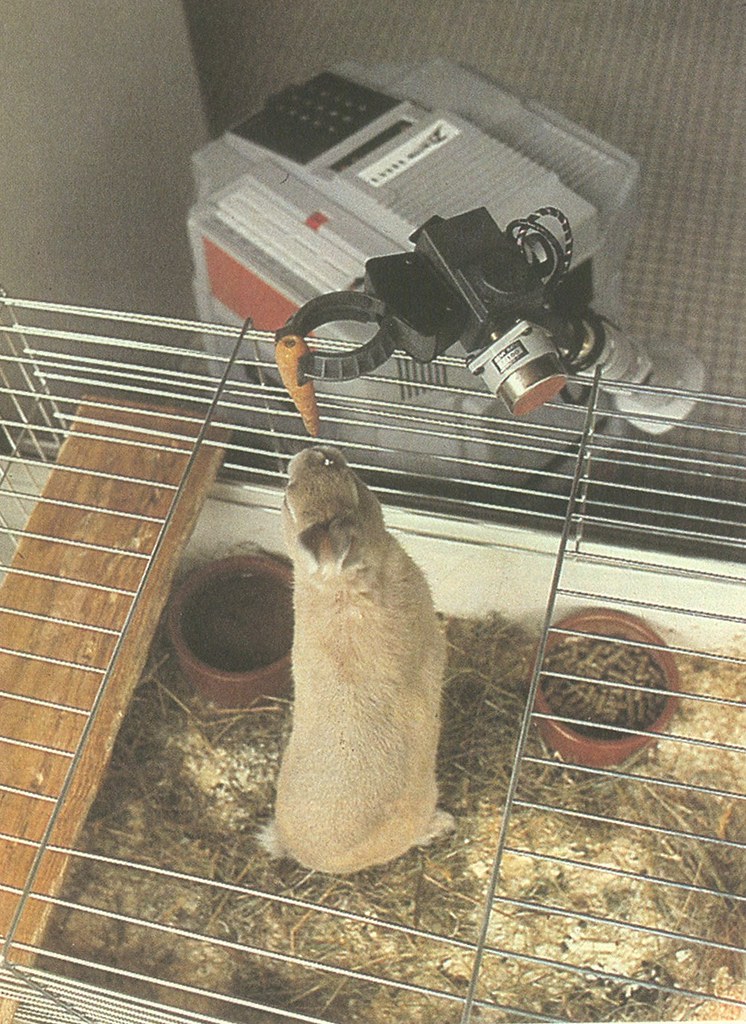
What the HERO 1 actually did — when a program ran — was sense, decide, and act on its small world. The sonar found the range to an obstacle; the light, sound, and motion detectors registered a changing environment; the head turned to aim; the arm, if fitted, reached and gripped; and the Votrax voice, if fitted, announced the result. None of it amounted to practical work, and Heathkit did not pretend otherwise — the robot was marketed to the education and entertainment markets as a platform for learning robotics, circuitry, and the rudiments of artificial intelligence (Wikipedia).
1.4 Where it sat
The HERO 1 arrived at the right moment. By 1982 the 8-bit microprocessor was cheap and well understood, the home-computer boom was underway, and Heathkit — a company whose whole identity was the educational kit — had both the manufacturing base and the instructional-writing tradition to turn a robot into a course of study. The result sold on a scale that few hobby robots ever reached: roughly 14,000 units over its production life, according to Wikipedia; no Heath figure has been found to confirm it. The price was not trivial — $999.95 for the basic kit, $1,499.85 for the complete kit with arm and voice, and $2,499.95 assembled at launch, cut to $799.95, $1,199.85 and $2,199.95 in Spring 1984 (Heathkit catalogue No. 865, Spring 1984, p. 68) — but it bought a complete, documented, expandable robotics laboratory.
The HERO 1 also anchored a family. Heathkit followed it with the HERO Jr, a smaller and simpler home-oriented robot with half the RAM (2 KB), and later the HERO 2000, a far more powerful machine built around an Intel 8088 main processor with multiple microprocessors and RAM expandable to 576 KB (Wikipedia). The HERO 1 was the first and, by the reported unit counts, the most popular of the line, and Heathkit supported HERO robots until 1995 (Wikipedia; HERO FAQ). The Robots History compares the three through the catalogues.
What makes the HERO 1 worth a deep dive is not that it was capable — it was not, by any practical standard — but that it was complete and completely documented. Every subsystem shipped with a manual: assembly, technical reference, the arm, the voice, remote operation, BASIC, and the accessory ROMs (the ET-18 manual set, freely available today). That documentation makes it possible to take the machine apart, layer by layer, with confidence.
The volumes that follow do exactly that. Vol. 2 examines the 6808 hardware architecture and memory; Vol. 3 the three-wheel drive and the seven stepper motors; Vol. 4 the rotating head and the five-axis arm; Vol. 5 the sonar, light, sound, and motion sensing; Vol. 6 the Votrax SC-01 speech; Vol. 7 the four ways to program and command the robot; and Vol. 8 acquiring, restoring, and interfacing a HERO 1 today. Vol. 9 is the cheatsheet — every hard number in one place.
Comments (0)