Television · Volume 3
Solid State and Digital, 1971–1981
In the ten years from 1971 Heath’s television line changed more than in any other decade. The tubes went, apart from the picture tube and the high-voltage rectifier. The chassis broke up into plug-in modules that a failed owner could post back to Benton Harbor. The picture tube changed shape and then changed gun geometry, which ended the convergence ritual that had defined the Heathkit colour set. And in January 1974 the GR-2000 put digital logic into the tuning and wrote the channel number on the screen. It is Heath’s most famous television and has its own dive. This volume follows the whole line of the period, from the first solid-state sets to the projection television Heath introduced as Zenith bought the company.
3.1 The modular solid-state chassis, 1971
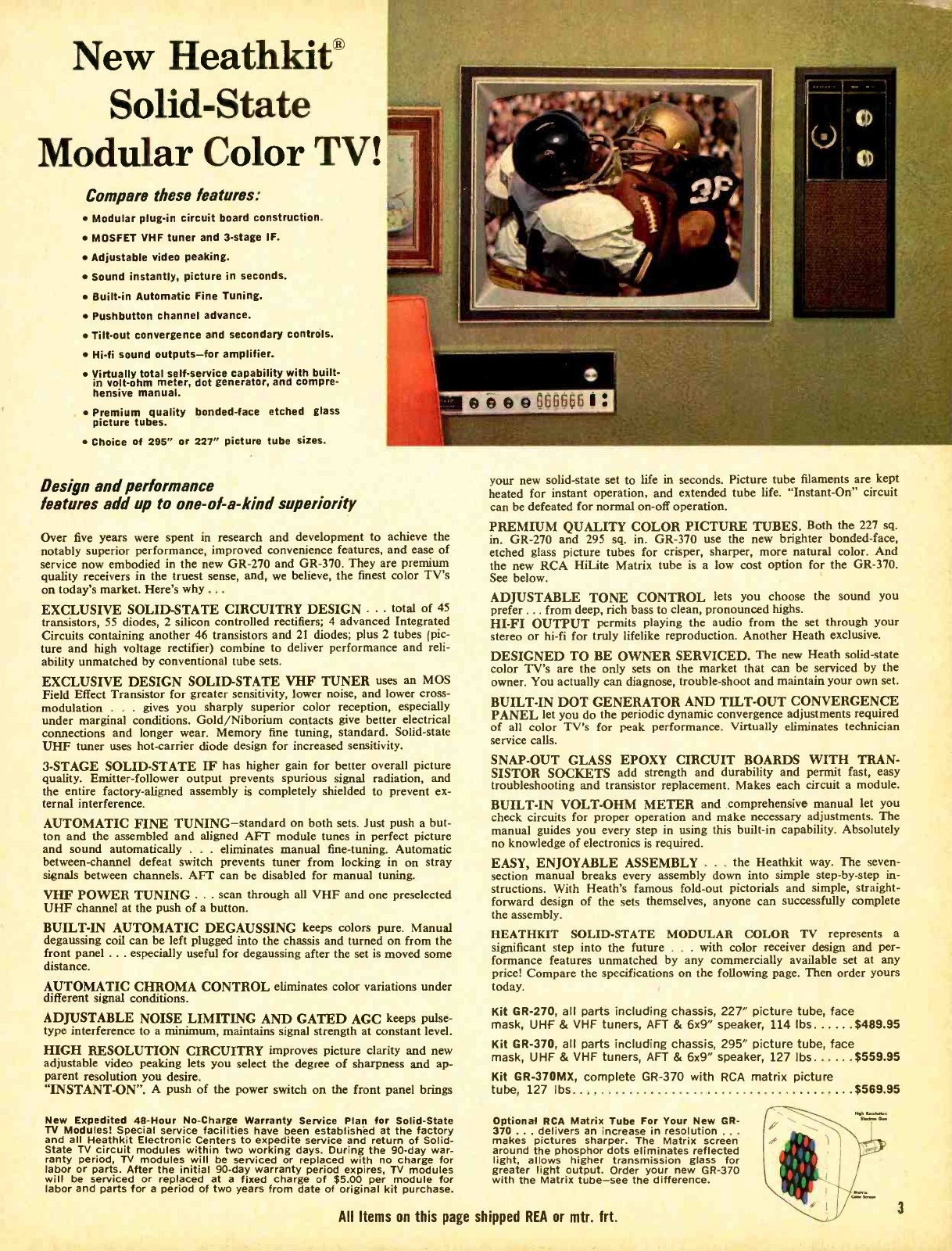
Schlumberger dated Heath’s first solid-state colour sets to 1970. It reported that they came with plug-in circuit boards “to simplify repair” and that “several new solid state color TV models” followed in 1971 (Schlumberger annual reports). The first catalogue found to carry them is the 1971 edition. It introduced two sets on a common chassis: the GR-270 with a 227 sq in (20-inch) tube at $489.95, and the GR-370 with a 295 sq in (23-inch) tube at $559.95. There was also a GR-370MX with RCA’s matrix tube for $569.95.
Heath said that over five years of development had gone into the chassis, and it listed the result in detail: 45 transistors, 55 diodes and 2 silicon-controlled rectifiers, 4 integrated circuits containing another 46 transistors and 21 diodes, and 2 tubes (the picture tube and the high-voltage rectifier). Other features were:
- a MOSFET VHF tuner with gold-alloy contacts and a hot-carrier-diode UHF tuner;
- a shielded, factory-aligned three-stage solid-state i.f.;
- automatic fine tuning as standard;
- VHF power tuning (a pushbutton that scanned the VHF channels and one preselected UHF channel);
- “instant-on”, which kept the picture-tube filaments warm;
- adjustable video peaking;
- a tilt-out convergence panel and a volt-ohm meter supplied with the kit (Heathkit 1971 catalogue, p. 3).
The modules changed how a Heathkit set was serviced. Instead of tracing a fault to a component, the owner could pull a board, and Heath set up an “expedited 48-hour” exchange at the factory and at every Heathkit Electronic Center. Modules were serviced free during the 90-day warranty and for a flat $5.00 each for two years afterwards. The architecture that the GR-2000 later refined, and the exchange service that supported it, are described in the GR-2000 overview.
3.2 The MTX-5 tube and the GR-900
Heath’s January 1972 catalogue (No. 800/28, whose GR-900 copy ends “And have a happy new year”) introduced “another Heathkit ‘first’”: the GR-900, at $599.95 less cabinet. It used Heath’s MTX-5 “ultra-rectangular” black-matrix tube, which Heath called “the largest color picture tube available to the industry”, with a full 25-inch diagonal and 315 sq in of picture. With the change in the FTC rule, a Heathkit “25-inch” set now really measured 25 inches. The GR-900 added a varactor UHF tuner with detent tuning of any twelve preselected UHF channels, an angular tint control and “programmed troubleshooting” charts. A sister set, the GR-371MX at $579.95, used the same tube with a simpler tuner (Heathkit catalogue 800/28, January 1972, pp. 2–5).
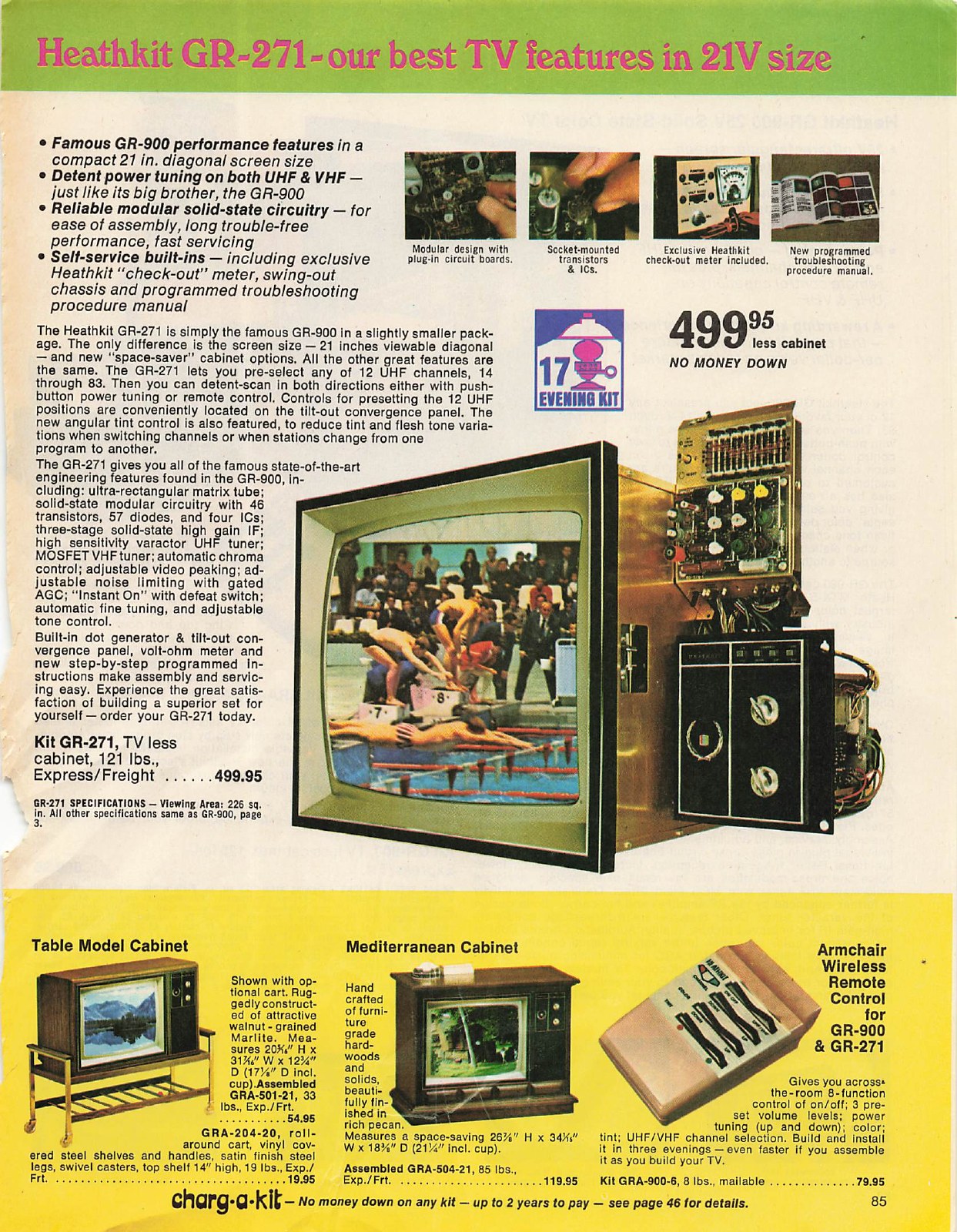
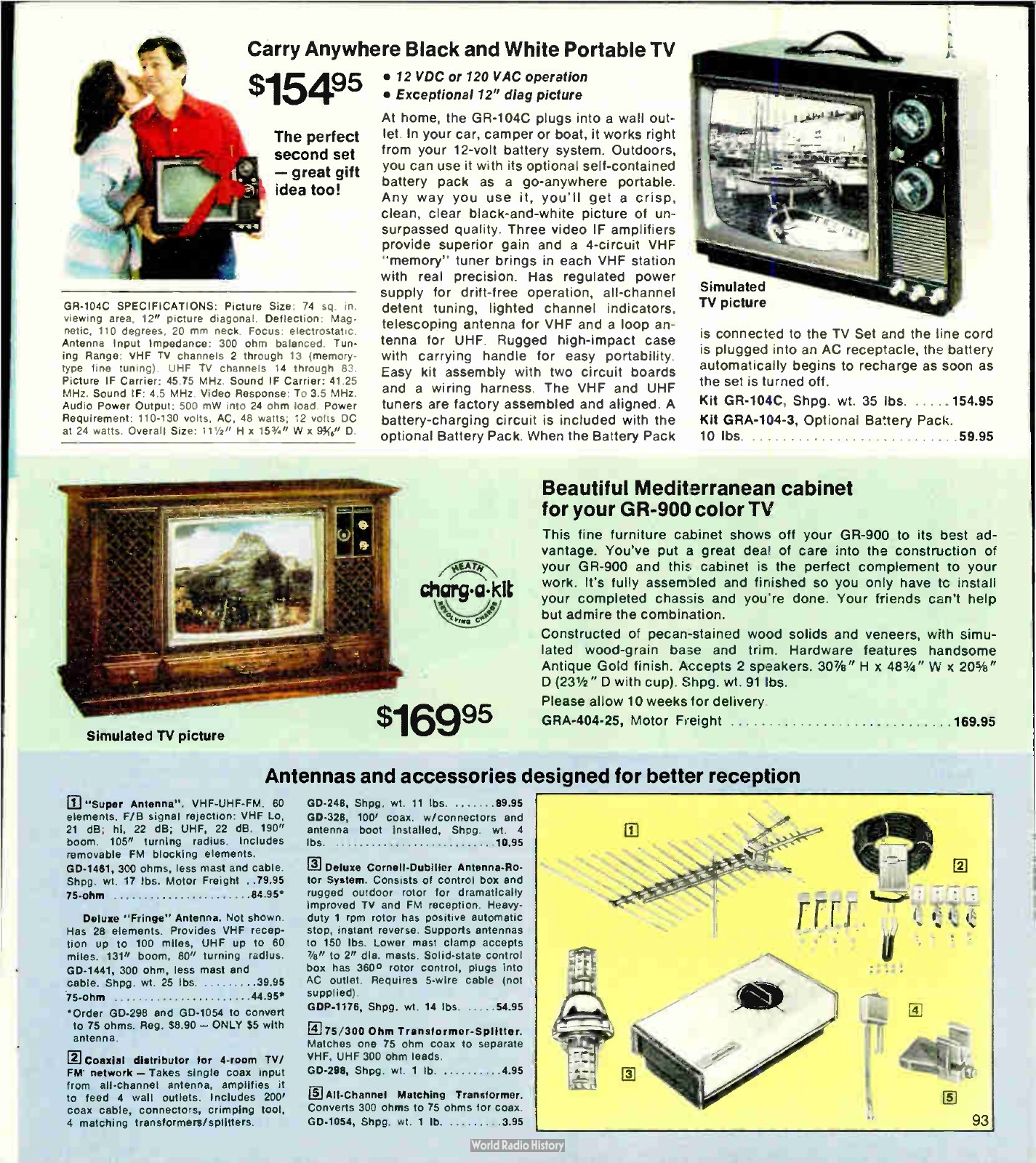
The GR-900 was sold into furniture as elaborate as the set. The GRA-405-25 “electronic hideaway” cabinet ($179.95) had motor-driven doors that opened at the push of a frame-mounted button. A wireless remote control for the set (GRA-900-6) cost $79.95. The set stayed in the catalogue until 1975, when it cost $619.95. A 21-inch version with the same features, the GR-271, appeared in the 1974 catalogue at $499.95 (Heathkit catalogue 810/74, p. 81).
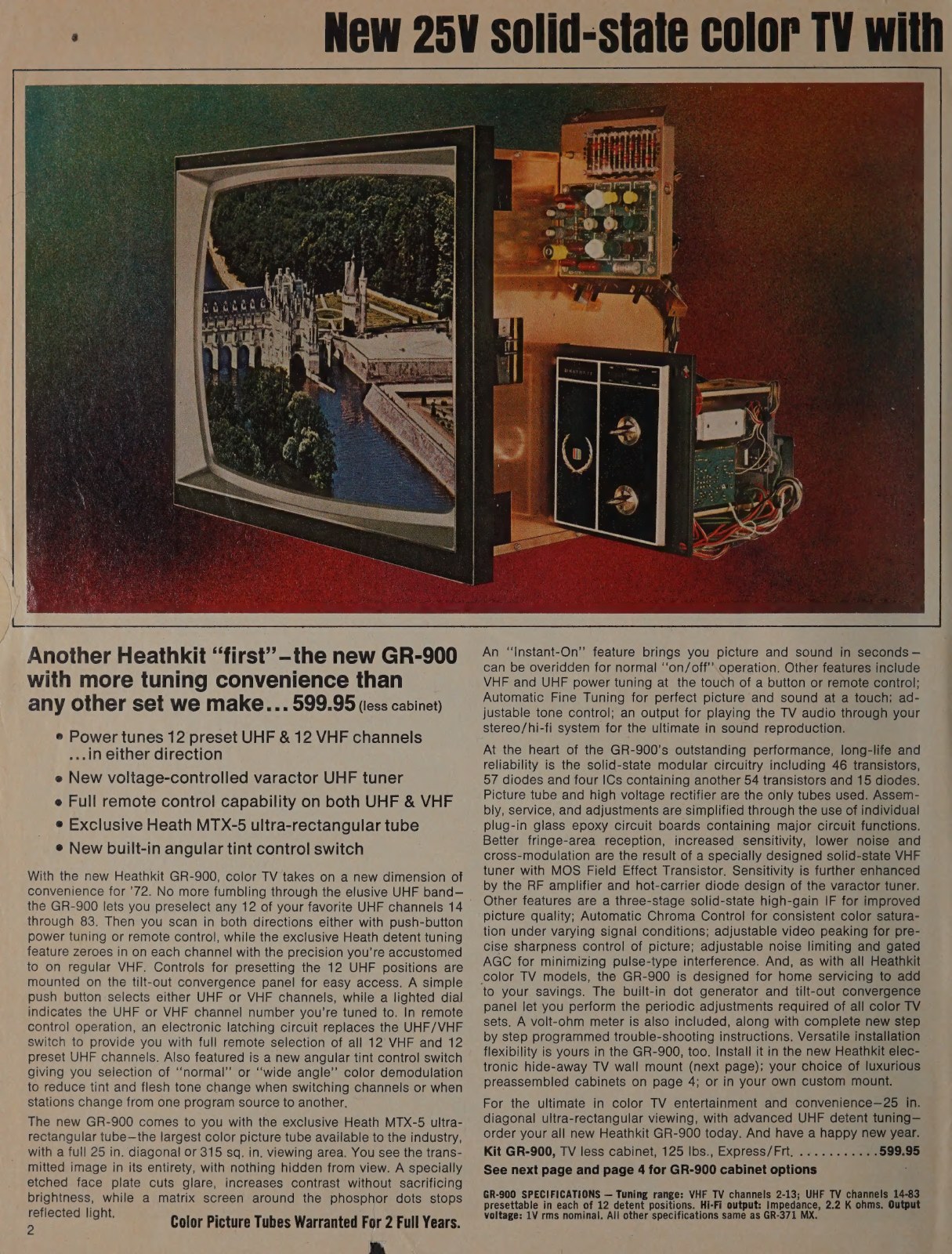
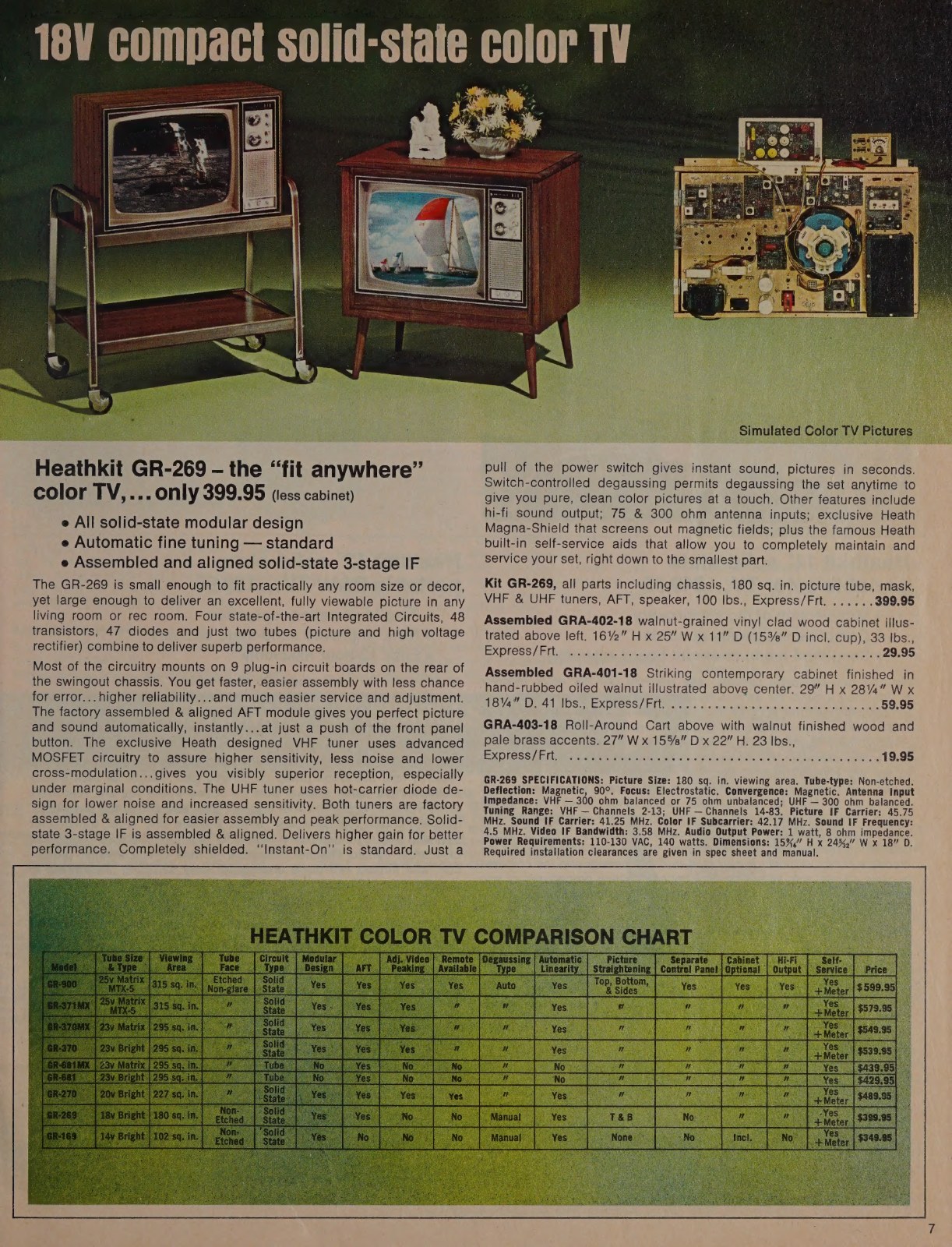
The same catalogue printed a comparison chart of the whole colour line at a moment when tube and solid-state sets were sold side by side. It is the clearest single statement of what each generation added:
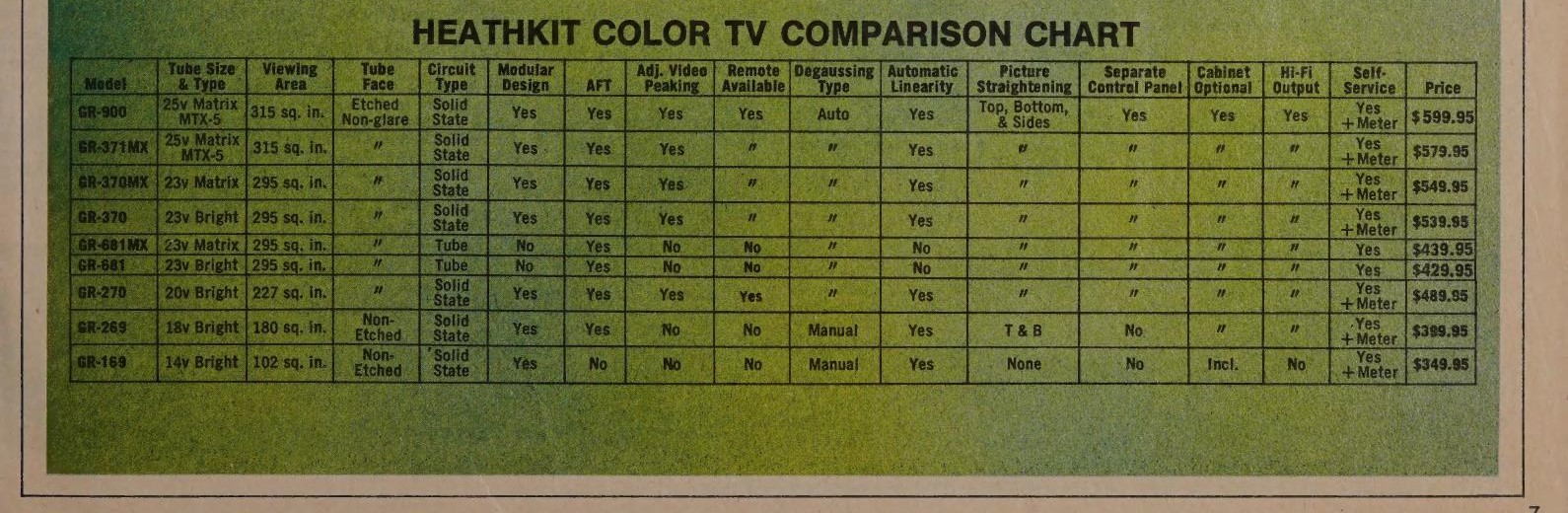
Table 1 — The MTX-5 tube and the GR-900
| Model | Tube | Area | Circuit | Price, Jan. 1972 |
|---|---|---|---|---|
| GR-900 | 25-inch MTX-5 matrix | 315 sq in | solid state | $599.95 |
| GR-371MX | 25-inch MTX-5 matrix | 315 sq in | solid state | $579.95 |
| GR-370MX | 23-inch matrix | 295 sq in | solid state | $549.95 |
| GR-370 | 23-inch “bright” | 295 sq in | solid state | $539.95 |
| GR-681MX | 23-inch matrix | 295 sq in | tube | $439.95 |
| GR-681 | 23-inch “bright” | 295 sq in | tube | $429.95 |
| GR-270 | 20-inch “bright” | 227 sq in | solid state | $489.95 |
| GR-269 | 18-inch | 180 sq in | solid state | $399.95 |
| GR-169 | 14-inch | 102 sq in | solid state | $349.95 |
3.3 Smaller sets and portables
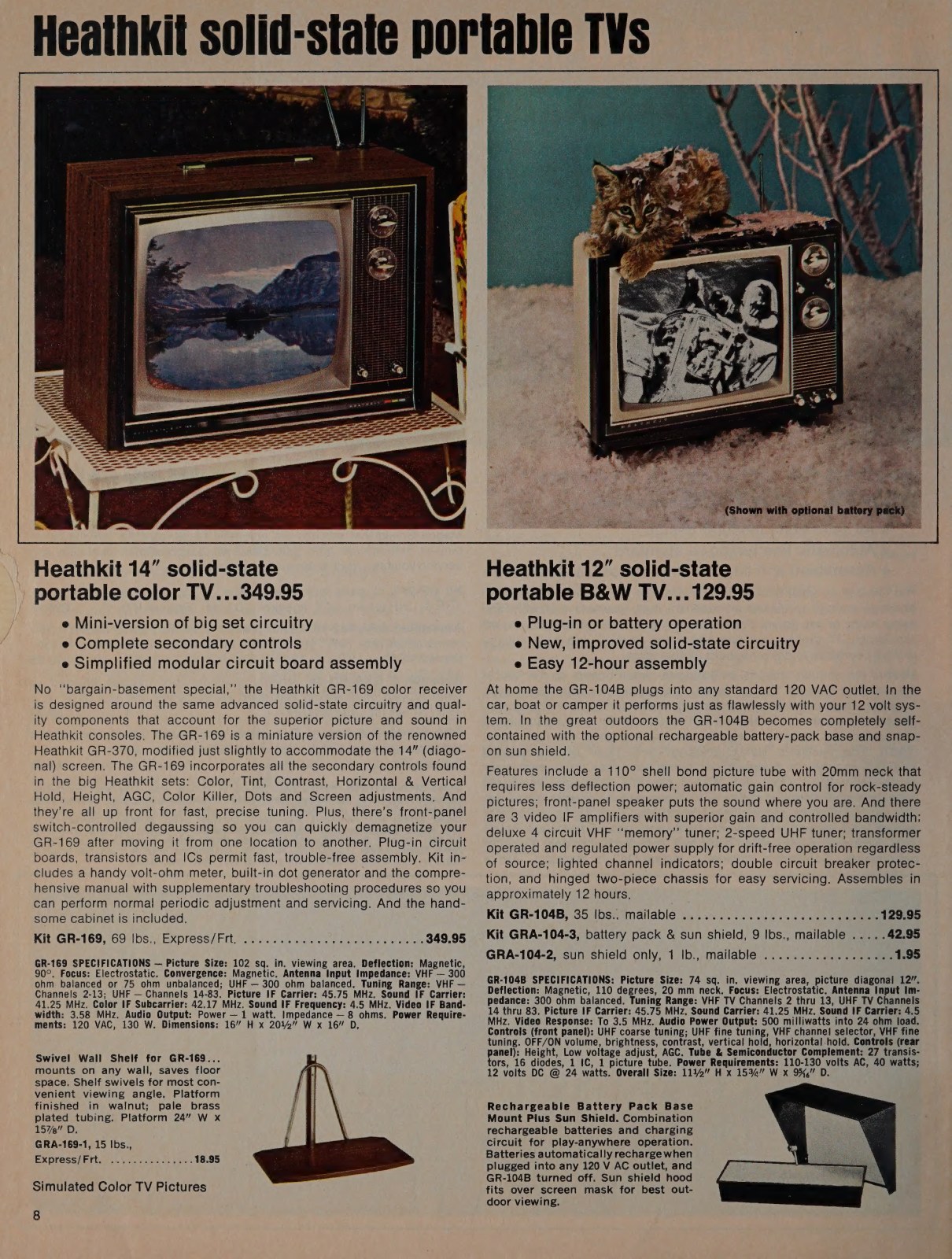
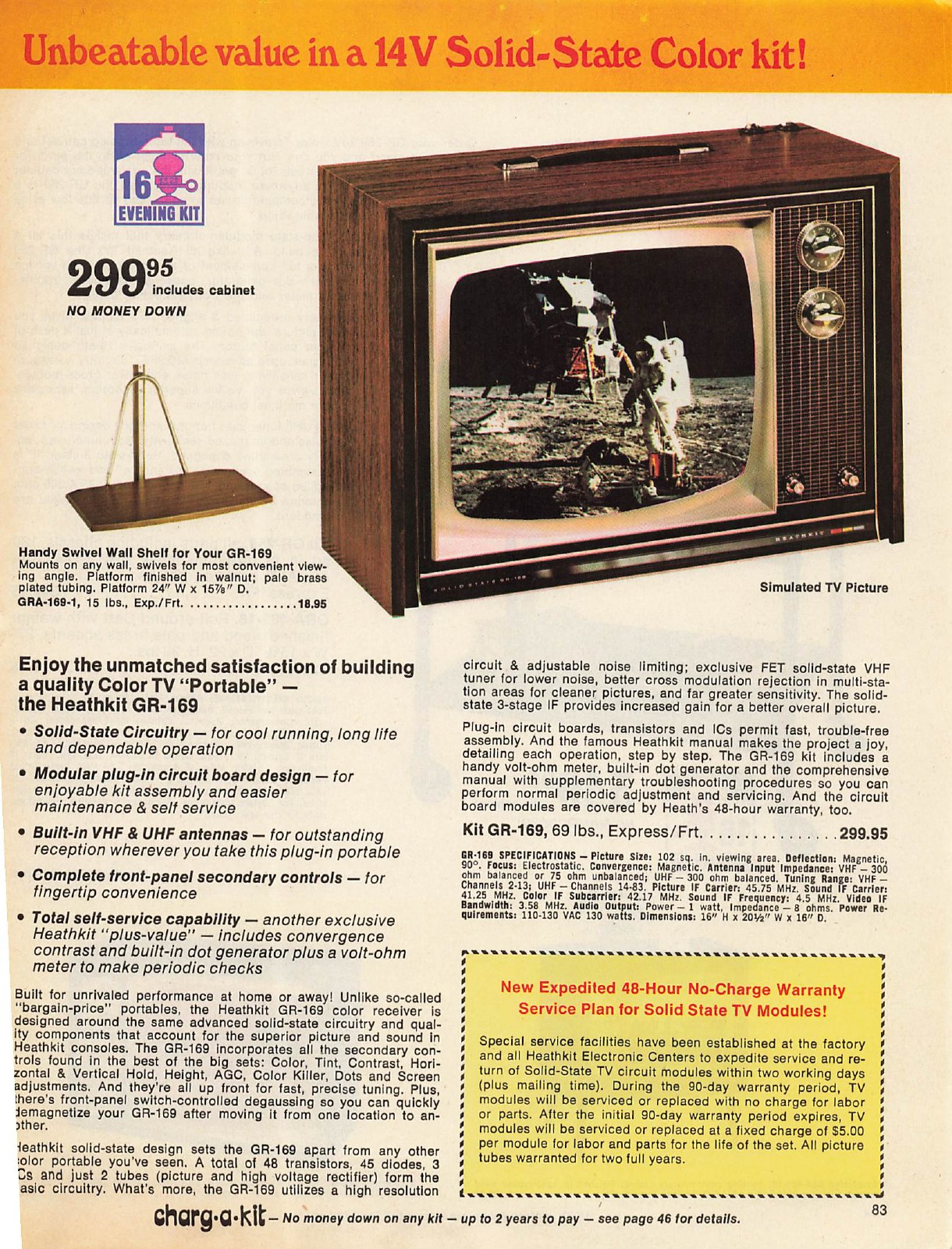
The solid-state chassis also made small colour sets practical. The GR-169 was a 14-inch portable with a carrying handle and its cabinet included. Heath called it a “miniature version of the renowned Heathkit GR-370”, with all the larger set’s secondary controls, and priced it at $349.95 in 1972 and $299.95 in 1974. The GR-269 was an 18-inch “fit anywhere” table set at $399.95 in 1972, later $349.95 (Heathkit catalogue 800/28, pp. 7–8; 810/74, pp. 79–80).
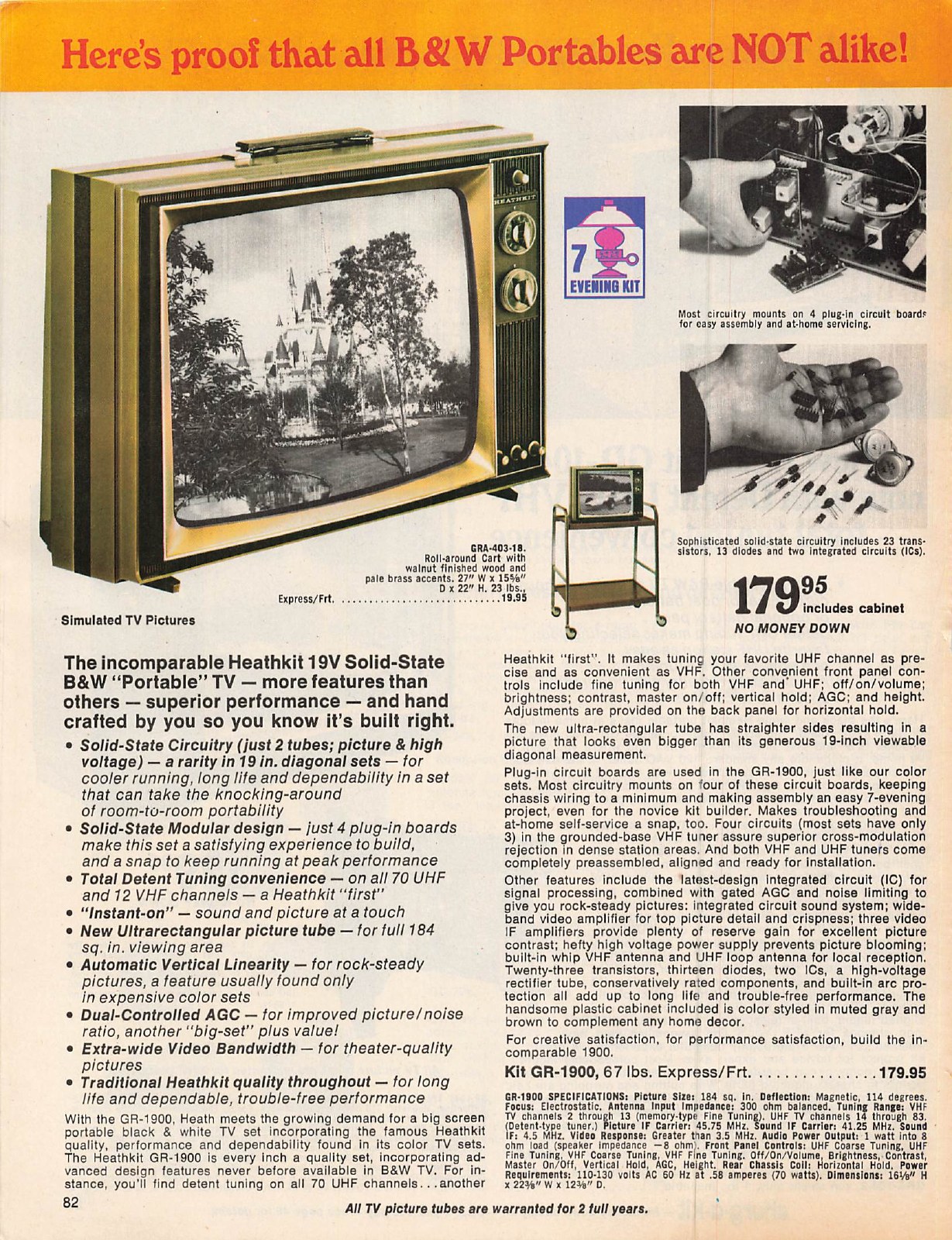
The black-and-white line got one large solid-state set, the GR-1900 of 1974: a 19-inch (184 sq in) “portable” at $179.95. It used the same plug-in board construction as the colour sets, with four boards and “an easy 7-evening” build, and it had detent tuning on all 70 UHF channels as well as the 12 VHF channels, which Heath claimed as a Heathkit first (Heathkit catalogue 810/74, p. 78). It appears only in that catalogue. The 12-inch GR-104 kept the portable market until 1978.
3.4 The GR-2000, in one paragraph
In January 1974 Heath introduced the GR-2000 “Digital Design” colour television at $649.95. It was a 25-inch set with twenty plug-in boards and all-electronic varactor tuning of any sixteen preset channels. The set counted its way through the channels with a four-bit counter and decoder and displayed the channel number on the screen in inch-high digits. An optional clock module and an ultrasonic remote control were available. Its sealed, pre-aligned LC i.f. filter meant the builder never aligned the i.f. strip, and a built-in dot generator and test meter let the owner converge and check the set. Radio-Electronics could find its on-screen channel readout in no other production colour set sold in the United States, and noted that Sharp, Hitachi and Blaupunkt had shown or sold the feature elsewhere. The set stayed in the catalogue until 1981. Its design, build, set-up, restoration and documents are covered in the six-volume GR-2000 dive, which also examines the circulating claims about its sales and patents. One detail not recorded there is that the set was re-issued as the GR-2000A, which the Christmas 1980 catalogue offered at $569.95, reduced from $669.95 (Heathkit Christmas 1980 catalogue, p. 103). No description of what the suffix changed has been found.
3.5 The end of convergence: the GR-300, GR-400 and GR-500
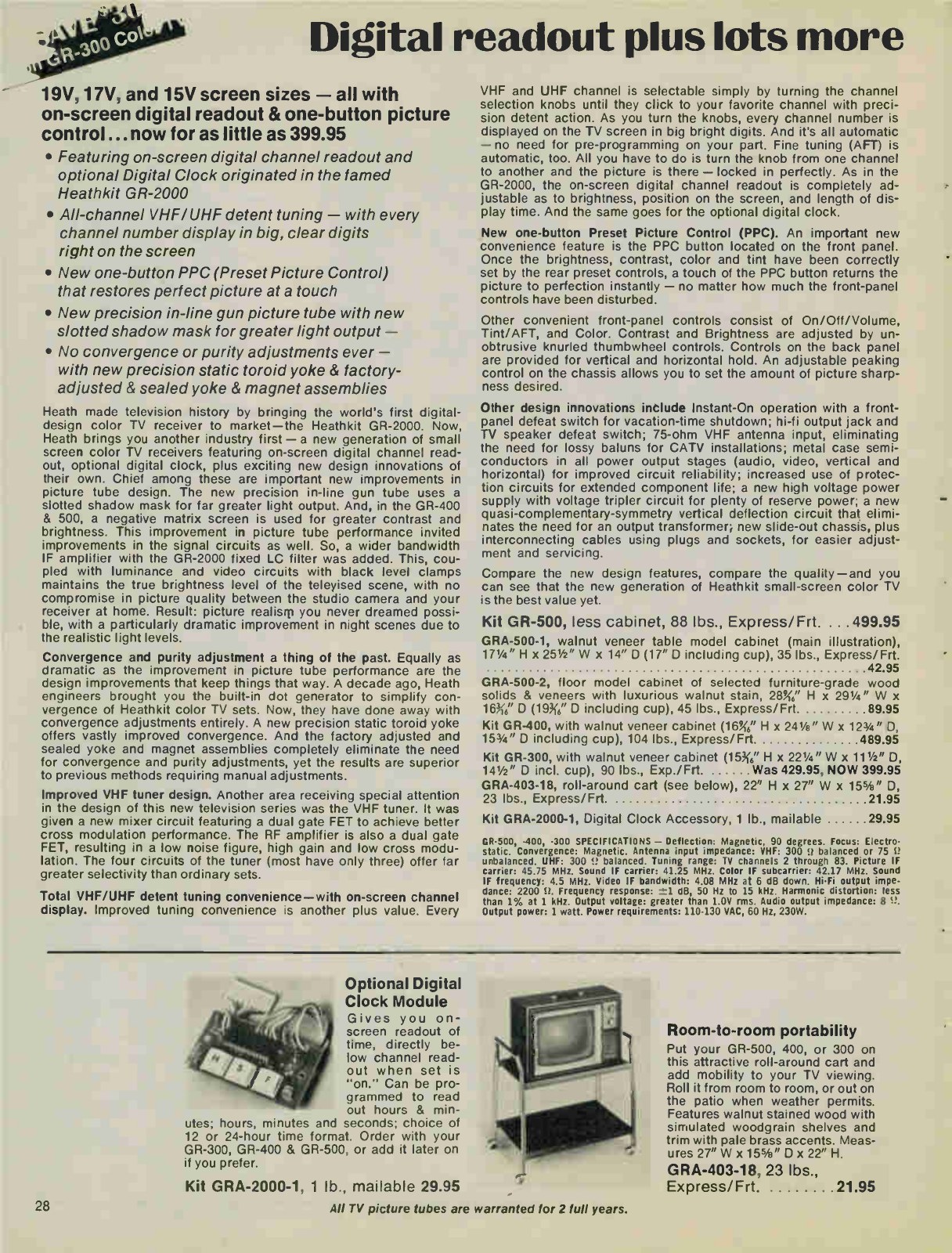
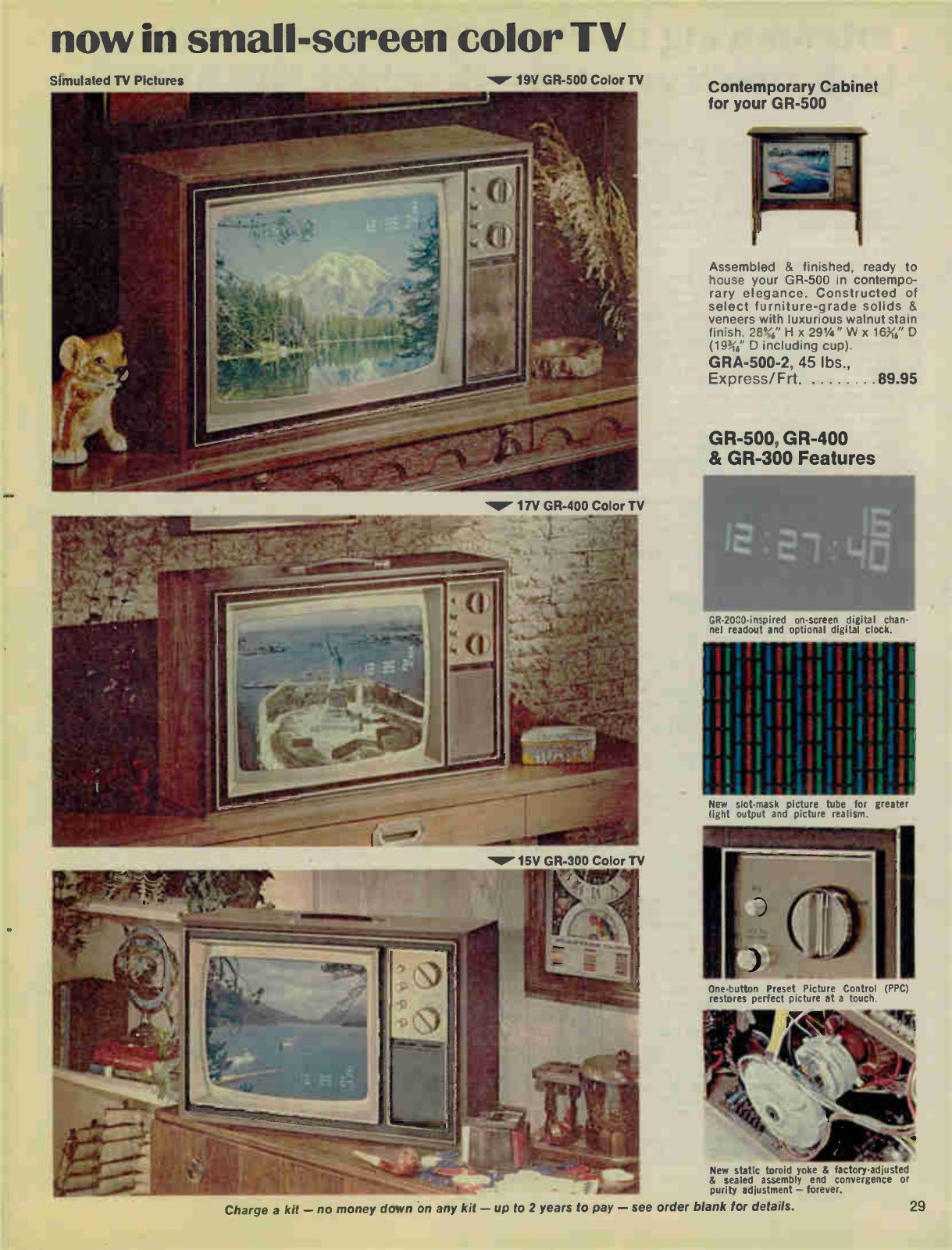
The GR-2000 still had to be converged by its owner, with the dot generator, a mirror and an afternoon of patience. The small-screen sets introduced by Christmas 1975 did away with that. The GR-500 (19-inch, $499.95 less cabinet), GR-400 (17-inch, $489.95 in a walnut-veneer cabinet) and GR-300 (15-inch, reduced to $399.95) took the GR-2000’s on-screen channel readout and optional clock down to smaller sets. They also used a new kind of picture tube: a “precision in-line gun picture tube with new slotted shadow mask”, with a precision static toroid yoke and factory-adjusted, sealed yoke and magnet assemblies. The result, in Heath’s words:
“A decade ago, Heath engineers brought you the built-in dot generator to simplify convergence of Heathkit color TV sets. Now, they have done away with convergence adjustments entirely.”
(Heathkit Christmas 1975 catalogue, p. 26). The in-line gun was an industry-wide change of the early 1970s. Placing the three guns side by side, instead of in a triangle, let a self-converging yoke keep the three pictures together without dynamic convergence controls. For Heath it removed the one job that had made a colour kit harder than any other kit. The sets also had the GR-2000’s fixed LC i.f. filter, black-level clamping, dual-gate FET tuners, detent tuning of every VHF and UHF channel with the number shown on screen, and a one-button “Preset Picture Control” that restored the owner’s preferred picture settings.
The GR-400 stayed on sale at $449.95 until 1979, and the GR-500 at $499.95 until Winter 1981, which makes it one of the longest-lived sets of the solid-state era.
3.6 The GR-2000 family
The digital chassis became a family, with details in the GR-2000 overview:
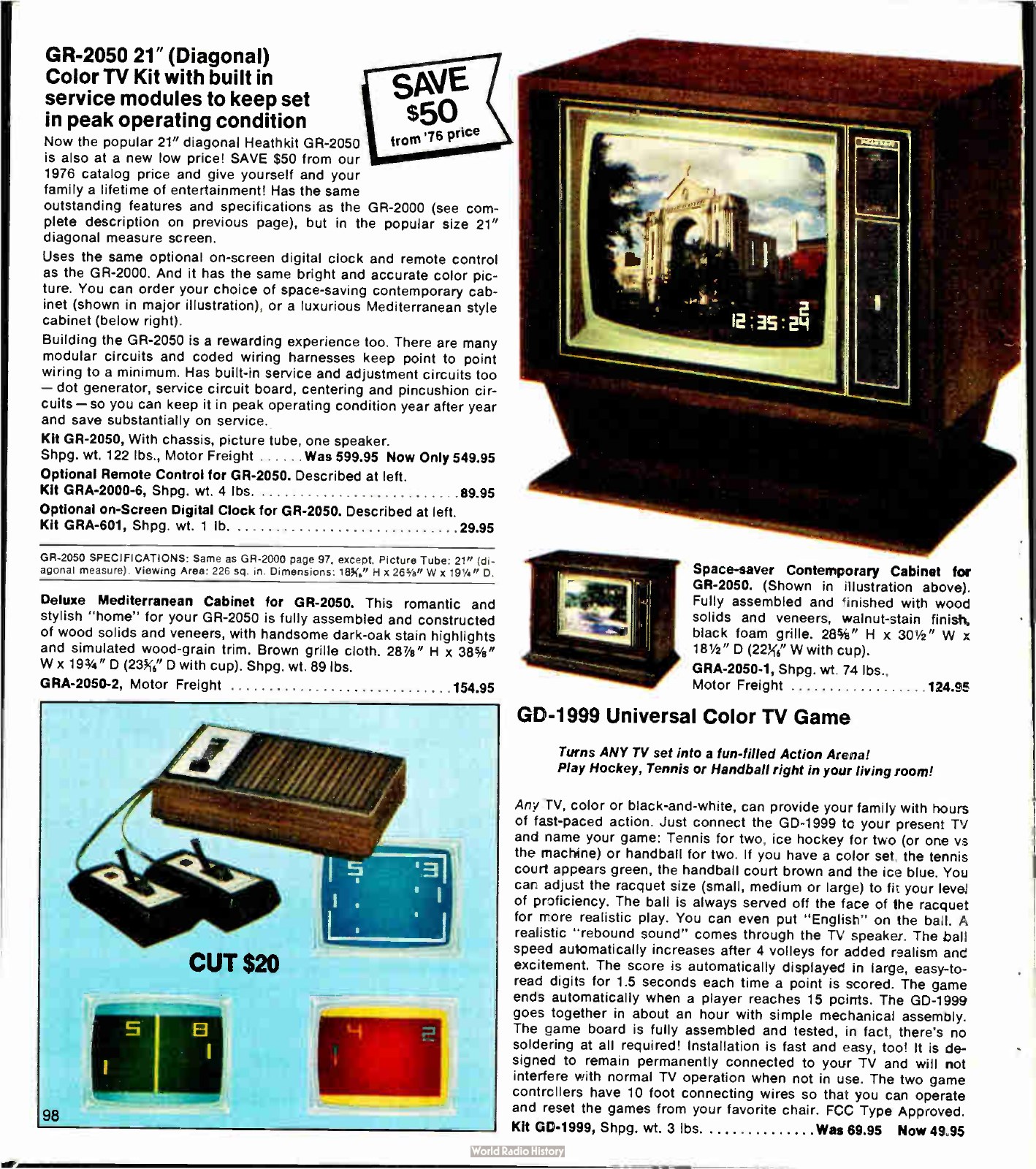
- GR-2050 (Christmas 1975, $599.95). The GR-2000’s design in a 21-inch set, which the Winter 1981–82 catalogue described as offered “at the lowest selling price for a Heathkit TV”. It was still offered in Christmas 1981 at $549.95.
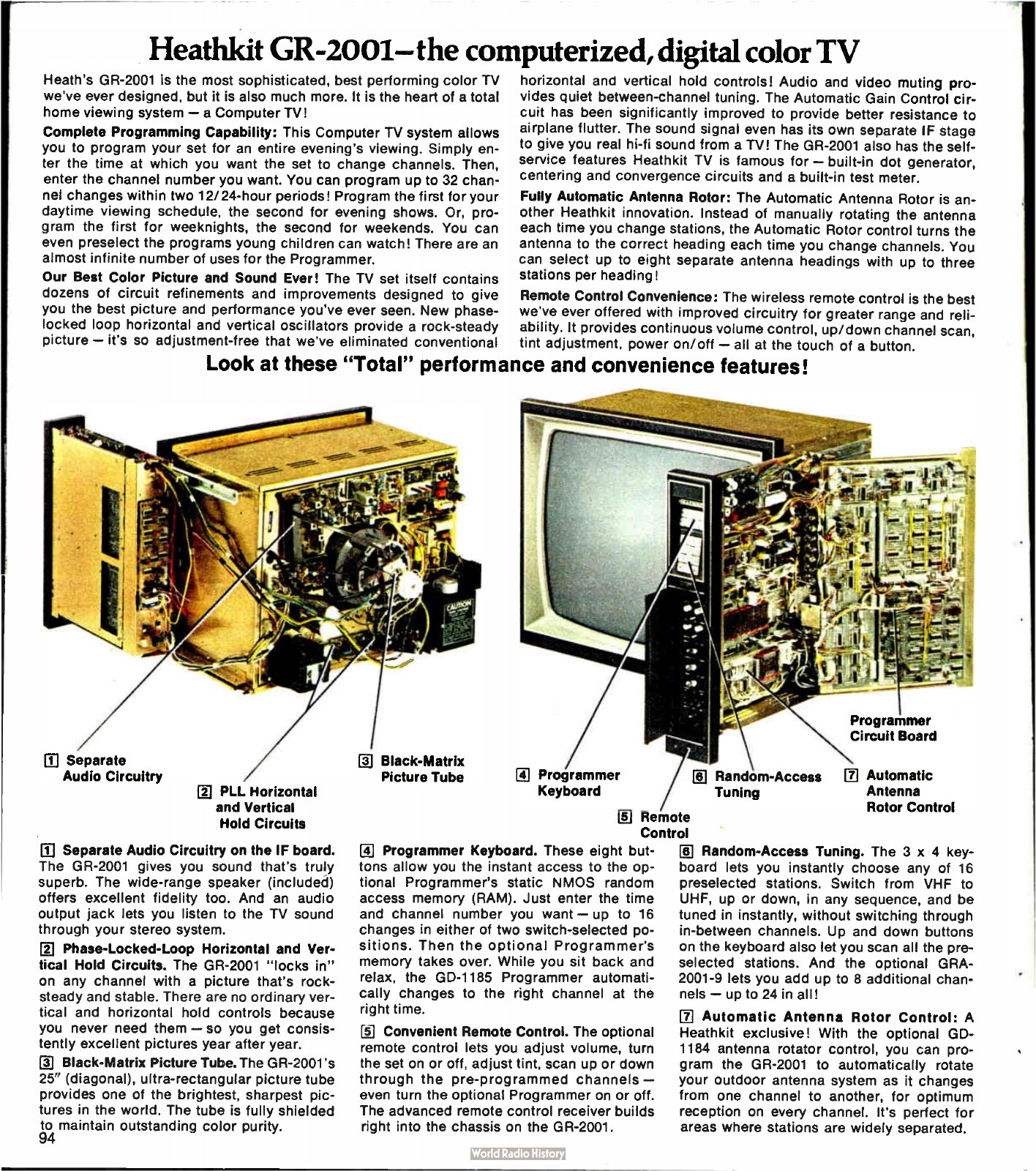
- GR-2001 (1976; first catalogue found Fall 1977 at $699.95). Heath called it “the computerized, digital color TV”. It added phase-locked-loop horizontal and vertical oscillators, which removed the hold controls, a keyboard for random-access tuning, a separate sound i.f. and hi-fi audio. Two accessories made it the first television Heath could call a system. The GD-1185 programmer ($169.95) switched the set to chosen channels at chosen times, up to 32 channel changes across two 12- or 24-hour periods, using a static NMOS memory. The GD-1184 automatic antenna rotor control ($59.95) turned the aerial to the right heading each time the channel changed (Heathkit Fall 1977 catalogue, pp. 94–95). The GR-2001 stayed until Christmas 1982, cut from $769.95 to $699.95.
3.7 Games and video
The mid-1970s also brought the first things to plug into a television besides an aerial. Schlumberger’s 1976 report recorded that a TV game kit had achieved “the highest [unit sales] ever recorded by Heath during a three month period” (company history, volume 4). That was the GD-1999 universal colour TV game, which worked with any set. The GR-2000 dive gives its launch price as $69.95. The Fall 1977 catalogue promised that it “turns ANY TV set into a fun-filled Action Arena!” with hockey, tennis and handball, and a few months later it was being cleared at $24.95 (Heathkit Fall 1977 catalogue, p. 98; Winter 1978, p. 10). From $69.95 to $24.95 took about eighteen months, as ball-and-paddle games became cheap everywhere.
The same pages show Heath reselling other makers’ video products well before Zenith owned it. The Fall 1977 catalogue offered a “Heath-recommended” Sony Betamax video recorder, and Christmas 1978 a Sanyo black-and-white surveillance camera and monitor. A television kit was no longer the only way Heath put video into a living room.
3.8 The Screen Star projection set, 1979
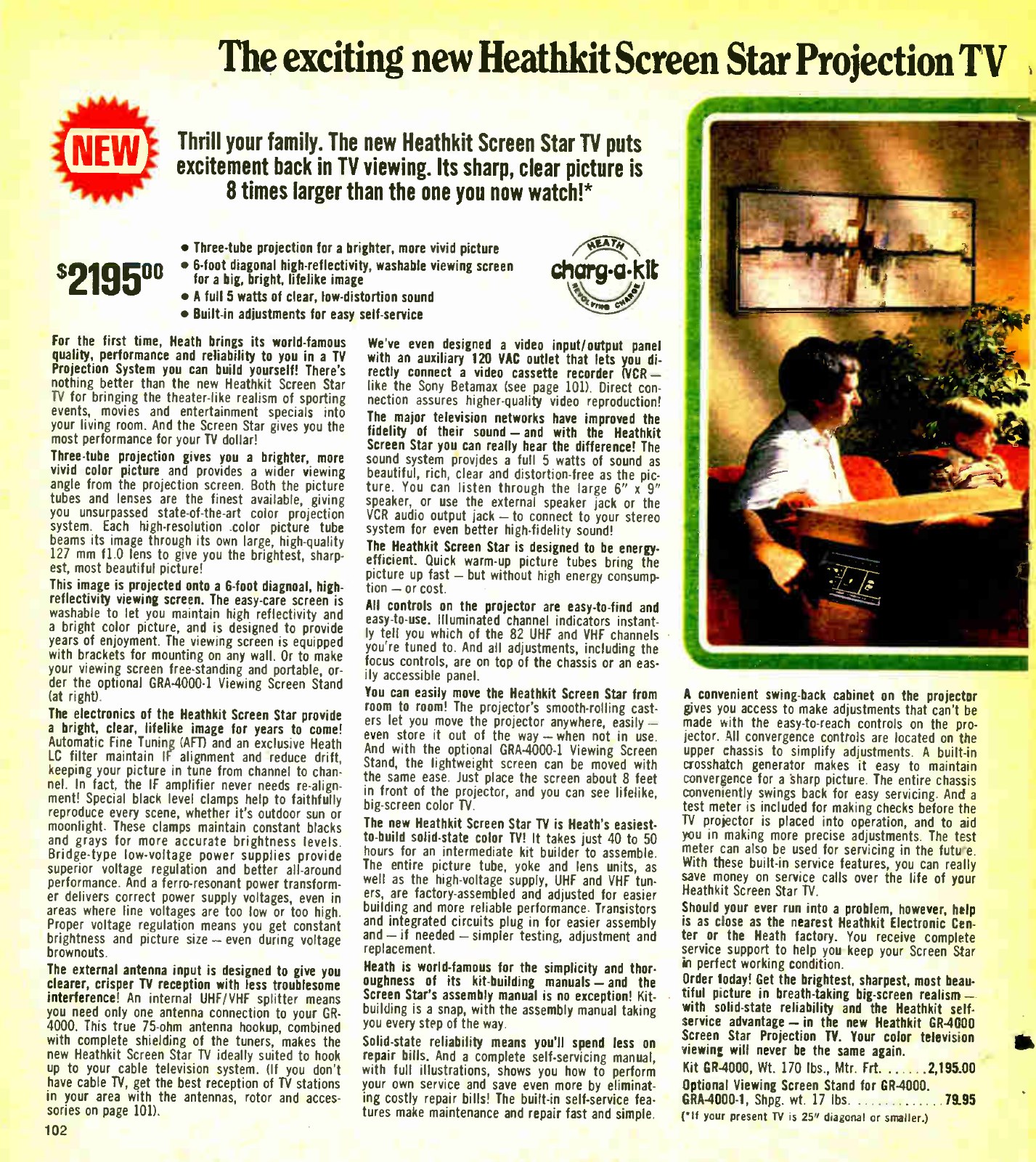
The last television Heath designed before the Zenith purchase was also its most expensive. The GR-4000 “Screen Star” projection television was introduced in the Christmas 1979 catalogue at $2,195. It was a three-tube projector on casters with 127 mm f/1.0 lenses, throwing a picture onto a separate 6-foot-diagonal high-reflectivity screen about 98 inches away. Heath claimed its picture was “8 times larger than the one you now watch”, and that the set rivalled units “costing $3000.00 or more” (Heathkit Christmas 1979 catalogue, pp. 104–105).
It kept the Heath formula. The projection tubes, yoke, lens unit, high-voltage supply and tuners came factory-assembled and adjusted, making it, Heath said, its “easiest-to-build color TV”. It also kept the exclusive LC i.f. filter and a built-in crosshatch generator and test meter for the periodic convergence that a three-tube projector still needed. It also had an input/output panel for connecting a video recorder directly. In his letter in the same catalogue, David Nurse introduced “a major new home entertainment product — projection TV” and, on the same page, told customers that Heath was about to become a subsidiary of Zenith. By Winter 1981–82 the GR-4000 was a “final opportunity … while supplies last” at $1,499 (Heathkit catalogue, Winter 1981–82, p. 100).
3.9 What changed in ten years
The Heathkit colour set of 1981 was a different machine from the set of 1971, and the difference shows in four steps:
- Tubes to transistors (1971). Heat, warm-up and the tube-by-tube failure pattern disappeared, and plug-in modules made fault-finding a matter of swapping boards.
- Round-cornered to square tube (1972). The MTX-5 gave the full 25-inch picture, and Heath’s advertising moved from viewing area back to diagonal size.
- Analogue to digital tuning (1974). Counters, decoders and a character generator replaced the turret tuner and the dial.
- Delta gun to in-line gun (1975). The owner no longer had to converge the set, and the built-in dot generator stopped being the reason to buy a Heathkit.
The fourth step mattered most to the kit business. From the GR-53 to the GR-2000, Heath’s television advertising rested on self-servicing: because the owner built the set, the owner could adjust it. The in-line tube took most of the adjustment away. What remained were the modules, the manual and the pleasure of building, and those were easier for a large manufacturer to match than a built-in dot generator had been. The next volume follows what happened when that manufacturer bought Heath.
Sources
- Heathkit catalogues, World Radio History: 1971, pp. 3–10; 800/28, January 1972, pp. 2–8; 810/74, pp. 78–83; Christmas 1975, pp. 21–27; Fall 1977, pp. 93–99; Winter 1978, p. 10; Christmas 1979, pp. 55, 100–105; Christmas 1980, pp. 102–105; Winter 1981, pp. 29–32; Winter 1981–82, pp. 100–102.
- Schlumberger Limited annual reports, 1970–1976, Internet Archive.
- GR-2000 dive, all volumes.
- Heath Company dive, volume 4.
Comments (0)