Test Equipment · Volume 1
A Surplus Scope and a Service Bench, 1947–1954
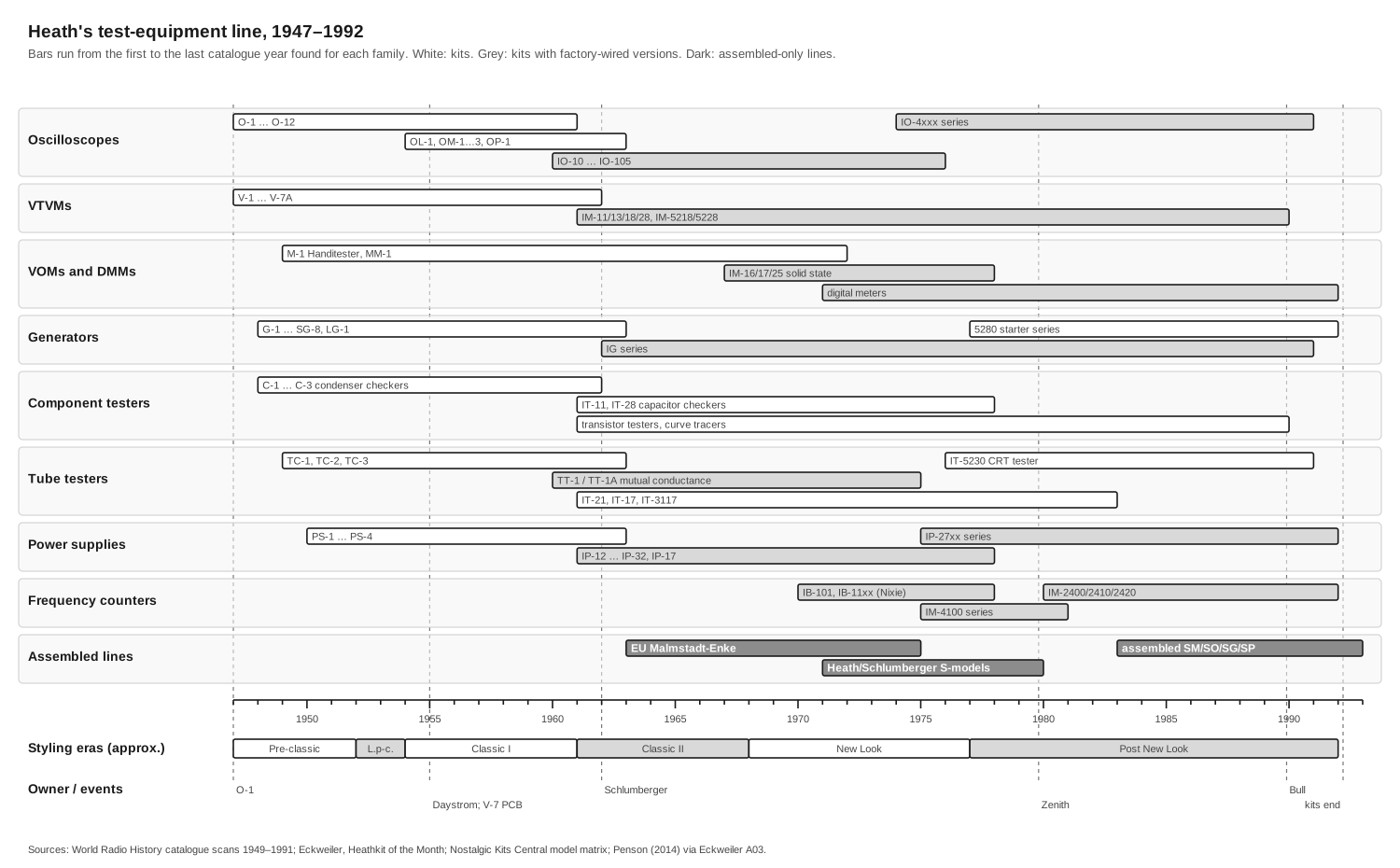
Heath’s electronic business began with a piece of test equipment and, for its first eight years, was mostly test equipment. The O-1 oscilloscope of July 1947 and the V-1 voltmeter that followed it that winter opened a line that ran for forty-five years, through twelve O-series scopes, some twenty vacuum-tube voltmeters, generators, tube checkers, bridges, counters, digital multimeters and curve tracers, and ended only when the company stopped selling kits in 1992. This dive follows that line as a whole: what Heath built for the bench, in what order, at what price, against whom, and why it changed. Individual instruments that already have their own dives are summarised and linked rather than retold, and the company’s own story (Benton Harbor, Daystrom, Schlumberger, Zenith, Bull) is told in the nine-volume history dive.
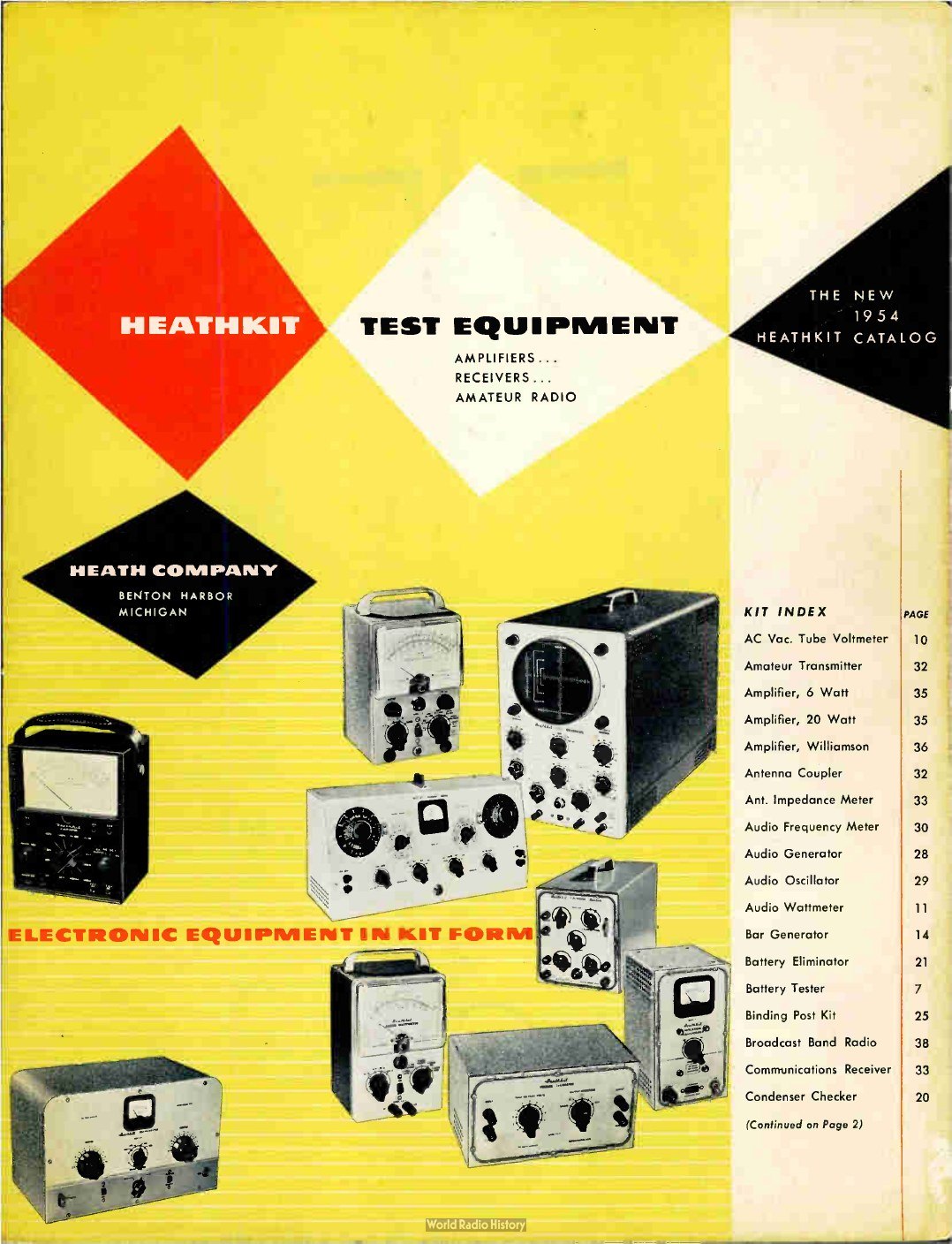
This first volume covers the Anthony years, from the surplus oscilloscope of 1947 to the catalogue of 1954, the last before Howard Anthony’s death and the sale to Daystrom. The next two volumes follow the line through the Daystrom and Schlumberger decades; the fourth covers the Zenith years and the end; the fifth covers collecting and using the instruments today; and the sixth holds the master model table.
1.1 The bench Heath set out to fill
In 1947 an oscilloscope was a laboratory instrument. Tektronix, founded in Portland in 1946, showed its first production scope, the 511, in 1947; Allen DuMont, who made scopes himself, noted that it sold for $795, about twice the price of his own equivalent (Wikipedia, “Tektronix”). The radio serviceman’s bench was built around the multimeter, the tube checker and perhaps a signal generator, bought factory-made from Hickok, Simpson, Triplett, Supreme, Precision or RCA. Television was about to arrive in quantity, and with it a set of repairs, from sweep alignment to peak-to-peak waveform checks, that the multimeter alone could not do.
Howard Anthony had thought about instruments in kit form before the war. His engineer Bjorn Heyning heard that Anthony had suggested the idea to Hickok and been laughed at (Heyning, Heath Stories #5 and #13). What changed his position in 1946 was a warehouse of war surplus, including five-inch 5BP1 cathode-ray tubes, and a Radio News article of October 1946 by Lyman Greenlee showing how to build a five-inch scope from salvage parts for about $35. Brueschke and Mack found the O-1 circuit “nearly identical” to Greenlee’s apart from the power supply. The story of how the surplus arrived, what the O-1 contained and how the first orders came in is told in the history dive’s first volume and is not repeated here.
What matters for this line is the price. The O-1 was advertised in July 1947 at $39.50 complete, one-twentieth of the Tektronix 511. Heath’s October 1947 flyer admitted that “we couldn’t supply it for anywhere near this price if it were not for surplus” (October 1947 flyer). The O-1 was not a Tektronix. It was an instrument a serviceman or a student could own, and that remained the premise of every Heath instrument for thirty years.
1.2 Competitors in kit form
Heath was not alone for long. The Electronic Instrument Company (EICO) of Brooklyn, founded in 1945 by the radio repairman Harry Ashley, sold a factory-built VTVM and signal tracer from July 1946 and brought out its first kit, the 221K vacuum-tube voltmeter, in August 1948. It was priced at $33 and cut to $23.95 within three months, a dollar under Heath’s $24.50, and its advertisements borrowed Heath’s own slogan, “Nothing else to buy.” EICO added an oscilloscope in 1949, a sweep generator and a second scope that December, and a tube tester in 1950. By August 1950 it claimed “over 50,000 servicemen” as customers (Post, “The EICO Story,” supplementary pictures; Wikipedia, “Eico”). Allied Radio’s Knight-Kit line and smaller makers such as Paco and Precise followed.
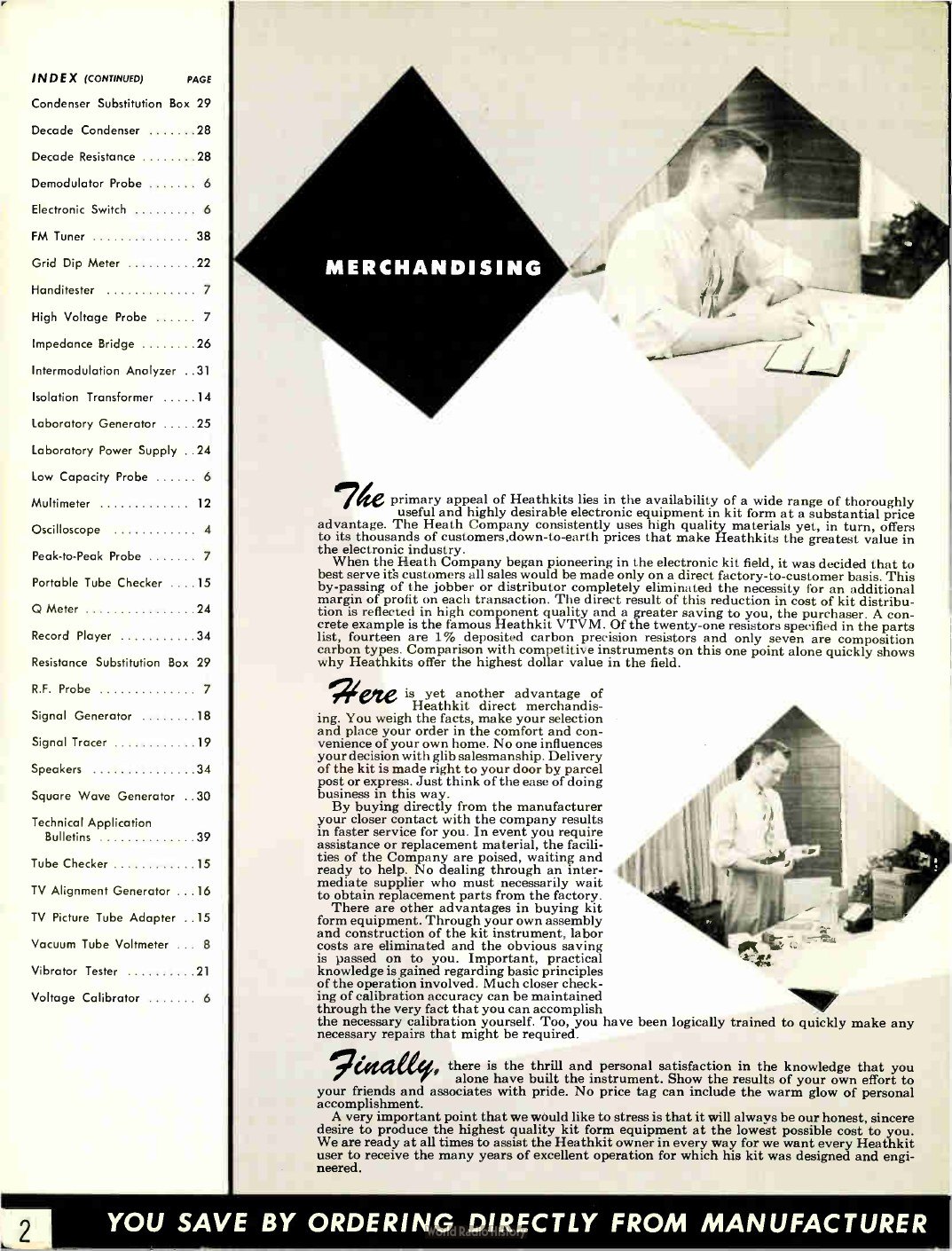
The two companies differed in method. EICO sold through distributors and parts jobbers, and many of its instruments were also sold factory-wired. Heath sold only by mail and only direct: its 1952 catalogue set out “All Sales Direct” as policy, and every page footer read “You save by ordering direct from manufacturer” (1952 catalogue, p. 2). The 1954 catalogue made the same argument with a component count: of the twenty-one resistors in the V-6 voltmeter, fourteen were 1 per cent precision types, and “only seven are composition carbon types” (1954 catalogue, p. 2).
1.3 One kit a month, 1947–1949
Kits followed the oscilloscope at roughly one a month, and most of them were instruments. The history dive tabulates the first two years in full (volume 2); the instrument families that grew out of them are these.
Table 1 — One kit a month, 1947–1949
| Family | First model | First advertised | Price | Line continued as |
|---|---|---|---|---|
| Oscilloscope | O-1 | July 1947 | $39.50 | O-2 … O-12, then IO series |
| Vacuum-tube voltmeter | V-1 | November 1947 | $24.50 | V-2 … V-7A, then IM series |
| RF signal generator | G-1 | January 1948 | $19.50 | G-5, SG-6, SG-7, SG-8, then IG-102 |
| Sine/square audio generator | G-2 | 1948 | $34.50 | AG and IG series |
| TV/FM sweep generator | G-3 | 1948 | $24.50 | TS series, then IG-52 |
| Condenser checker | C-1 | March 1948 | $19.50 | C-2, C-3, then IT-11 |
| Signal tracer | T-1 | March 1948 | $19.50 | T-2 … T-4, then IT-12 |
| Tube checker | TC-1 | February–March 1949 | $29.50 | TC-2, TC-3, then IT-21 |
| Impedance bridge | IB-1 | April 1949 | $69.50 | IB-1B, IB-2, IB-2A, IB-28 |
| Pocket multimeter | M-1 “Handitester” | June 1949 | $13.50 | M-1 into the 1960s |
| Electronic switch | S-1 | August 1949 | $34.50 | S-2, S-3, then ID-22 |
Sources: the Heath flyers of 1947–1949 as tabulated in the history dive, volume 2; Eckweiler #2 (G-2, G-3, S-1, C-1 prices); Eckweiler #130 (TC-1 in Radio News, March 1949).
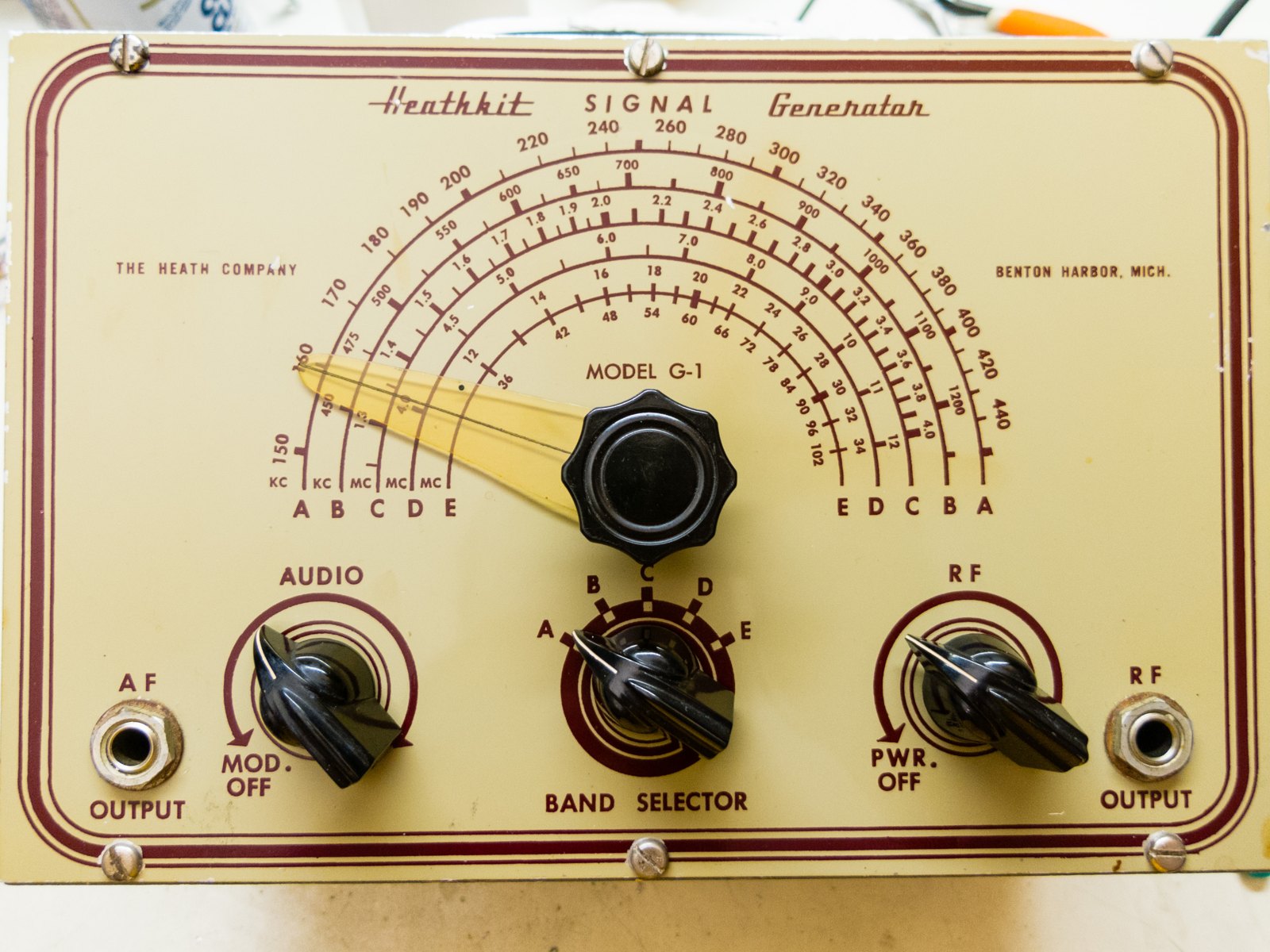
Three people named in the sources shaped these instruments. Bjorn Heyning designed the V-1 and wrote its manual, the first real Heathkit manual; Anthony settled his objection about calibration by telling builders to use the ohmmeter battery as a DC standard and the house mains as an AC one. Joe Miller wound the G-1’s coils so precisely that one trimmer calibrated five bands, and Anthony advertised the generator’s harsh neon-relaxation modulation tone as a feature because it made the signal “easy to find.” Cliff Edwards silk-screened the early panels and drew the pictorials that became the Heathkit manual’s signature (Heyning, Heath Stories #5–7; history dive volume 2).
The calibration argument explains the whole early line. A kit instrument had to be trimmed by a builder who owned no standards, so every Heath design of these years was built around a reference the customer already had: a flashlight cell, the 60-cycle mains, a broadcast station of known frequency. The voltmeter that grew from that argument is covered in the VTVM dive, which follows the V-1 through its successors to the IM-5228 of 1989, the last tube instrument Heath sold.
1.4 The O-series oscilloscopes
The oscilloscope stayed at $39.50 through six models from July 1947 to the summer of 1951 while the circuit under it was rebuilt almost every year. From the O-5 onward Heath released a new scope each September, in time for the autumn flyer and Christmas. Bob Eckweiler’s three-part survey of the series, built from the flyers and Radio News advertisements, gives the dates below (Eckweiler #85, #87, #89).
Table 2 — The O-series oscilloscopes
| Model | Announced | Withdrawn | Price | What changed |
|---|---|---|---|---|
| O-1 | July 1947 | Dec. 1947 | $39.50 | Surplus 5BP1 CRT and transformer; 884 thyratron sweep; 55 lb |
| O-2 | Jan. 1948 | June 1948 | $39.50 | Half the weight; lighter transformer |
| O-3 | July 1948 | Apr. 1949 | $39.50 | Direct deflection-plate and Z-axis inputs |
| O-4 | Apr. 1949 | Sep. 1949 | $39.50 | New electrolytics replace surplus oil capacitors |
| O-5 | Sep. 1949 | Aug. 1950 | $39.50 | Push-pull amplifiers (about ten times the vertical gain); 6SN7 multivibrator sweep; first scope with a step-by-step manual |
| O-6 | Sep. 1950 | Aug. 1951 | $39.50 | Input buffer; 10 tubes |
| O-7 | Sep. 1951 | Aug. 1952 | $43.50 | Cascade vertical amplifier with phase splitter; sensitivity 0.03 V/in |
| O-8 | Sep. 1952 | Aug. 1953 | $59.50 | 5CP1 post-deflection-accelerator CRT |
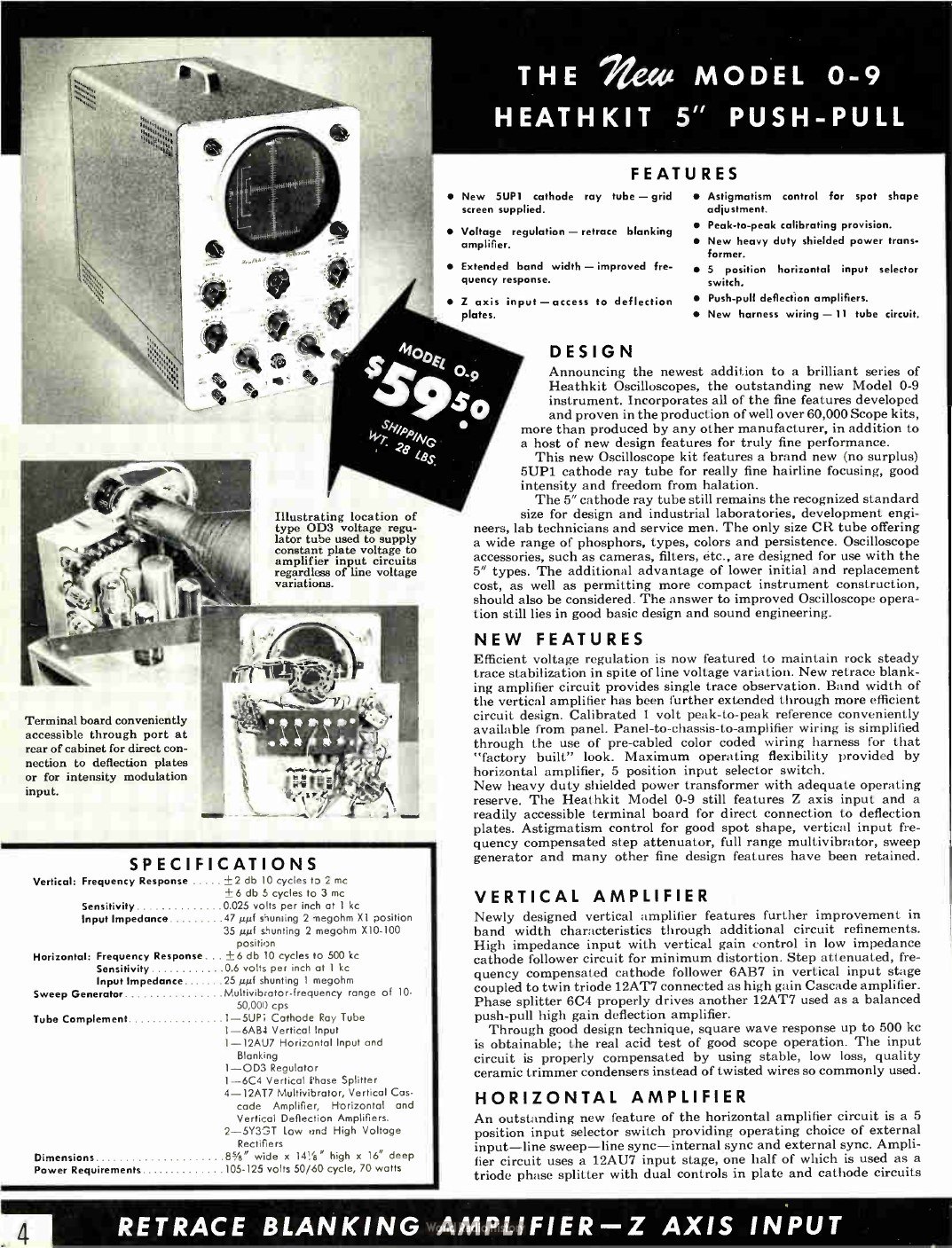
| O-9 | Sep. 1953 | Aug. 1954 | $59.50 | New (not surplus) RCA 5UP1 CRT; OD3 voltage regulation; retrace blanking |
The O-5 was the turning point. Its push-pull deflection amplifiers raised vertical gain about tenfold and, Heath claimed, frequency response fifty-fold, and it came with a modification kit (No. 315, $12.50) so that owners of the O-3 and O-4 could add some of its features (Eckweiler #87). The upgrade kit became a Heath habit: the VTVM line had one too.
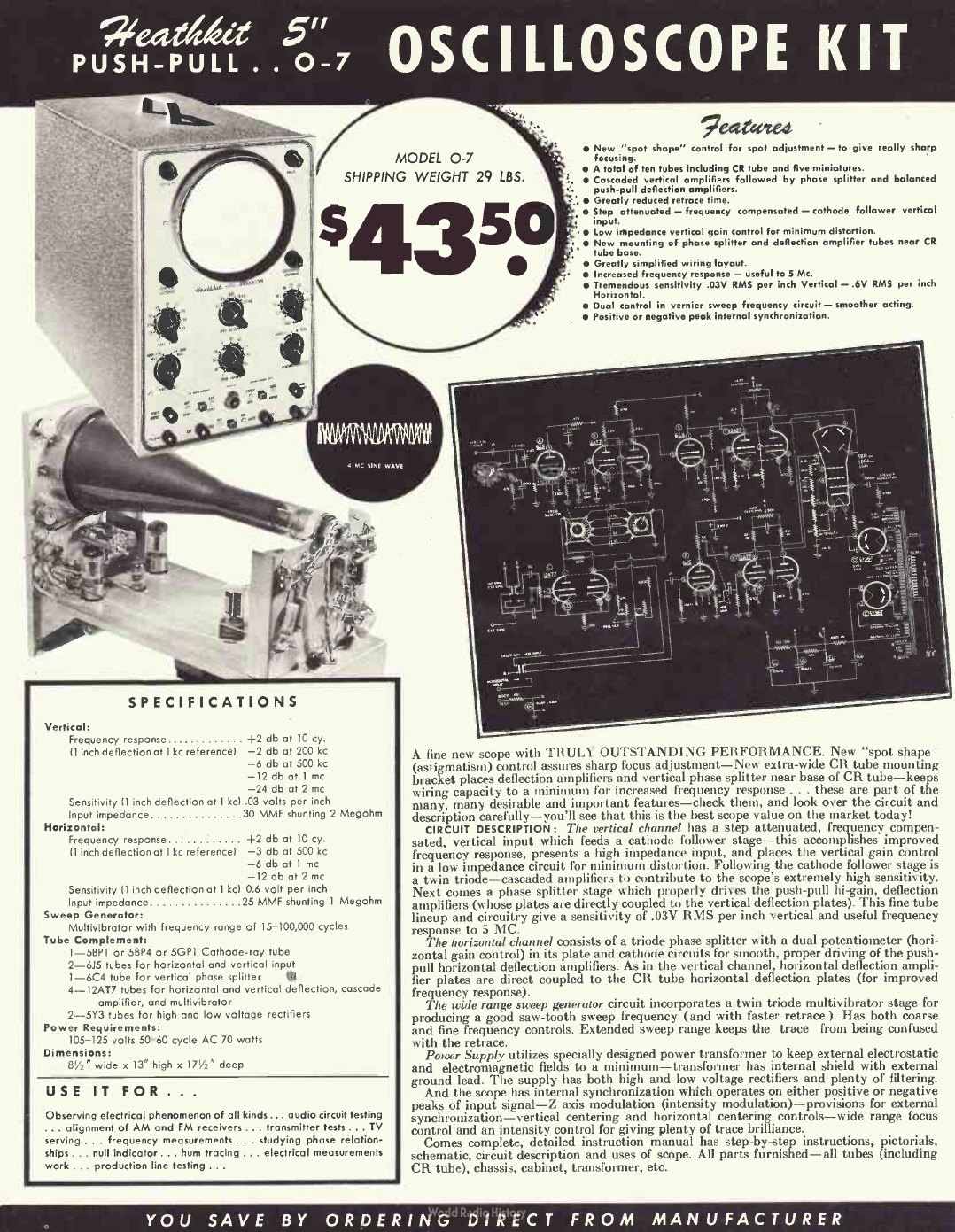
By 1953 the surplus that had made the O-1 possible was no longer the point. The O-9’s advertising stressed that its 5UP1 tube was “a brand new (no surplus)” RCA type, and its page in the 1954 catalogue made the claim on which Heath’s instrument reputation rested: the scope incorporated the features “developed and proven in the production of well over 60,000 Scope kits, more than produced by any other manufacturer” (1954 catalogue, p. 4). Rich Post’s later figure of “nearly 100,000” scopes by 1954 is unsourced; Heath’s own 60,000, printed in 1954, is the better number (Post, “The Heathkit Legacy”).
1.5 Testers for the service trade
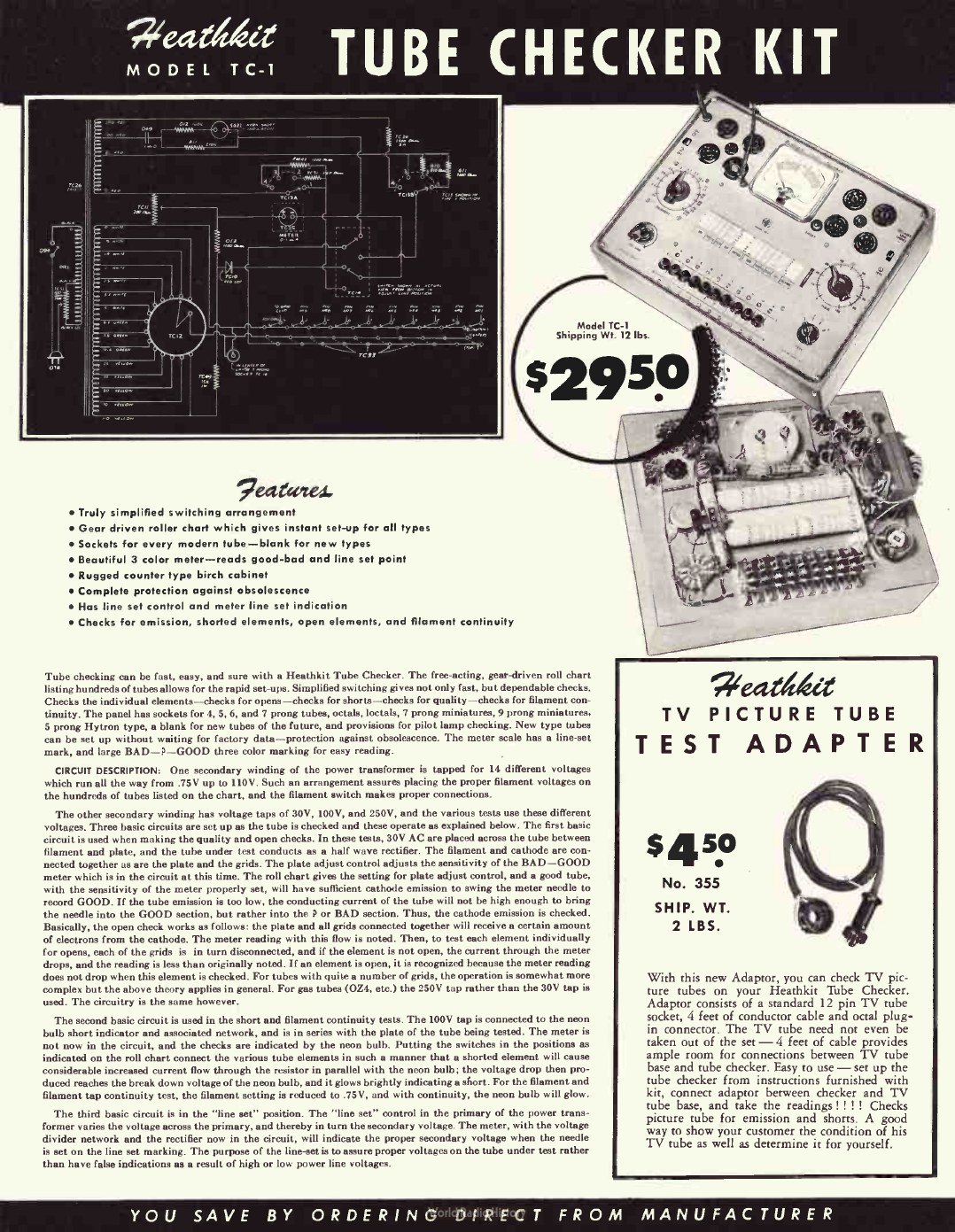
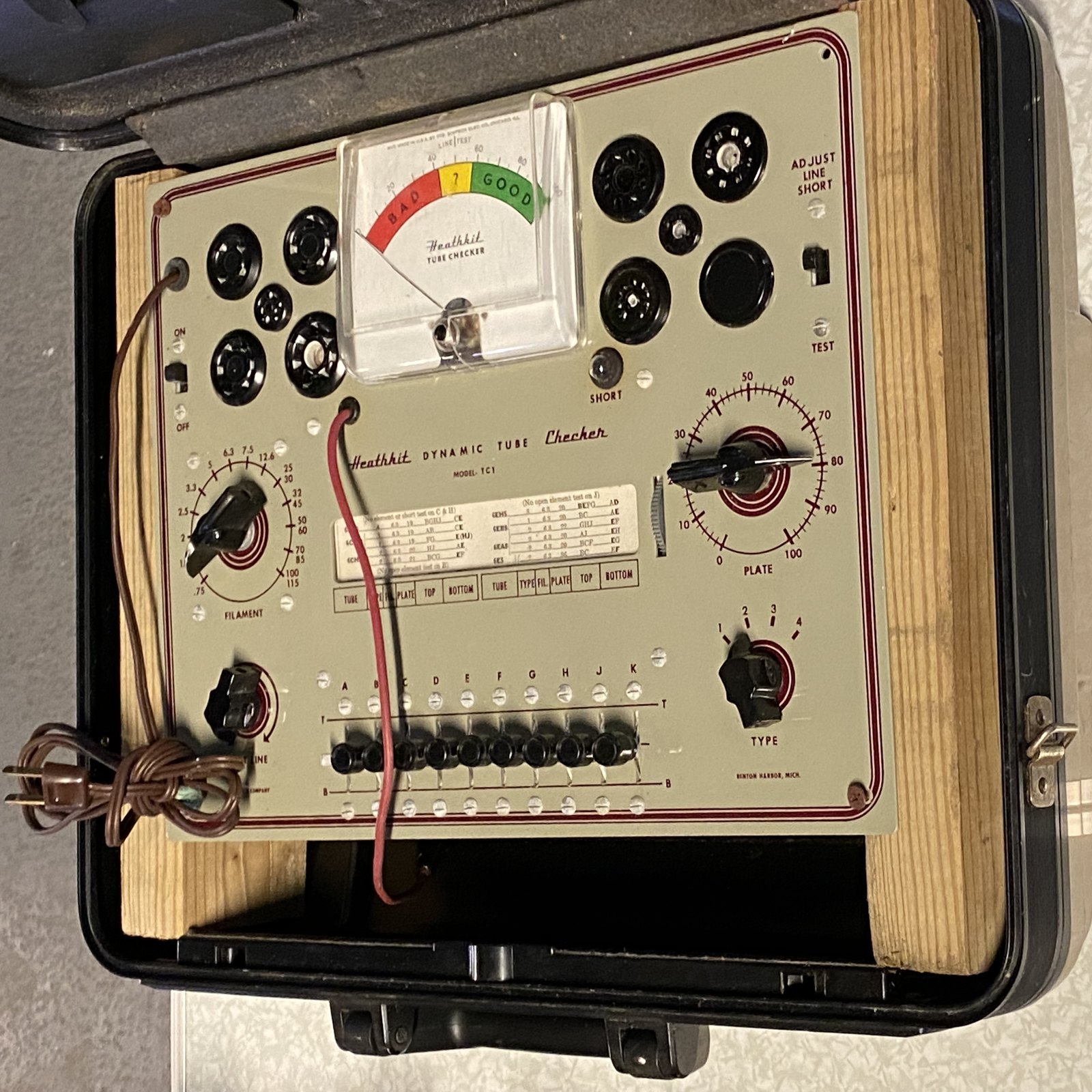
The tube checker was the television serviceman’s everyday instrument, and Heath entered the market in 1949 with the TC-1, an emission checker at $29.50 with a gear-driven roll chart. Eckweiler groups Heath’s tube testers into three series: the TC emission checkers of 1949–1962, the IT checkers of 1962–1981, and the two TT mutual-conductance testers of 1961–1973 (Eckweiler #130). The TC-2 of autumn 1953 added lamps behind the roll chart and a portable version in a carrying case, the TC-2P at $34.50. The emission principle, and why the later TT-1 measured something different, is explained in the TT-1 dive.
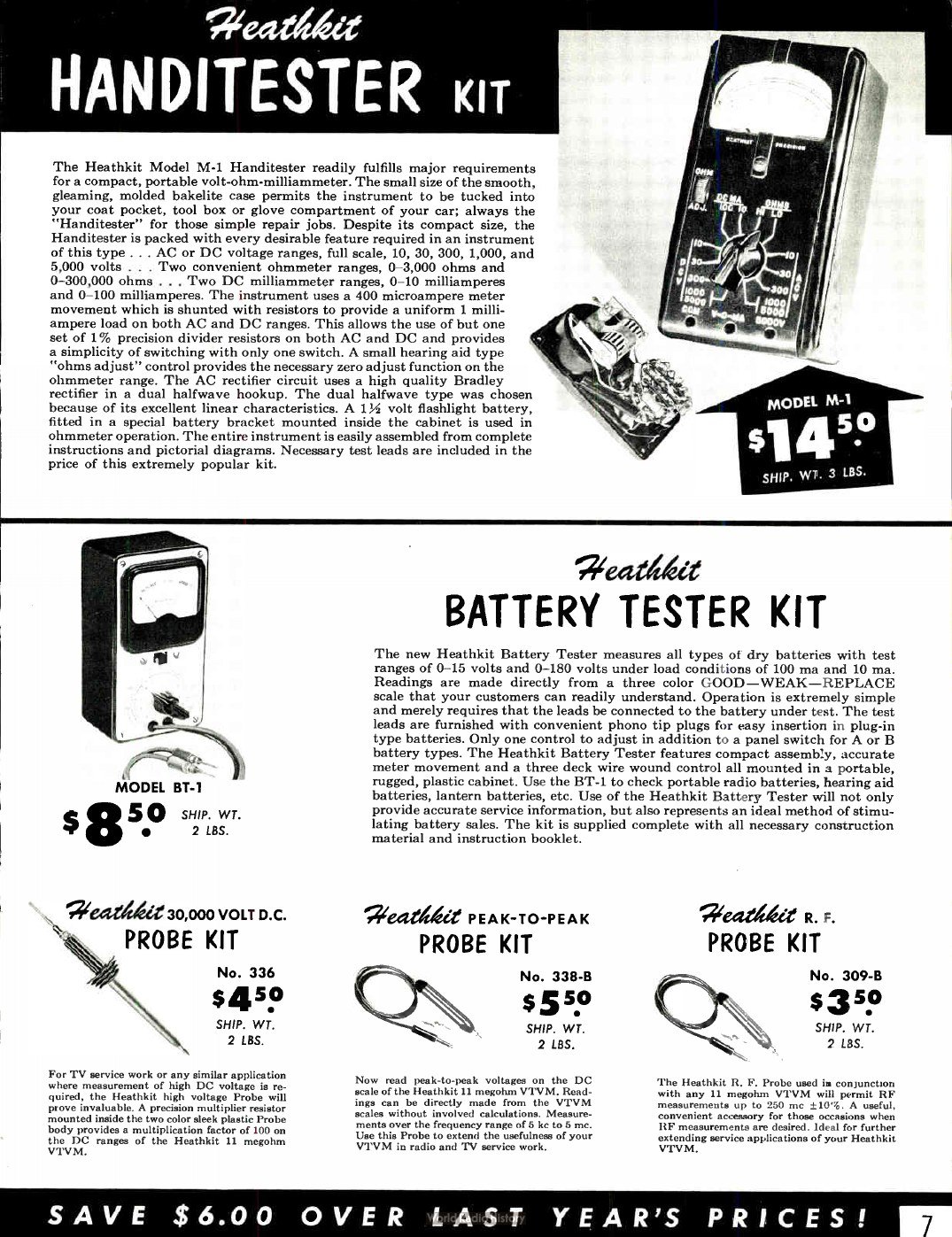
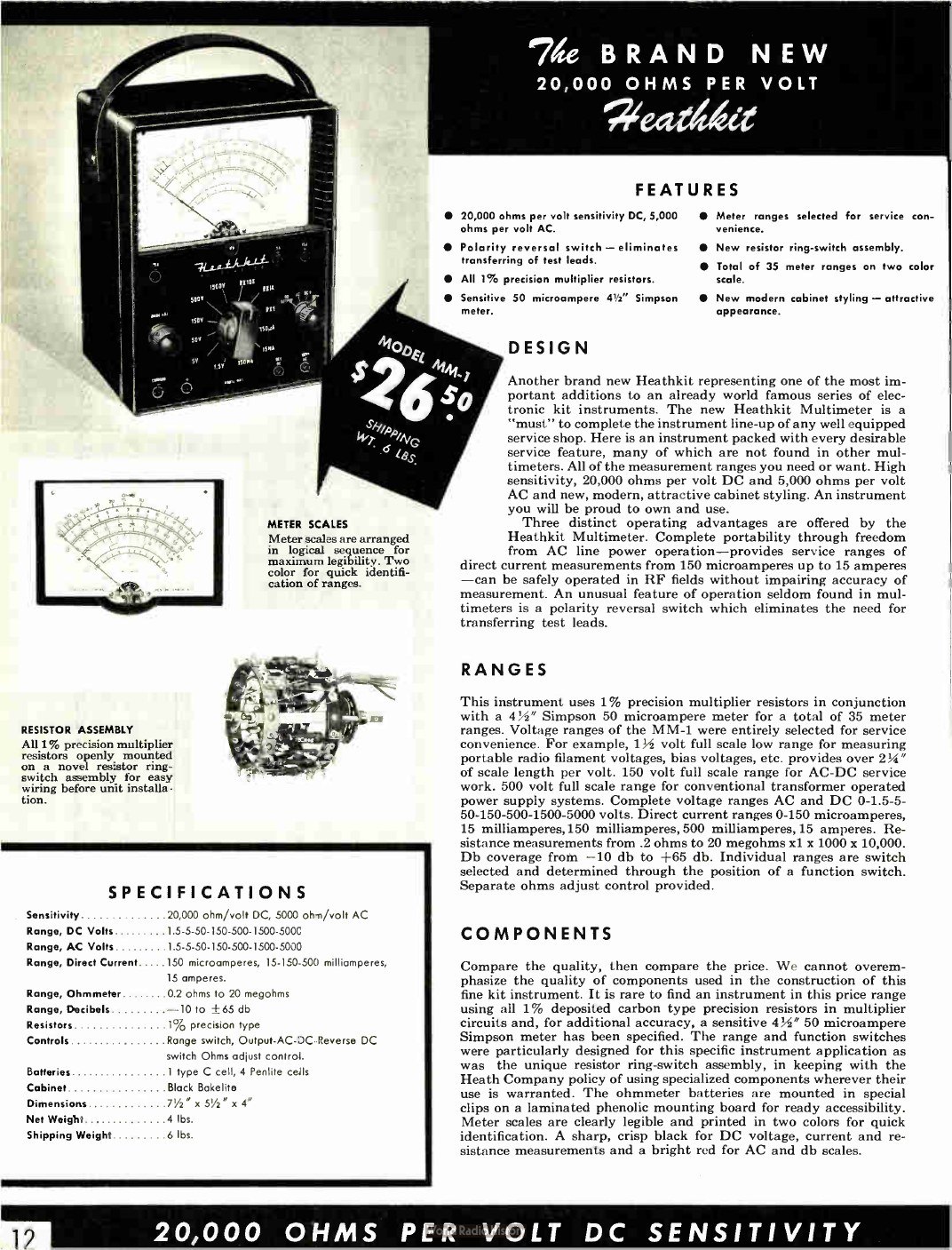
Around the tube checker Heath built the rest of the service bench, most of it at prices under $30: the C-series condenser checkers, a battery tester (BT-1, $8.50), a vibrator tester (VT-1, $14.50) for car radios, an isolation transformer (IT-1, $16.50) for working safely on AC-DC sets, signal tracers, resistance and capacitance substitution boxes at $5.50 each, and probes for the voltmeter at $3.50 to $5.50 (1954 order blank). The television instruments came next: the TS-series television alignment generators (TS-2, TS-3 and TS-4, the last at $49.50 in 1956), a bar generator for linearity (BG-1, $14.50) and, by 1956, a cathode-ray-tube checker. The same catalogues sold the M-1 “Handitester,” a pocket volt-ohm-milliammeter at $14.50, and, introduced as “brand new” in the 1954 catalogue, the MM-1, a 20,000-ohms-per-volt multimeter at $26.50 with a Simpson 50-microampere meter and a polarity-reversal switch.
1.6 Laboratory instruments and the consultants
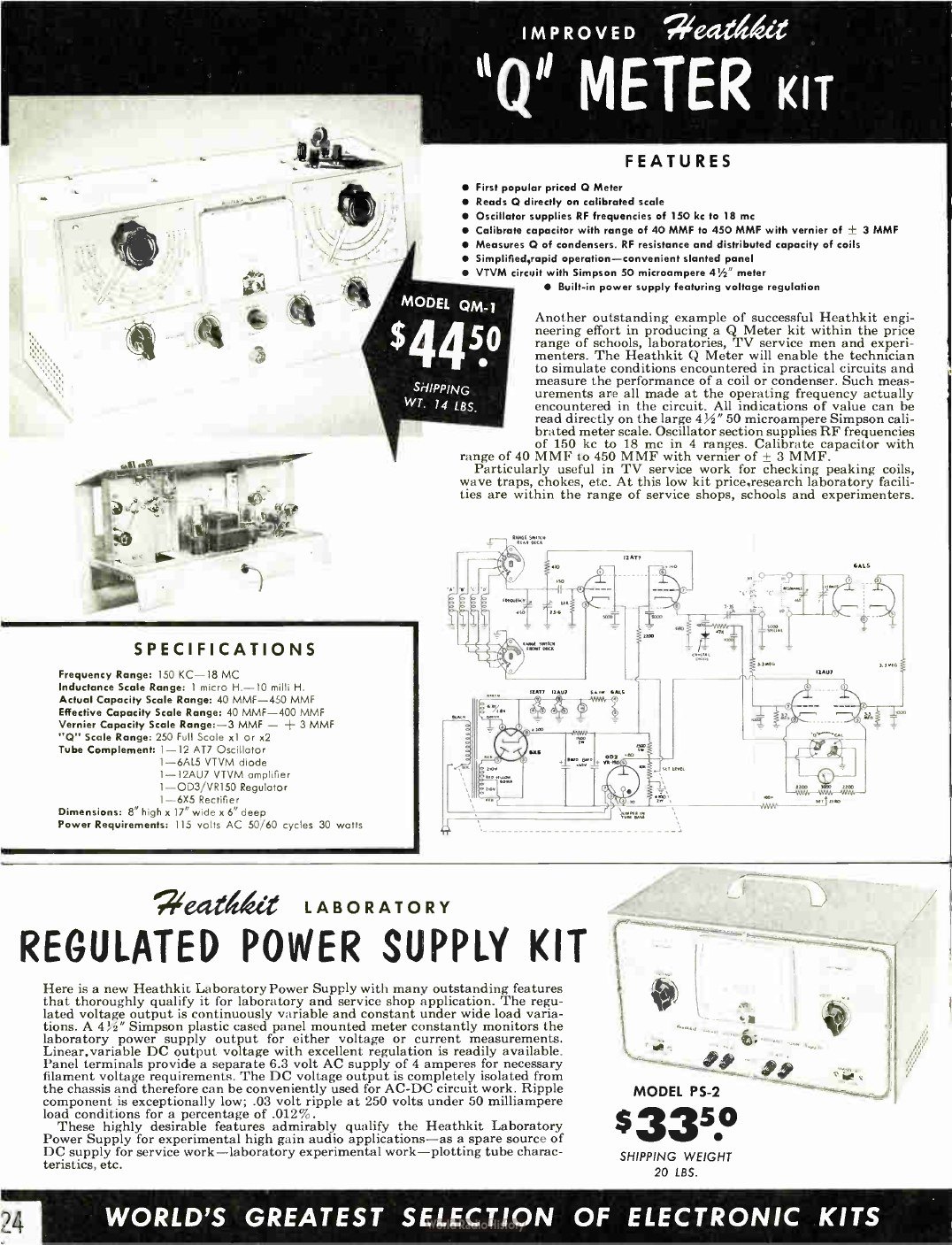
By 1952 the catalogue had moved beyond the service bench. The IB-1 impedance bridge of 1949 used a General Radio dial and a 1,000-cycle hummer at $69.50; the intermodulation analyser IM-1 ($39.50), the audio frequency meter AF-1 ($34.50), the AW-1 audio wattmeter ($29.50), the SQ-1 square-wave generator ($29.50), the AV-2 AC voltmeter ($29.50) and the PS-2 regulated laboratory supply ($33.50) followed (1952 catalogue; 1954 order blank).
Several of these came from outside consultants. Carl Helber, an engineer at an Akron aircraft company, visited Benton Harbor on 3 November 1951 and was asked for a Q-meter covering 160 kc to 30 Mc to sell for $69.50 or less. He was paid $5 an hour. The QM-1 appeared at $39.50, and Helber’s next design became the LG-1 laboratory signal generator of September 1953, $39.50, with a panel meter calibrated in output volts and a shielded attenuator (Helber, Heath Stories #52; Eckweiler #32). Walther Buhl designed the GD-1 grid-dip meter, which introduced Heath to radio amateurs. Anthony’s pricing rule, as he told Helber, was to add up the parts at Allied Radio catalogue prices and call that 80 per cent of the selling price. The full account of the consultants is in the history dive’s second volume.
Heath later listed its “firsts” on the back of its catalogues, and the instrument claims began in these years: the first vacuum-tube voltmeter, oscilloscope and laboratory instrument kits; the first impedance-bridge and Q-meter kits; the first alignment generator with electronic sweep; and the first kit maker to own patents on new circuits, the example given being an oscilloscope sweep circuit (1966 catalogue, “Famous Heathkit Firsts”). They are Heath’s own claims and have not been checked against EICO’s or anyone else’s dates.
1.7 The catalogue of 1954
The 1954 catalogue shows where the Anthony years had led. Its cover was headed “Heathkit Test Equipment,” with amplifiers, receivers and amateur radio in small type beneath. The order blank has fifty-seven lines, and forty-four of them are instruments, probes or instrument accessories; the other thirteen are the AT-1 transmitter and two small amateur accessories, a receiver, a broadcast radio, an FM tuner, three amplifiers, the Williamson amplifier sets, a record player and two cabinets (1954 catalogue, p. 39). Rich Post counted 48 kits in that year’s catalogue, and Chas Gilmore counted forty-two test-equipment kits against nine amateur products in the 1956 catalogue (Post; EEJournal, “Heathkits and Hams,” part 1).
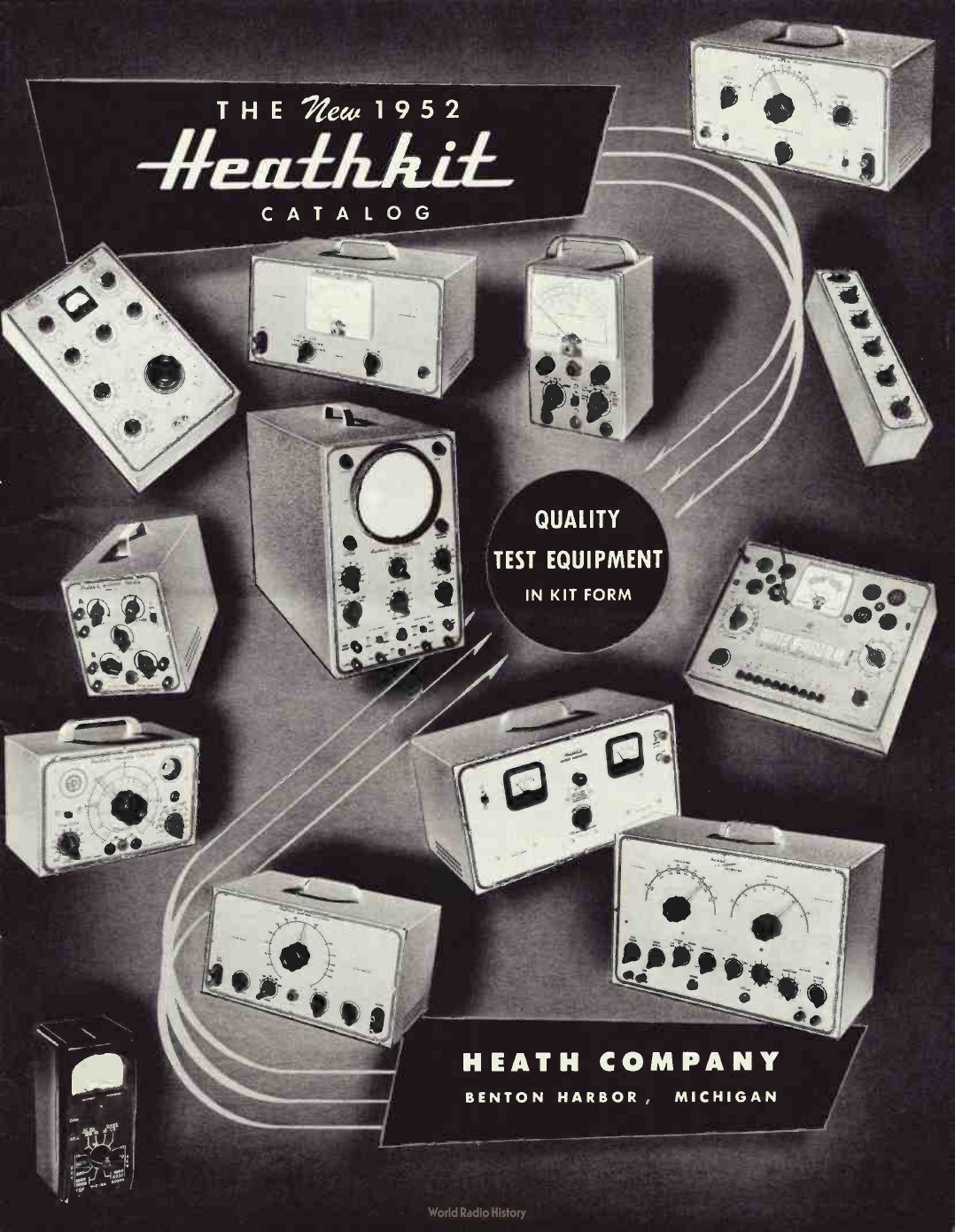
Prices had hardly moved. The voltmeter was still $24.50, as it had been in 1947; the RF generator $19.50; the tube checker $29.50. Only the oscilloscope had climbed, to $59.50, and it had become a different instrument on the way, with twice the tubes, a new CRT and regulated supplies. That stability, and the reliance on the customer’s labour, bought Heath the market that EICO and the Knight-Kit line competed for. What changed after 1954 was not the method but the owner: in July 1954 Anthony was killed in an air crash, and in February 1955 his widow sold the company to Daystrom, which also owned the Weston instrument company (history dive, volumes 2 and 3). The next volume follows the line under Daystrom.
Sources
- Brueschke, Erich E., and Michael Mack. “The History of the Heath Companies and Heathkits: 1909 to 2019.” The AWA Review 32 (2019). https://archive.org/details/thehistoryoftheheathcompanies
- Eckweiler, Bob (AF6C). “Heathkit of the Month” #2 (IT-11), #32 (LG-1), #85, #87 and #89 (O-series oscilloscopes), #130 (IT-17 and the tube-checker series). RF, Orange County Amateur Radio Club. https://www.w6ze.org/Heathkit/Heathkit_Index.html
- Heath Company flyers and catalogues, 1947–1954, and the 1966 catalogue, World Radio History. https://www.worldradiohistory.com/Archive-Catalogs/Heathkit_Catalogs.htm
- Heyning, Bjorn, ed. Heath Stories, vols. 1–2 and supplements (1986–1990), transcribed by Bill Wilkinson. https://www.heco.wxwilki.com/wwheco2/index.html
- Gilmore, Chas, interviewed by Steven Leibson. “H is for Heathkits and Hams,” part 1. EEJournal. https://www.eejournal.com/article/h-is-for-heathkits-and-hams-part-1-early-days-through-the-1950s/
- Post, Rich (KB8TAD). “The Heathkit Legacy.” https://boatanchorpix.x10host.com/HLegacy.htm; and supplementary pictures for “The EICO Story.” https://people.ohio.edu/postr/bapix/ARF/EICOhist.htm
- Wikipedia, “Eico” and “Tektronix.” https://en.wikipedia.org/wiki/Eico · https://en.wikipedia.org/wiki/Tektronix
- Heathkit history dive, this site, volumes 1–3. https://heathkit.fubsypoly.com/heathkit/vol-1/
Comments (0)