Education · Volume 1
Learning by Building, 1947–1974
Heath sold education long before it sold a course. The first Heathkit advertisement of 1947 promised an oscilloscope kit with “diagram and instructions and excellent training course”, and for the next quarter-century the company’s teaching took three forms. The first was the assembly manual, which taught every buyer something whether or not the buyer wanted to learn. The second was a small shelf of kits that were sold as lessons: the EK “Educational Series” kits and the EF “How to Understand and Use” instrument courses of the 1960s. The third was a line of factory-assembled laboratory instruments for universities, built with two chemists and a physicist and sold under names such as Heath/Malmstadt-Enke and the Berkeley Physics Laboratory. This volume follows all three up to 1974, the year before Heath launched its numbered home-study curriculum.
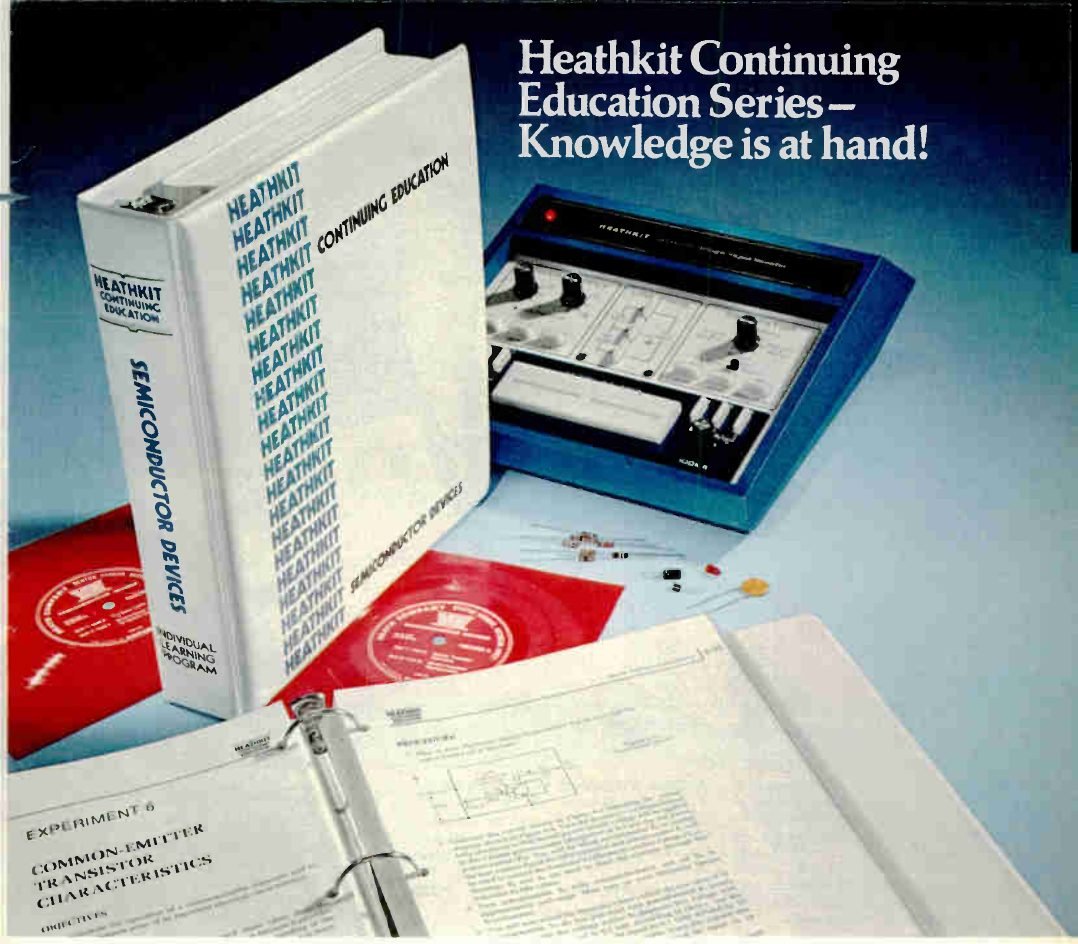
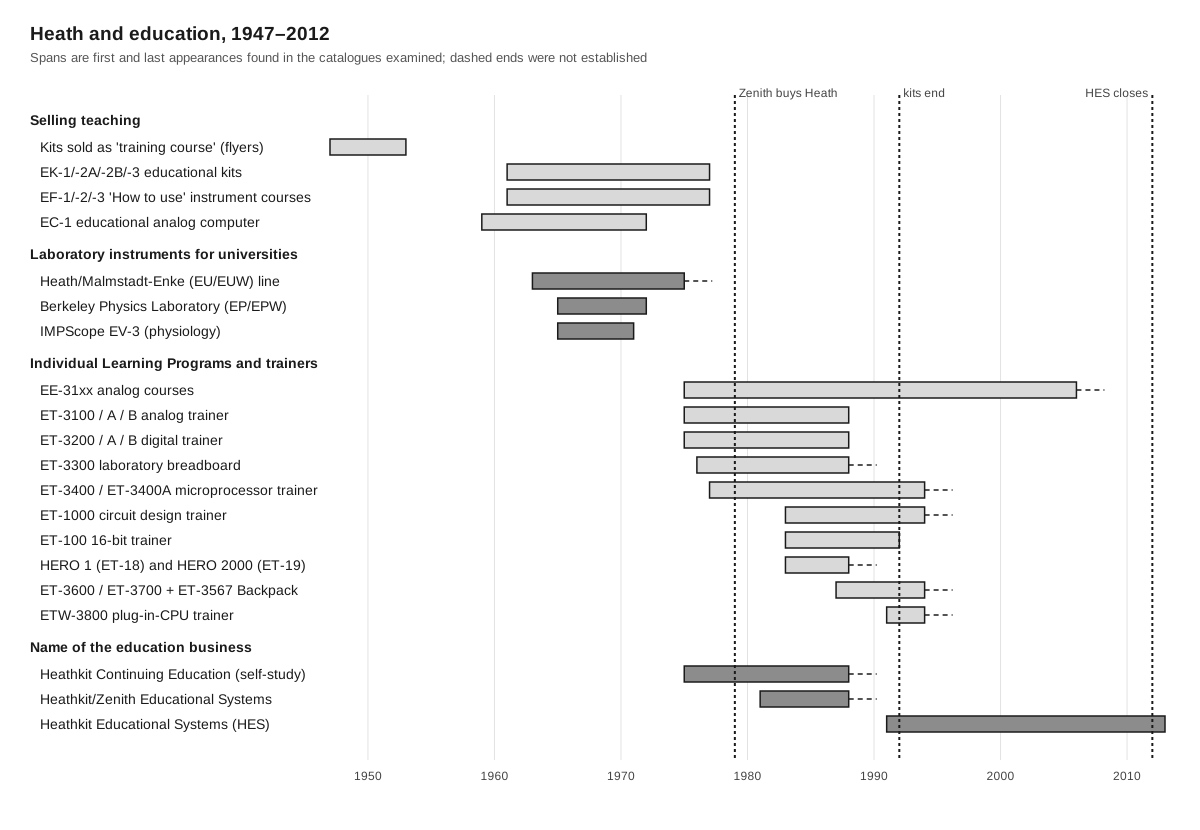
The dive has six volumes. This one covers the years to 1974. Volume 2 covers Heathkit Continuing Education from its launch in Christmas 1975 to the Zenith purchase of 1979. Volume 3 covers Heathkit/Zenith Educational Systems, from 1979 to the end of the kits in 1992. Volume 4 covers Heathkit Educational Systems, which outlived the kits by twenty years. Volume 5 is about the trainers and courses today, and volume 6 holds the model tables and sources. The two trainers with dives of their own, the ET-3100 and the ET-3200, are summarised and linked rather than retold. The company’s own history is in the site history dive.
1.1 The manual as teacher
The Heathkit manual is the root of everything in this category. Its method (one action to a step, a drawing for every group of steps, a parts list that taught the colour code, a closing circuit description written like a textbook chapter) is described in the history dive’s volumes on the manual and on how a manual works, and is not repeated here. Two points matter for the educational line.
The first is that the manual taught by accident. Its purpose was to get a kit built by someone who could not read a schematic, and it did that by explaining each operation as it came. A builder who finished a VTVM had been told, in passing, what every resistor in the divider was for. Heath’s later educational business said as much about itself. Its 1993 catalogue claimed that the company “was literally asked to enter the electronics education business by electronics instructors”, because it had been “very common to find teachers who had built Heathkit-supplied kits into TVs, stereos, amateur radios, etc.” and had learned from the step-by-step instructions (Heathkit Educational Systems catalogue No. 279, p. 4). That is a marketing recollection written two decades after the event, but it matches what the company said in 2008, that its educational business began in 1974 “as an outgrowth of the instructions that accompanied its electronic kits” (history dive, volume 7).
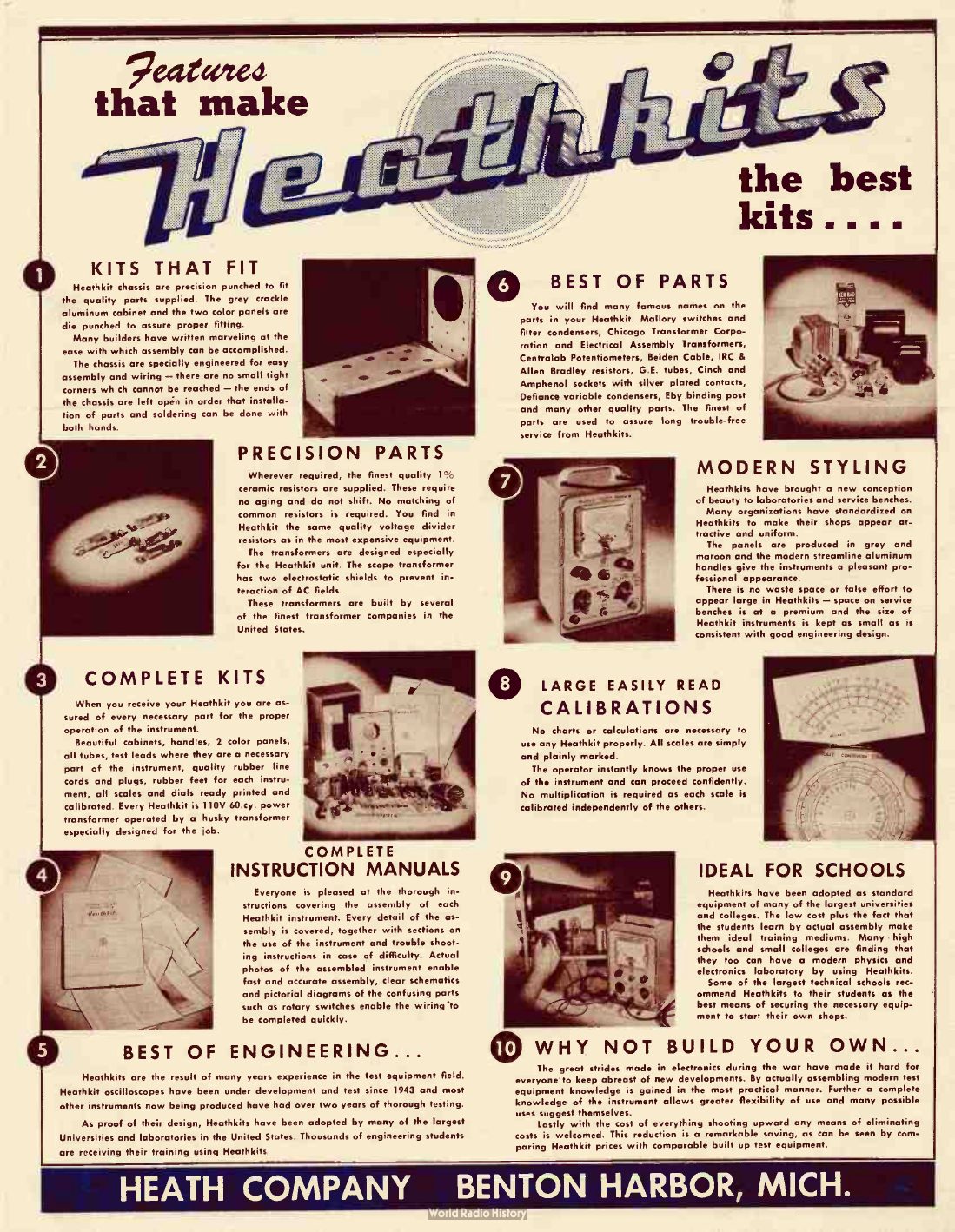
The second is that the kits were sold to schools from the start. A 1948 flyer, “Features that make Heathkits the best kits”, ended its nine panels with “Ideal for Schools”: Heathkits, it said, had “been adopted as standard equipment of many of the largest universities and colleges”, because “the students learn by actual assembly” (Heath schools flyer, 1948). The flyers of 1948 to 1951, and the market the GI Bill created for them, are covered in the history dive’s volume 2. What the early flyers offered schools was ordinary test equipment at kit prices. They did not offer a curriculum. That came in the 1960s.
1.2 The Educational Series kits, 1961–1976
The first Heath products designed as lessons rather than as equipment were the EK kits. Each was a textbook-workbook with a kit of parts, and the thing built at the end was a by-product of the lesson. The May 1961 catalogue introduced the pair EK-2A and EK-2B, “Basic Radio”, as a “2-part textbook and kit project” in which “difficult mathematics are eliminated”. The student began with a crystal set and improved it “chapter by chapter” into a regenerative receiver in Part I, then rebuilt it as a two-band superheterodyne in Part II (Heathkit catalogue, May 1961). By the autumn of 1961 the EK-1 “Basic Electricity” kit had joined them as the first step, and by March 1962 the EK-3 “Basic Transistors” had made a four-kit series (Fall–Winter 1961; March 1962, p. 13).
Table 1 — The Educational Series kits, 1961–1976
| Kit | Title | What the student built | Price, March 1962 |
|---|---|---|---|
| EK-1 | Basic Electricity | a DC volt-ohm-milliammeter | $19.95 |
| EK-2A | Basic Radio, Part I | crystal set, then a regenerative tube receiver | $19.95 |
| EK-2B | Basic Radio, Part II | a two-band superheterodyne (cabinet AK-8, $3.95, extra) | $19.95 |
| EK-3 | Basic Transistors | experiments on a test chassis, then a two-station transistor intercom | $16.95 |
The manuals are explicit about the audience. The EK-1 book, “Copyright © 1959 Heath Company” and first printed in December 1959, is headed as a text for self-study or “Group Classroom Instruction”. The EK-2A book carries a 1960 copyright (EK-1 manual, Internet Archive; EK-2A manual, Internet Archive). The catalogue called the EK-1 “the logical starting point for the Heath Basic Education Series” and said it was “designed by a science educator”. It was sold to “youngsters and adults alike”.
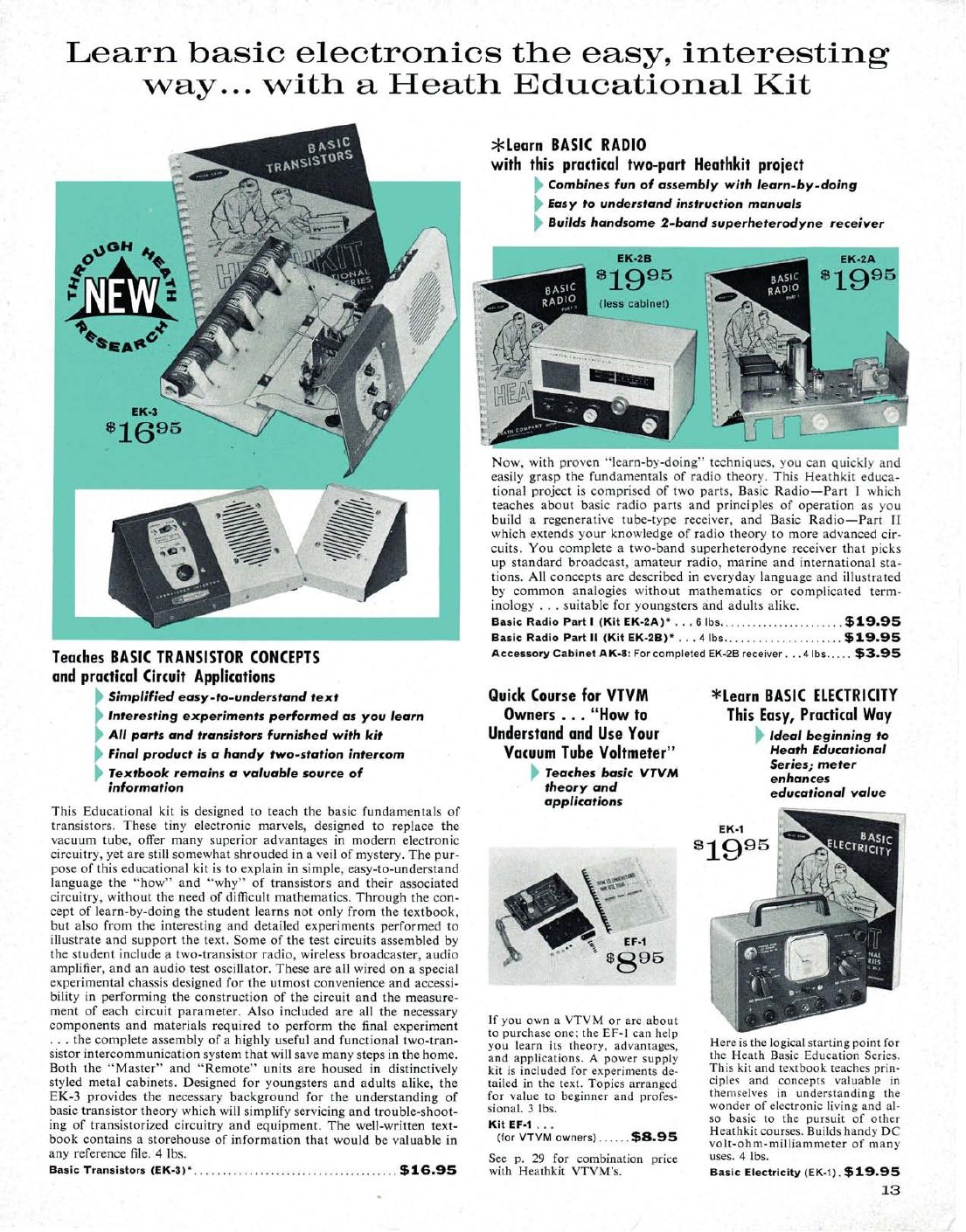
The EF series did the same for owners of Heath test equipment. The EF-1, “How to Understand and Use Your Vacuum Tube Voltmeter”, was a text and a small power supply kit on which the owner of a VTVM could perform the experiments in the book; the March 1962 catalogue priced it at $8.95. By 1963 the EF-2 oscilloscope course and the EF-3 signal-generator course had followed. Each came with a special experimental chassis using solderless spring-clip connectors, and each was also sold bundled with the matching Heathkit instrument. In 1969 the EF-2 alone cost $10.95, and the EF-2-3 with an IO-21 oscilloscope $70.95. The manuals could be bought in quantity at $3.00 each “(10 or more copies)”, a price line meant for classrooms (Heathkit 1969 catalogue, p. 31). The 1969 page gathered both series under one heading, “Heathkit Educational Series — Learn At Home Or In Class”.
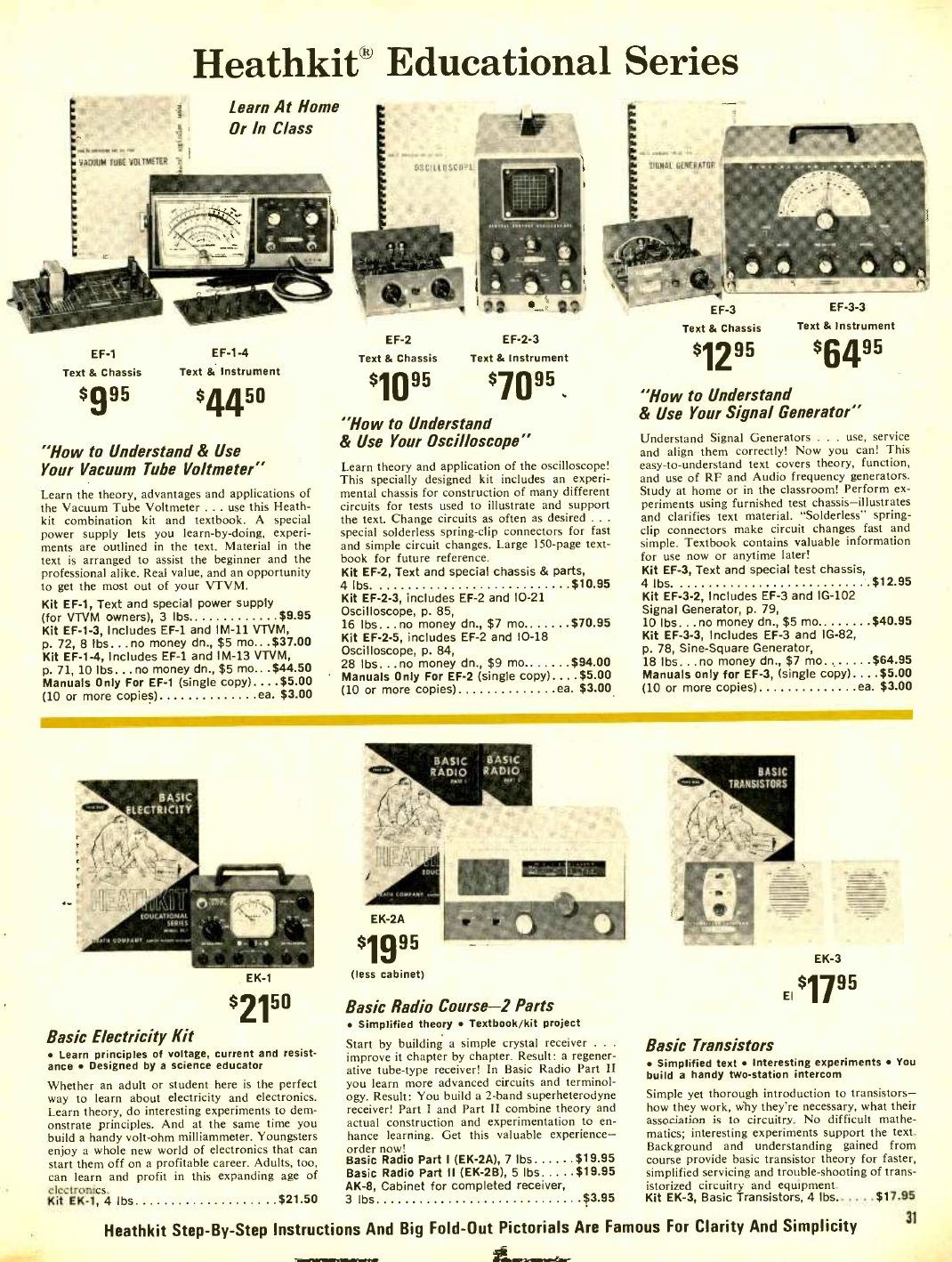
Both series lasted into the era of the numbered courses. The Christmas 1975 catalogue, the same issue that launched Heathkit Continuing Education, still listed all four EK kits and all three EF courses. The Spring 1976 catalogue still had the EK-1, now $32.95, and the EF series. None of them was found in the Fall 1977 catalogue, by which time the Individual Learning Programs had taken over their role (Christmas 1975; Spring 1976; Fall 1977). The Spring 1976 issue is worth reading for exactly this overlap. It sold a fifteen-year-old kit that taught Ohm’s law by building a meter, a few pages away from a new course that taught Ohm’s law with a programmed text and a record.
1.3 The EC-1 educational analog computer
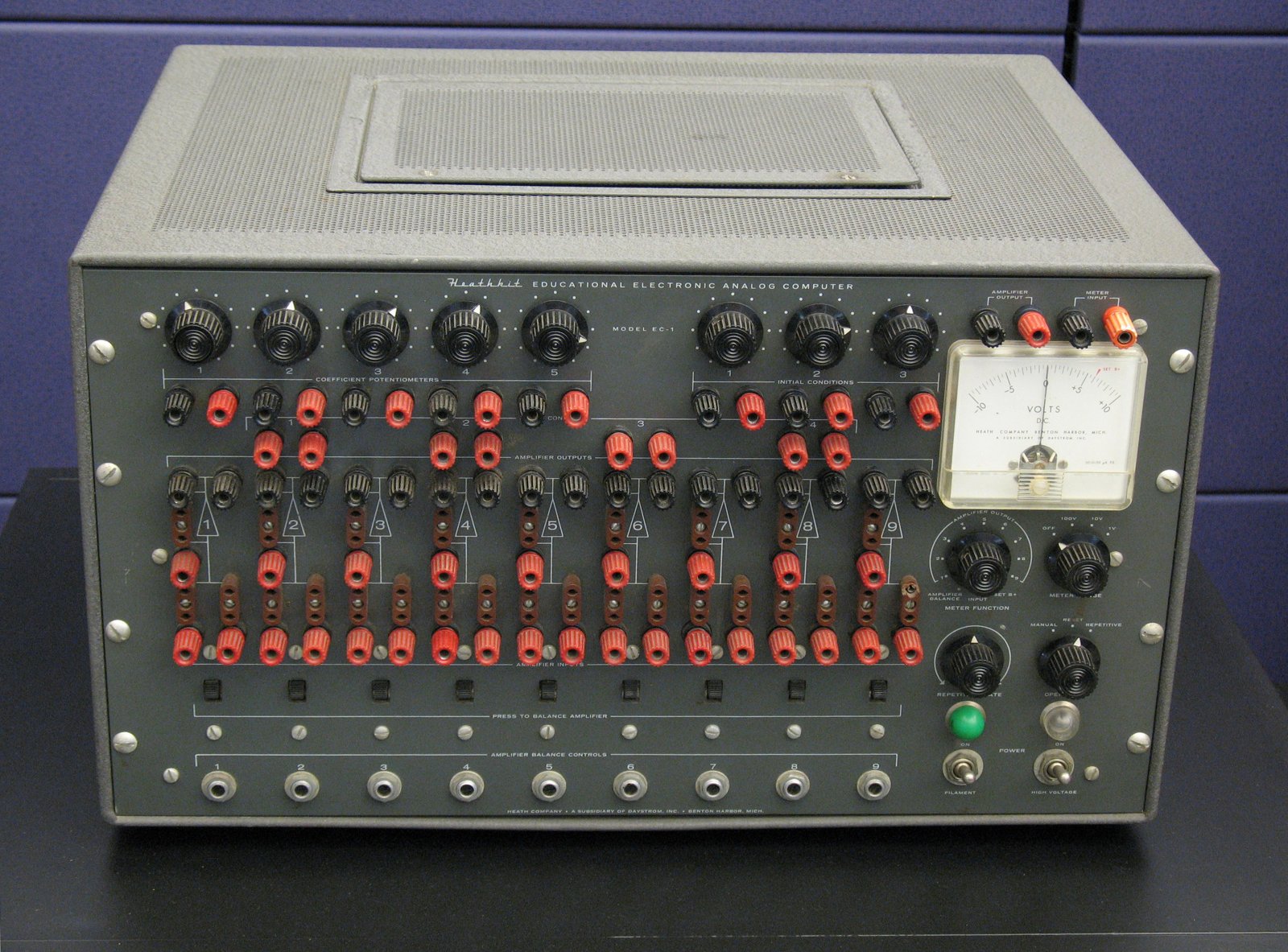
The other educational kit of the period was larger and dearer. The EC-1 “Educational Electronic Analog Computer” appeared in the 1959 catalogue as a teaching machine for colleges. It had nine amplifiers, patch terminals, coefficient potentiometers and a panel meter, and it followed the larger ES-400 analog computer system of 1956 (history dive, volume 3; Nostalgic Kits Central). The collectors’ model matrix lists the EC-1 from 1959 to 1971. A 1966 catalogue supplement indexed it under a single “Educational” heading with the “Home & Classroom Study Kits”, the “Instrument Application Series”, the IMPScope, the Berkeley Physics Lab and the Malmstadt-Enke Lab, which shows that Heath already thought of these as one line (Heathkit catalogue supplement 800/62, 1966, bound at the end of World Radio History’s file “Heathkit-1963-Supplement-80-33”). In 1977 the company pointed back to its analog computers as the start of its interest in “personal computing” (history dive, volume 5). The analog computers are planned to move into this site from the AnalogComputers project and are not documented further here.
1.4 Heath/Malmstadt-Enke: instruments to teach scientists
The most ambitious educational product of the 1960s was sold to universities, not hobbyists. In 1962 Heath began developing “a line of assembled products to fill a need for low-cost specialized equipment to teach electronics to scientists”, and the first, a strip-chart recorder, went on sale in August 1963 (history dive, volume 4). The partners were Howard V. Malmstadt of the University of Illinois and his former student Christie G. Enke, then at Princeton. In 1962 they had published Electronics for Scientists, “principles and experiments for those who use instruments”, written with E. Clifford Toren (Internet Archive). The University of Illinois chemistry department records that “in late 1963, the Heath Company began selling the Malmstadt-Enke Instrument Station”, which “was developed by Malmstadt as a teaching device that enabled students to assemble the various parts of an instrument and thus gain a better understanding of the basic principles involved”. With Enke he taught one-semester and three-week summer courses on instrumentation, and their materials “came to be used in more than 500 schools all over the world” (University of Illinois, Department of Chemistry).
The May 1963 catalogue announced the system as “a coordinated system of instruments, accessories, and text for research & development or educational purposes”. A complete station cost $995 without its cabinet. It comprised four universal experimental chassis with more than 200 parts, a universal power supply, a servo chart recorder, an operational amplifier system, a voltage reference, a transistorised supply, a laboratory meter and seven factory-assembled Heathkit instruments. It was “engineered by the Heath Company in conjunction with Dr. Malmstadt of the University of Illinois and Dr. Enke of Princeton University” (Heathkit catalogue, May 1963). The model prefix was EU, and EUW for the factory-wired units, which were most of them.
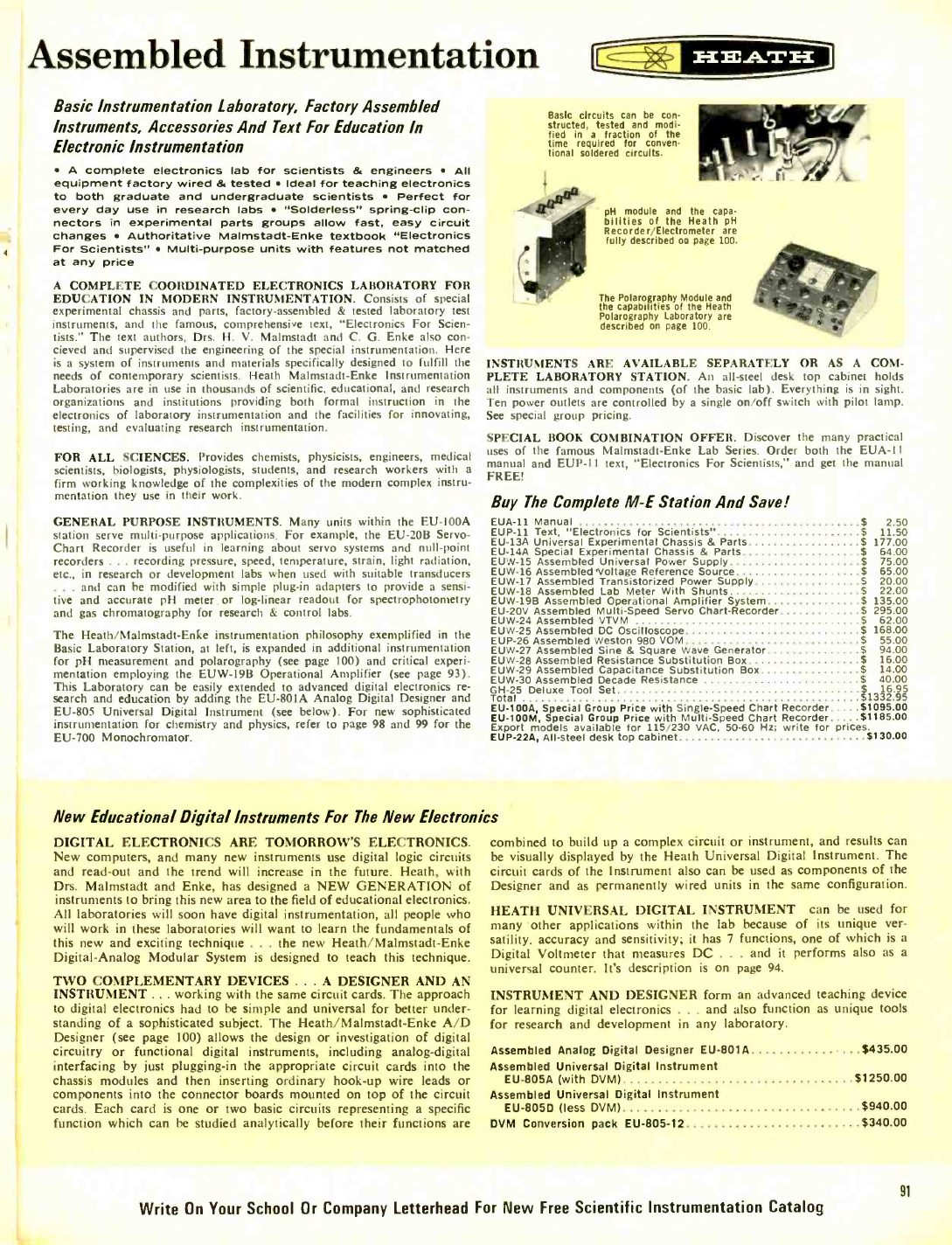
By 1969 the station had become the EU-100A Basic Instrumentation Laboratory. It was sold at a group price of $1,095, or $1,185 with the multi-speed recorder, and an all-steel desk-top cabinet cost $130 more. It was supported by the EUP-11 textbook ($11.50) and the EUA-11 laboratory manual. Around it Heath built extensions for chemistry: a recording pH meter and electrometer (EUW-301, $290), a polarography laboratory (EUW-402, $609), servo chart recorders and, from December 1967, the EU-700 scanning monochromator at $1,195, the first module of a spectroscopy system (Heathkit 1969 catalogue, pp. 90–100; history dive, volume 4).
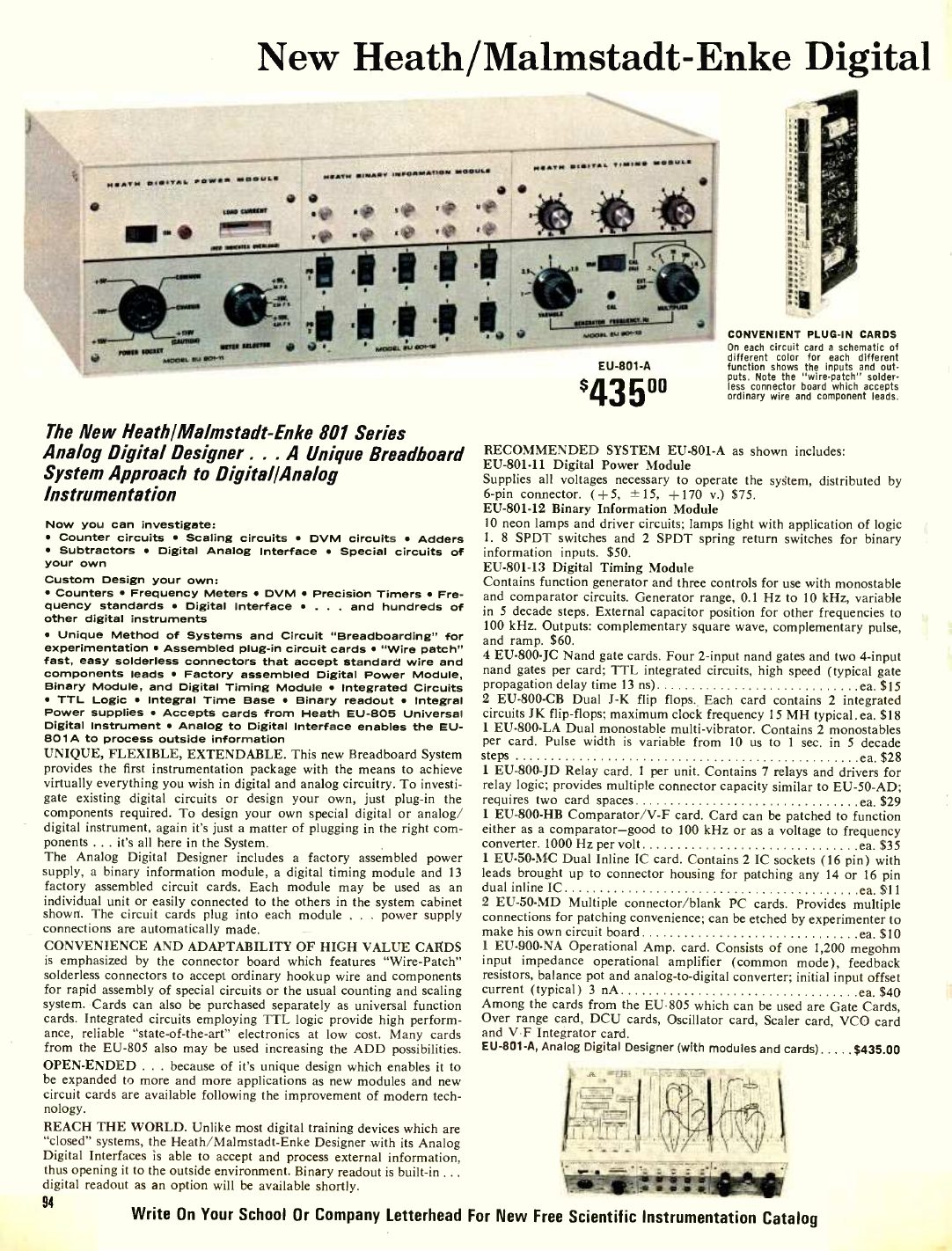
The line then moved into digital electronics. The EU-801A Analog Digital Designer ($435 in 1969) was a breadboard system: a power module, a binary module, a timing module and thirteen plug-in TTL circuit cards, with “wire-patch” solderless connector boards on which students built counters, scalers and digital voltmeters. The catalogue contrasted it with “most digital training devices”, which it called “closed” systems. Its companion, the EU-805 Universal Digital Instrument ($1,250 with DVM, $940 without), was Chas Gilmore’s first major design at Heath (history dive, volume 4). A 2016 history of Malmstadt’s school describes the first-generation ADD as a unit that “allowed one to quickly patch-wire a remarkably wide range of both digital and analog circuits” (Storey and Hieftje, Applied Spectroscopy, 2016). Neither the ADD nor the EU-805 is a trainer in the later sense. Both are, however, the first Heath products that let a student build digital logic on a solderless panel and watch it work, and that is the job the ET-3200 did for home students six years later.
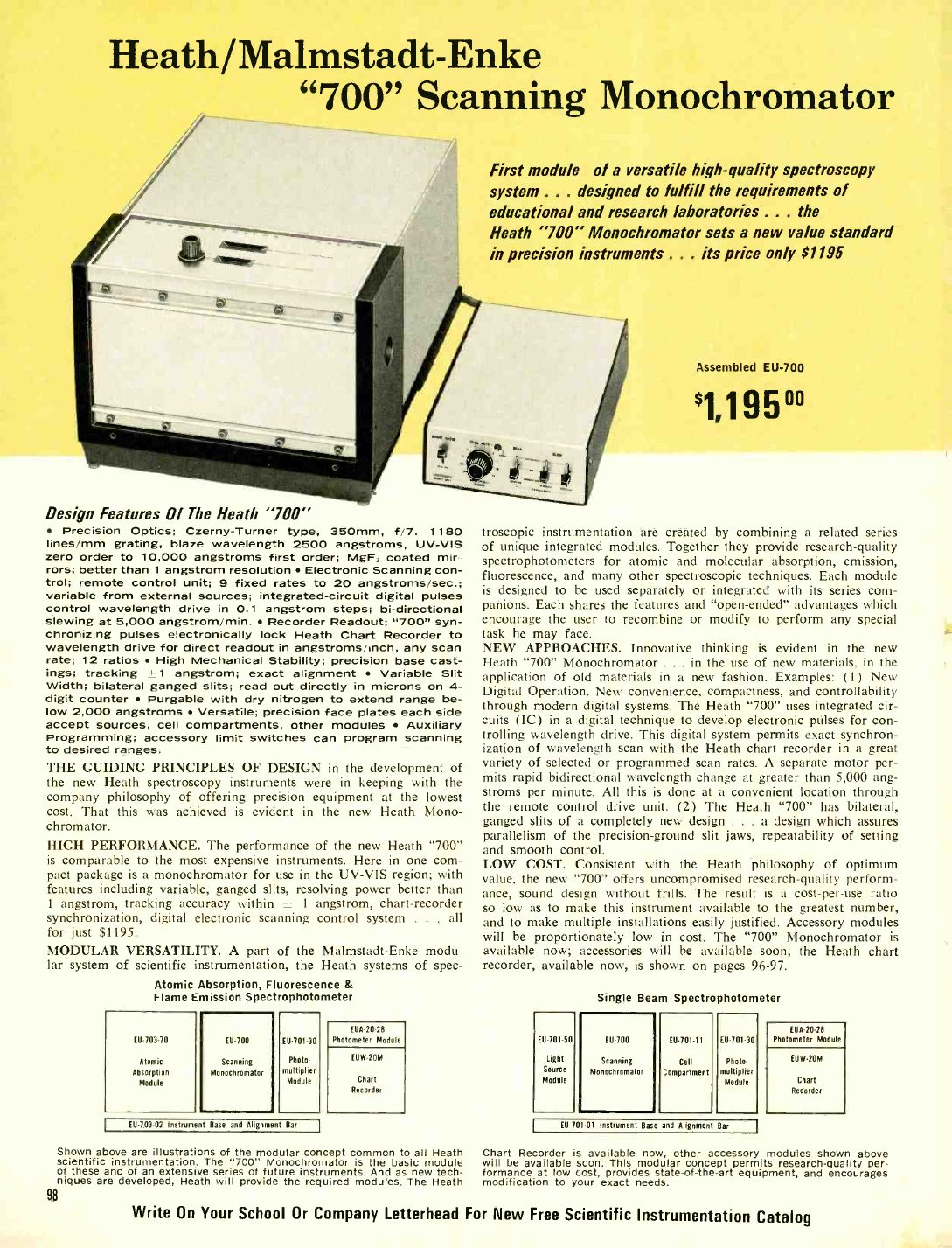
The partnership’s fortunes after 1970 belong to the company history. By 1972, 70 per cent of the assembled-instrument line’s sales went to educational institutions. The Heath/Malmstadt-Enke name was dropped in 1974, and the line continued as Heath/Schlumberger general-purpose instruments (history dive, volume 4). The Schlumberger instruments are part of the Test-Equipment category. For the educational line, the lasting legacy was an idea rather than a product: an instrument could be designed so that a student built and understood it, rather than only used it.
1.5 The Berkeley Physics Laboratory and the IMPScope
Two more university programmes came through Heath in the mid-1960s. The first was the Berkeley Physics Laboratory, a laboratory course developed at the University of California by Professor A. M. Portis and described in the American Journal of Physics in June 1964. Heath, “manufacturer of test instruments & materials as used at Berkeley”, offered complete two-student laboratory stations, “available assembled or in kit form”. In 1965 the EP-100A kit station cost $396.72 and the assembled EPW-100A $545.26. The stations were made up of standard Heath instruments (an IO-12S oscilloscope, IG-102S RF generator, IP-32 power supply, IM-11 VTVM and EUW-27 sine-square generator) plus special experiment chassis, a cathode-ray tube and deflection-coil set, and a battery set (Heathkit catalogue 1965, No. 800-55, p. 11). The history dive, following Brueschke and Mack, has the line leaving the catalogue in 1970. The 1971 catalogue (copyright 1970) still carries a full page, “The Berkeley Physics Laboratory by Heath”, with instrument groups for Parts A, B and C (Heathkit 1971 catalogue, p. 71). It was therefore still on sale in 1971.
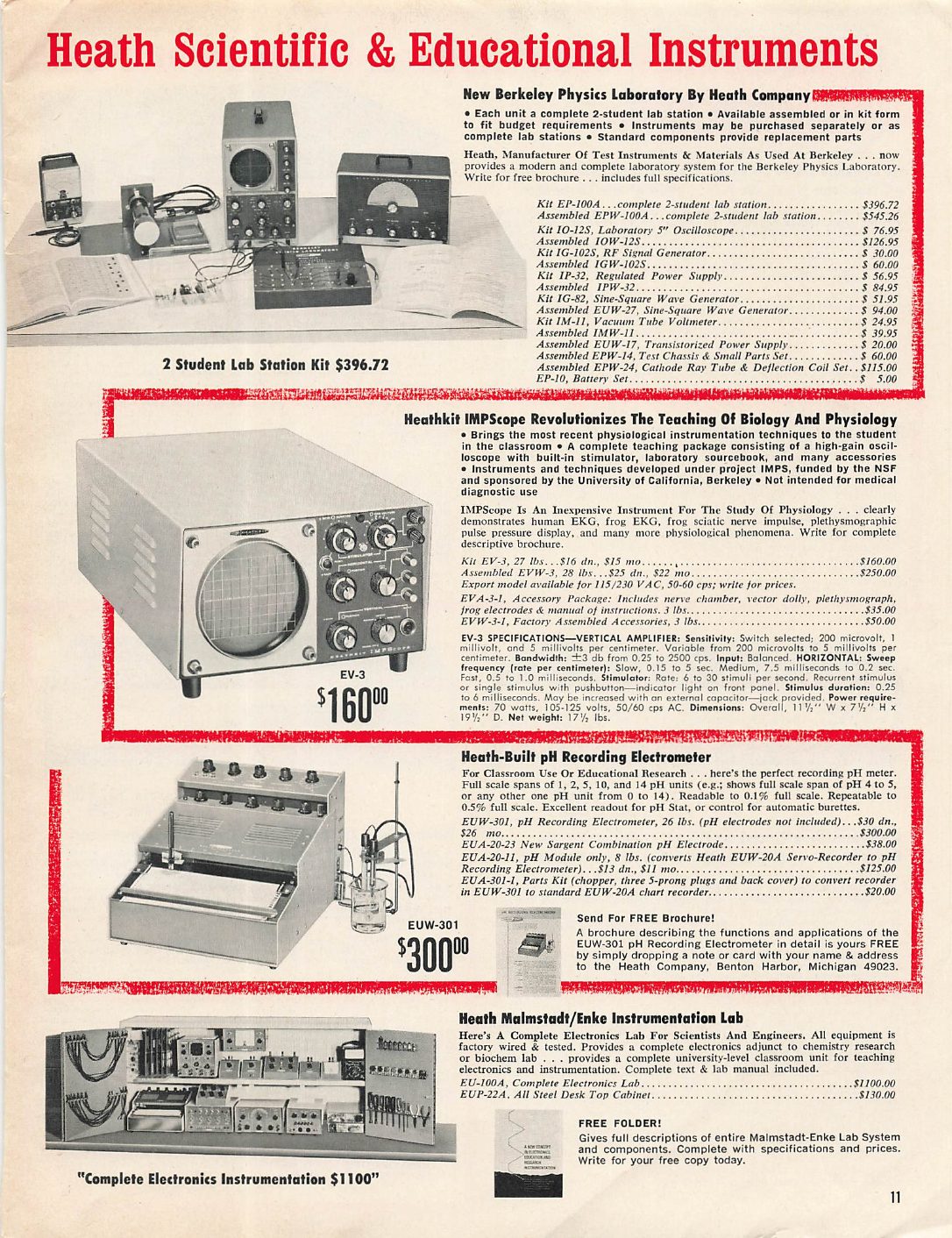
The second was the IMPScope (EV-3), an oscilloscope with a built-in stimulator for biology and physiology classes. It displayed a human or frog EKG, a frog sciatic-nerve impulse or a plethysmographic pulse. Its instruments and techniques were “developed under project IMPS, funded by the NSF and sponsored by the University of California, Berkeley”. It cost $160 as a kit and $250 assembled, with an optional accessory package of nerve chamber, frog electrodes and manual, and was “not intended for medical diagnostic use” (1965 catalogue, p. 11). The March 1965 catalogue tied it to the course materials of the BSCS (Biological Sciences Curriculum Study) programme (Heathkit catalogue, March 1965). A 1966 catalogue supplement lists the trade shows at which Heath showed its educational products that spring: the National Science Teachers Association convention in New York (IMPScope, Berkeley Physics Lab, chart recorder, “Basic electronic courses, and ‘How To …’ Instrument Application series”) and the biology societies’ meeting in Atlantic City (IMPScope, polarography and the Malmstadt-Enke Lab) (Heathkit catalogue supplement 800/62, 1966).
1.6 What the 1960s line added up to
By 1970 Heath was selling education in two quite different markets. At the bottom were twenty-dollar EK and ten-dollar EF kits for teenagers, hobbyists and high-school classrooms, sold in the general catalogue beside the stereo kits. At the top were thousand-dollar laboratory stations for university chemistry and physics departments, sold by letter on institutional letterhead (“Write on your school or company letterhead for new free Scientific Instrumentation Catalog”, as every page of the 1969 section said). Between them was a gap: the adult who wanted to learn electronics properly, in order, at home.
That gap is what the Individual Learning Programs filled. They took the EK idea (a text, a kit of parts and experiments) and made it a sequenced curriculum with examinations and credit. They took the Malmstadt-Enke idea (a purpose-built instrument that makes experiments quick to set up) and turned it into a trainer cheap enough for a home student. The man who put the two together was a newcomer from McGraw-Hill, and his arrival opens volume 2.
Sources
- Heath Company flyers and catalogues, World Radio History (https://www.worldradiohistory.com/Archive-Catalogs/Heathkit_Catalogs.htm): schools flyer 1948; May 1961; Fall–Winter 1961; March 1962; May 1963; March 1965 (800-53); 1965 (800-55); supplement 800/62 (1966, in the file “Heathkit-1963-Supplement-80-33”); 1969; 1971; Christmas 1975; Spring 1976; Fall 1977 (817).
- Heath Company. Basic Electricity, EK-1 text-workbook, © 1959. Internet Archive. https://archive.org/details/Heathkit_Basic_Electricity_Course_Basic_Electricity_ek-1
- Heath Company. Basic Radio, EK-2A text-workbook, © 1960. Internet Archive. https://archive.org/details/Heathkit_Basic_Electricity_Course_Basic_Radio_ek-2a
- Heathkit Educational Systems. Electronics and Computer Education, catalogue No. 279, 1993. https://www.worldradiohistory.com/Archive-Catalogs/Heathkit-Catalogs/Heathkit-1993_279-Education.pdf
- Malmstadt, H. V., and C. G. Enke, with E. C. Toren. Electronics for Scientists. W. A. Benjamin, 1962. https://archive.org/details/electronicsforsc0000malm
- University of Illinois, Department of Chemistry. “Malmstadt, Howard (1922–2003).” https://chemistry.illinois.edu/spotlight/faculty/malmstadt-howard-1922-2003
- Storey, A. P., and G. M. Hieftje. “The Academic Tree of Howard V. Malmstadt.” Applied Spectroscopy, 2016. https://doi.org/10.1177/0003702816681014
- Nostalgic Kits Central, Heathkit model matrix. https://www.nostalgickitscentral.com/heath/products/alphabetical.html
- Holley, Michael. “Heathkit Analog Computer” (photograph). Wikimedia Commons, public domain. https://commons.wikimedia.org/wiki/File:Heathkit_Analog_Computer.jpg
- Heathkit history dive, volumes 2, 3, 4, 5, 7 and 8. https://heathkit.fubsypoly.com/heathkit/vol-1/

Comments (0)