Education · Volume 3
Heathkit/Zenith Educational Systems, 1979–1992
When Zenith bought Heath in October 1979 it wanted the computers, but it also acquired an educational business that was, by the account of the man who ran it, worth about $15 million a year. For the next twelve years that business grew steadily while the kit business shrank around it. It added college credit and accreditation, a separate catalogue for schools, courses on robots, lasers, 16-bit processors, circuit design and computer servicing, and a new generation of trainers built for classrooms. This volume follows the line from the Zenith purchase to the end of the kits in 1992. The corporate side of those years (Zenith Data Systems, the Bull purchase of 1989, the decision of March 1992) is told in the history dive, volume 6.
3.1 A new name and a vice-president
The catalogues show the new name arriving. Through the 1980 catalogue (No. 848) the courses were “Heathkit Continuing Education”. In Winter 1981 they became the products of Heathkit/Zenith Educational Systems, and the Heathkit/Zenith prefix spread to the trainers themselves: the Winter 1981–82 catalogue headed the ET-3100A “Heathkit/Zenith ET-3100A Experimenter/Trainer” (Winter 1981; Winter 1981–82). The older name did not disappear. “Heathkit/Zenith Continuing Education” survived for the self-study courses as late as 1987, while “Educational Systems” named the business and its classroom products (Fall 1987, p. 73). Later trainers in the Zenith livery carry “Heathkit/Zenith Educational Systems” on their front panels (ET-3200 dive, volume 1).
Lou Frenzel, who had founded the line, stayed with it. “With the sale of the computer product line to Zenith, I became VP of the educational business which had grown to about $15 million in the meantime,” he wrote, and he credited the educational group with the HERO robot: “It too was a huge success” (Frenzel, Electronic Design, 2013). The $15 million figure is his recollection. No Zenith report giving the education line’s sales was found.
3.2 The schools catalogue
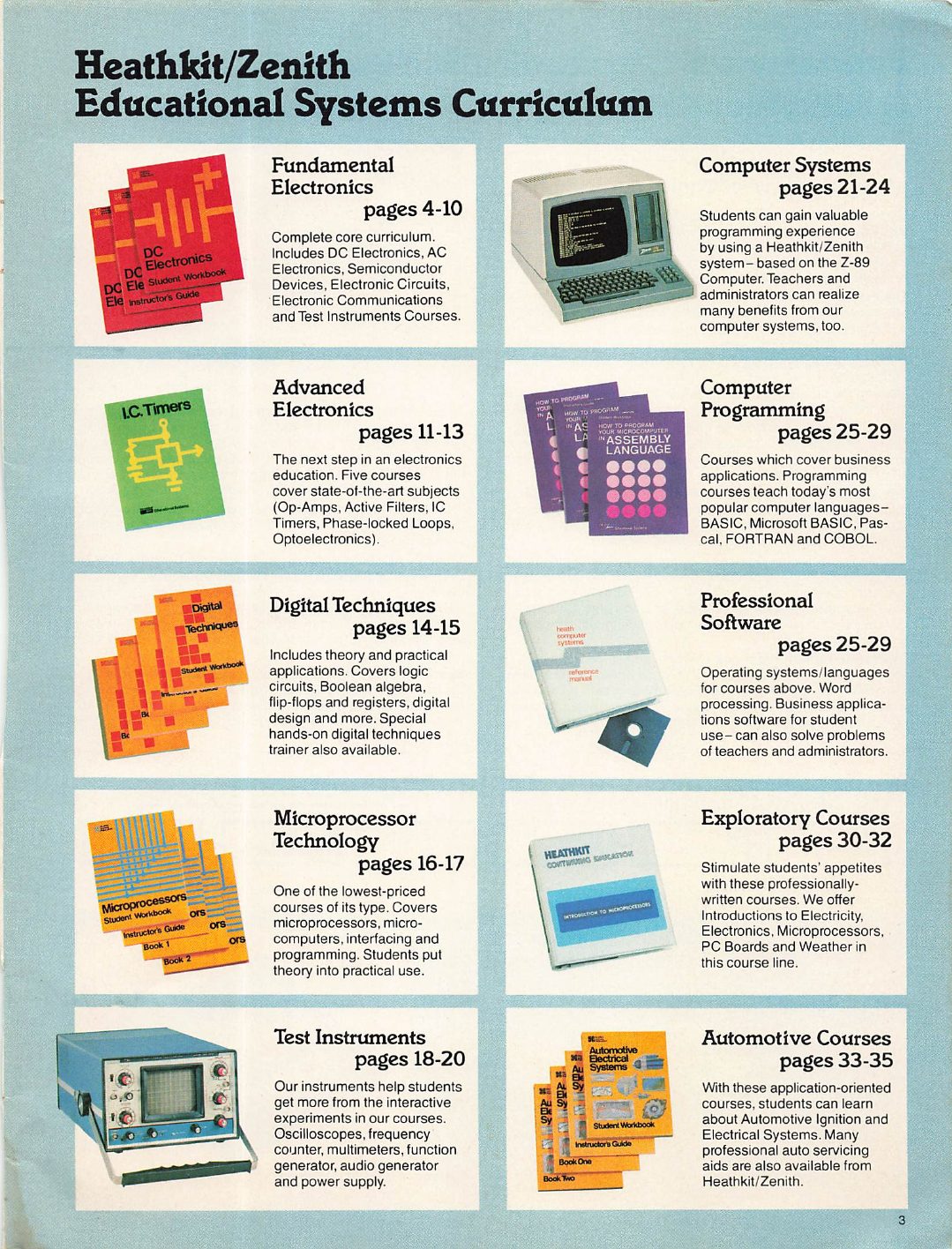
The Heathkit/Zenith Educational Systems & Instruments catalogue (No. 811-29R) is the best single picture of the business in the early Zenith years. World Radio History files it under 1975. Its contents place it about 1980–81: the Heathkit/Zenith name, the Z-89 computer on its cover and its programming pages, and the “Heathkit/Zenith” prefix on every course. It was written for teachers, training directors and the military, and it offered every course in two formats (811-29R, pp. 1–3):
- Classroom courses (EB- numbers): a student textbook, a student workbook with the experiments, an instructor’s guide “with suggestions on making the course more effective”, unit and final examinations “for competency-based progress”, and separate parts packs “so each student can participate”. Prices were not printed; schools were told to “contact your local representative (see back cover) to get complete information and price schedules.”
- Self-instruction courses (EE-, EC- and EI- numbers): the same material in the home-study binder format, offered for “on-the-job” and “in the field” training “because important people can’t be taken off the job and into the classroom”.
The catalogue’s sections show how wide the line had become. The Fundamental Electronics Series had six courses (DC, AC, Semiconductor Devices, Electronic Circuits, Electronic Communications, Test Equipment), all requiring the assembled ETW-3100. The Advanced Electronics series had five (op amps, active filters, IC timers, phase-locked loops, optoelectronics) on the ETW-3300. Then came Digital Techniques on the ETW-3200 and Microprocessors on the ETW-3400. The classroom Microprocessor course came with optional 35 mm slides and a filmstrip duplicating the flip charts of the home version. There were also test instruments, Z-89 computer systems, programming courses (BASIC, Microsoft BASIC, Pascal, FORTRAN, COBOL and assembly language), professional software, six Exploratory Courses and two Automotive courses (811-29R, pp. 4–35). Spanish editions of the DC, AC and Semiconductor courses were supported by an ET-3100S trainer with a Spanish manual.
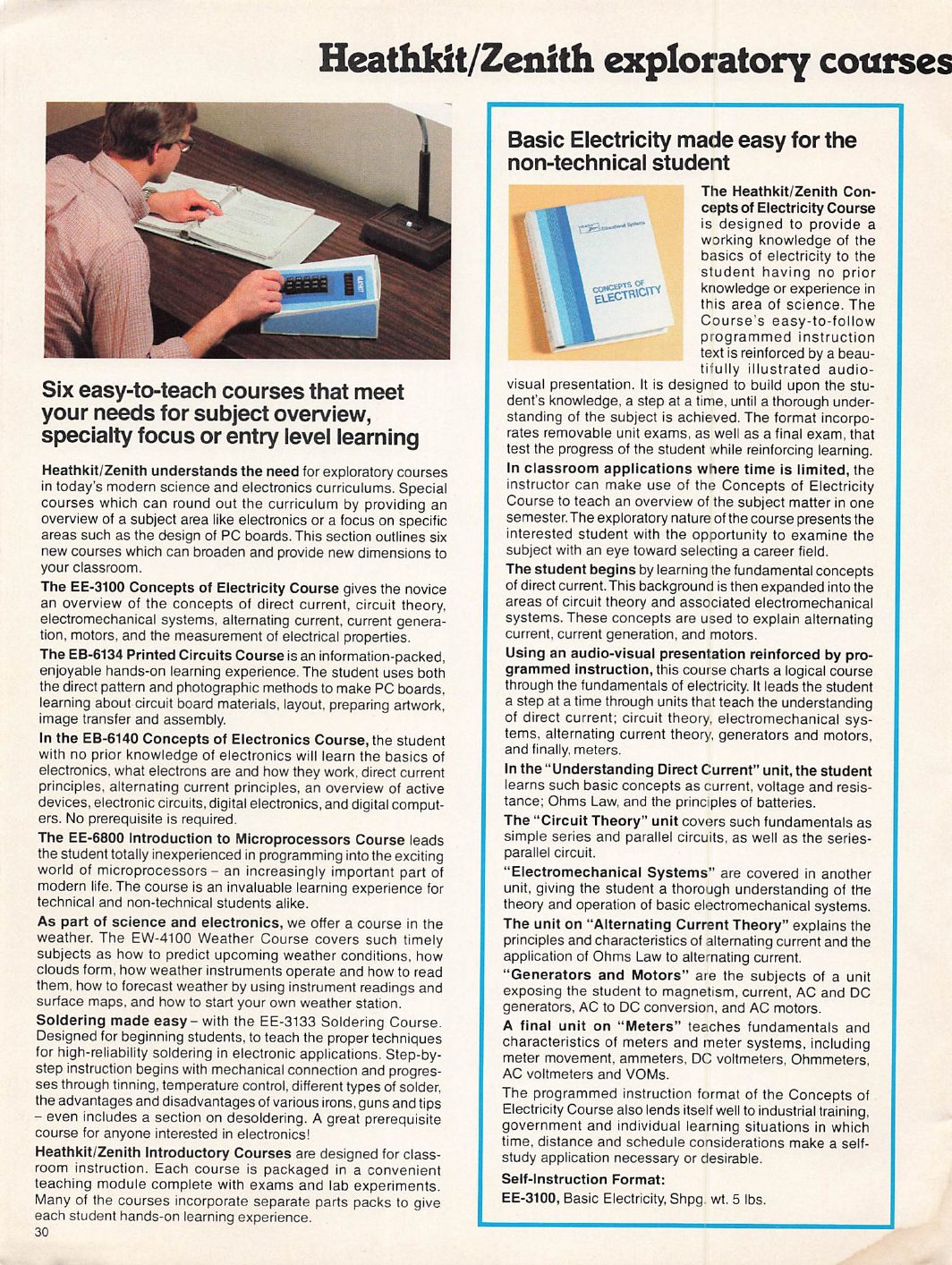
The exploratory courses show the business reaching down to schools that did not teach electronics at all. EE-3100 Concepts of Electricity ($24.95 in Winter 1981–82) needed no background. EB-6140 Concepts of Electronics ran from DC to digital computers in six units, and its self-study version was EE-3140 Electronics for the Hobbyist. The EB-6134 Printed Circuits course had students design and etch boards for two Heathkit products, an automatic lamp switch and the GD-1287 touch-control switch. The EW-4100 Weather course came with a barometer, a rain gauge and thermometers. The automotive courses (Automotive Electrical Systems, EB-10, and Ignition Systems and Tune-up, EB-20) used colour filmstrips and cassettes and prepared students for the NIASE mechanics’ examinations; Heath’s WO-2700 ignition analyser was sold beside them (811-29R, pp. 30–35).
3.3 Credit and accreditation, 1981
Two credentials arrived in 1981 and appeared in every education section afterwards.
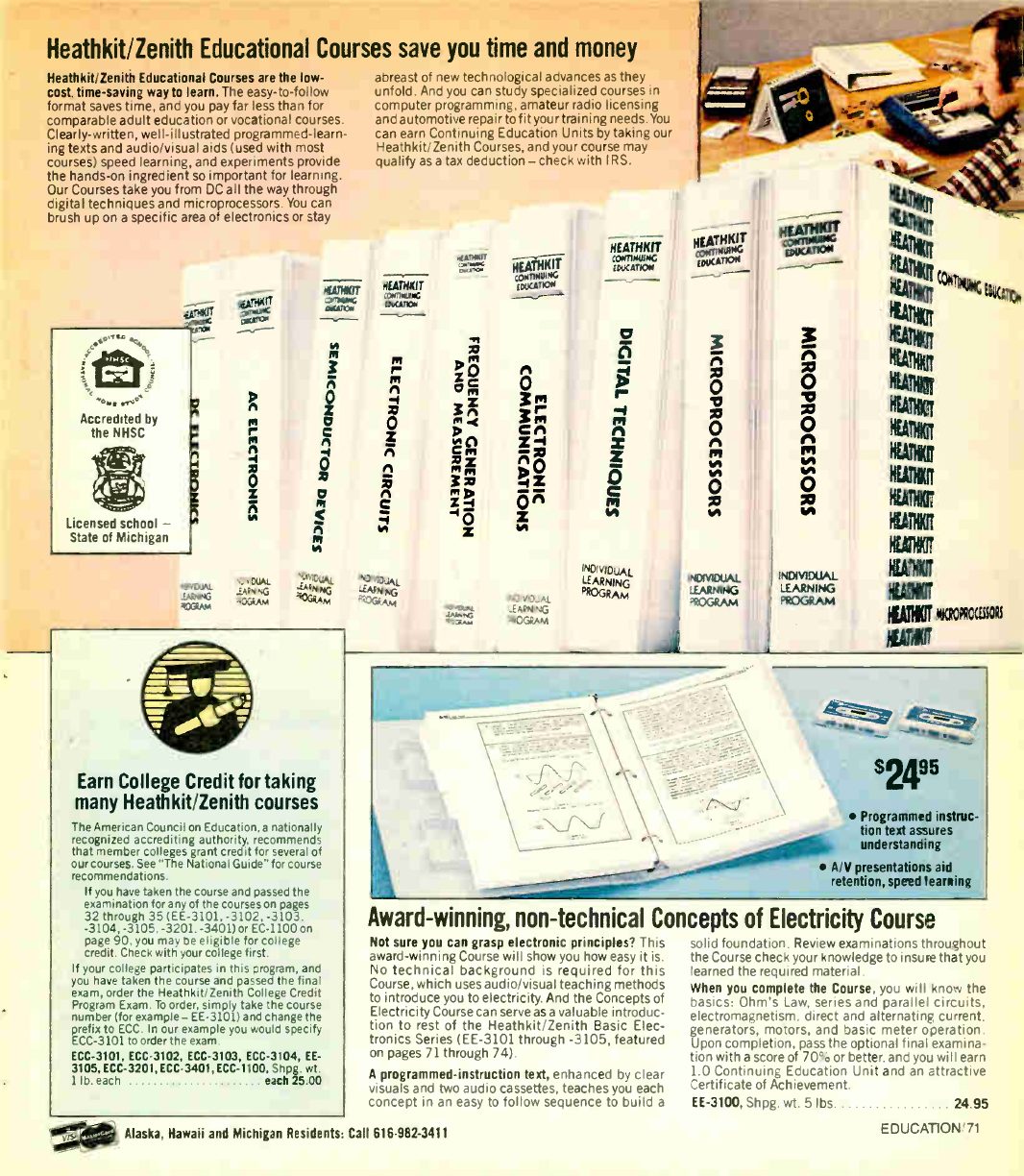
The first was college credit. From Winter 1981 the catalogue reported that “the American Council on Education, a nationally recognized accrediting authority, recommends that member colleges grant credit for several of our courses”. A student who had passed a course’s final examination could order a proctored “College Credit Program Exam” by changing the course prefix to ECC: ECC-3101 for DC Electronics, ECC-3401 for Microprocessors and so on, at $25 each. The eligible courses were EE-3101 to EE-3105, EE-3201, EE-3401 and the EC-1100 BASIC course (Winter 1981; Winter 1981–82, p. 71).
The second was accreditation as a school. The Winter 1981–82 catalogue carries two badges on its education opening: “Accredited by the NHSC” and “Licensed school — State of Michigan”. By Winter 1983–84 the text read: “Heathkit/Zenith Continuing Education is accredited by the National Home Study Council and licensed as a school by the State of Michigan” (Winter 1981–82, p. 71; Winter 1983–84). The National Home Study Council was the accrediting body of the American correspondence schools. Its accreditation put Heath’s courses in the same formal category as the established correspondence schools.
3.4 The A and B revisions, 1981–1983
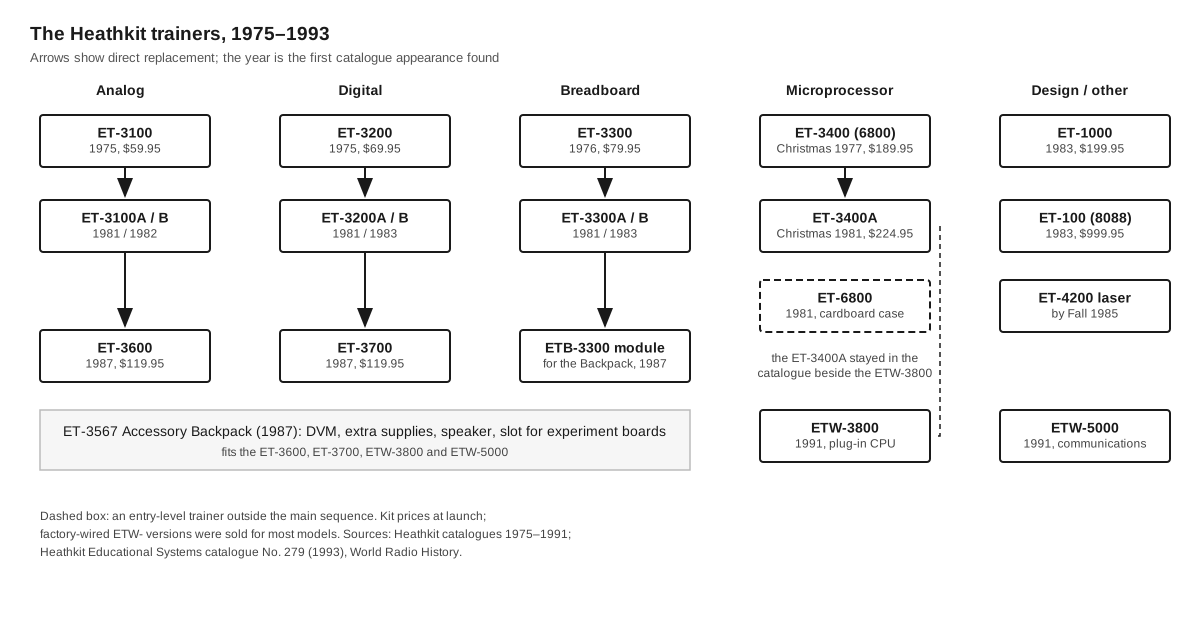
Between late 1981 and 1983 every trainer was revised, and most courses were reissued. The trainers came first. The ET-3100A, ET-3200A, ET-3300A and ET-3400A are all in the Christmas 1981 catalogue (the ET-3100A was first listed in Fall 1981, No. 854, according to Eckweiler). Their changes were mostly to mains safety (three-wire cords, external fuse holders, LED pilots, FCC and UL labelling), and the ET-3400A eventually moved to the 6808 processor with 512 bytes of RAM built in. The catalogue copy shows that change arriving later than the A suffix: in Christmas 1981 and Winter 1981–82 the ET-3400A is still described with the MC6800 and “256 bytes of Random Access Memory (RAM) built-in … expandable to 512”, and the MC6808 with 512 bytes is first found in Christmas 1982 (Christmas 1982) and remains in Fall 1983 (earlier copy and later copy: Winter 1981–82; Fall 1983). The B versions followed: the ET-3100B in Christmas 1982, with stronger supplies and a new generator, and the ET-3200B and ET-3300B in 1983 (Christmas 1981; ET-3100 dive, volume 1; ET-3200 dive, volume 1).
The courses followed in Christmas 1982, when the first A editions appeared: EE-3101A, EE-3102A, EE-3104A and EE-3105A. The records went. Each A course had an optional “Audio-Visual Accessory Package” (EEA-3102A and so on, $19.95) of two cassettes and an illustration booklet (Christmas 1982). Digital Techniques became EE-3201A about 1983, with new units on memories, data conversion and troubleshooting (ET-3200 dive, volume 4).
3.5 The microprocessor series, 1981–1985
Microprocessors became the largest single family. Around the ET-3400A Heath built a sequence of courses:
Table 1 — Microprocessors became the largest single family. Around the ET-3400A Heath built a sequence of courses
| Course | Title | First found | Price then |
|---|---|---|---|
| EE-3401 | Microprocessors (6800) | Christmas 1977 | $89.95 |
| EE-3403 | Voice Synthesis | Christmas 1981 | $129.95 |
| EE-3402 | Microprocessor Interfacing | Christmas 1982 | $99.95 |
| EE-3404 | Advanced Microprocessor (6809, with processor adapter module) | Christmas 1982 | $99.95 |
| EE-3405 | Microprocessor Applications | Winter 1983–84 | $99.95 (Fall 1985) |
| EE-8088 | Advanced 16-bit Microprocessors (8088) | Fall 1983 | $99.95 |
Sources: the catalogues named, World Radio History; the EE-3402 to EE-3404 dates follow the ET-3200 dive, volume 5.
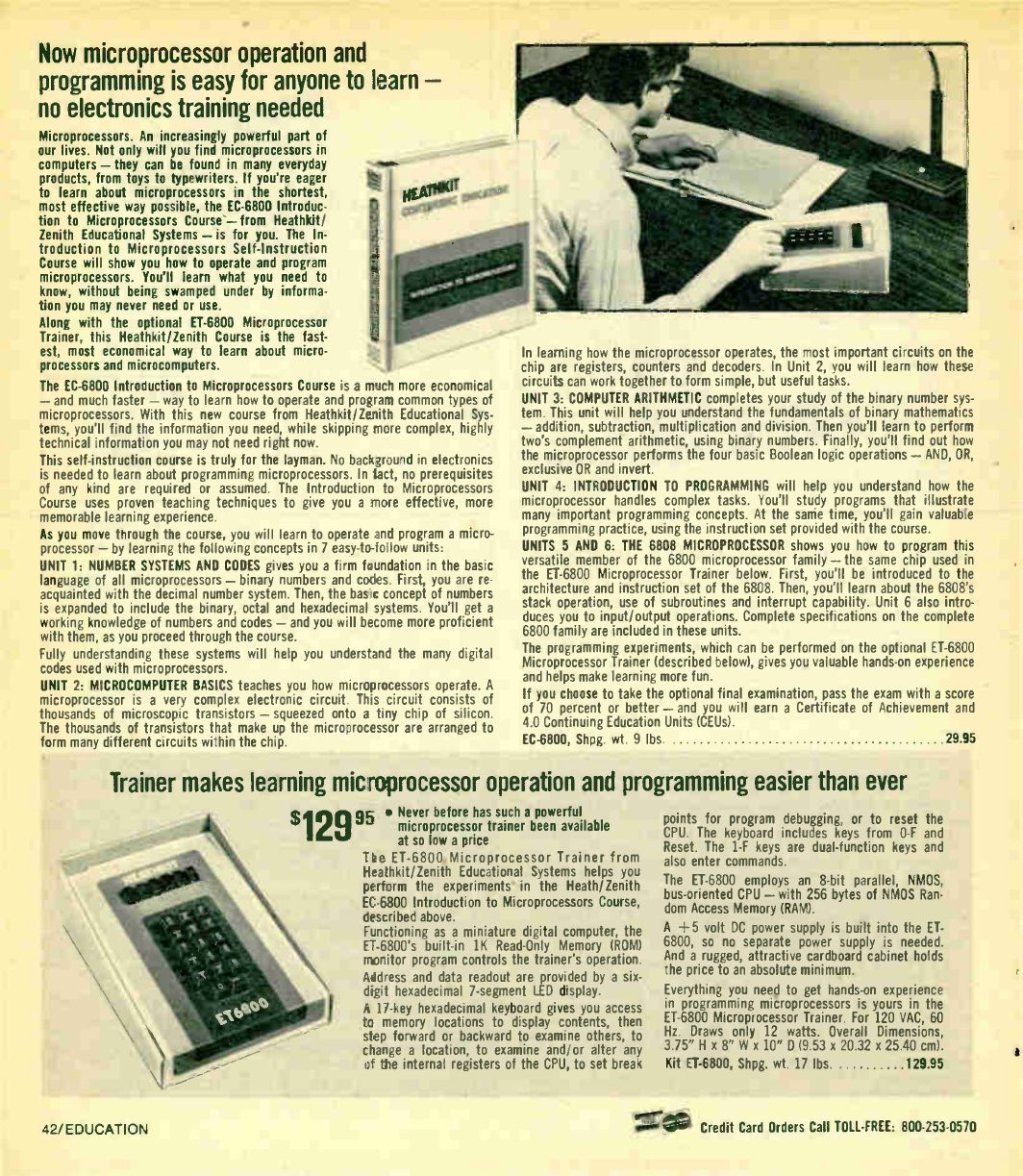
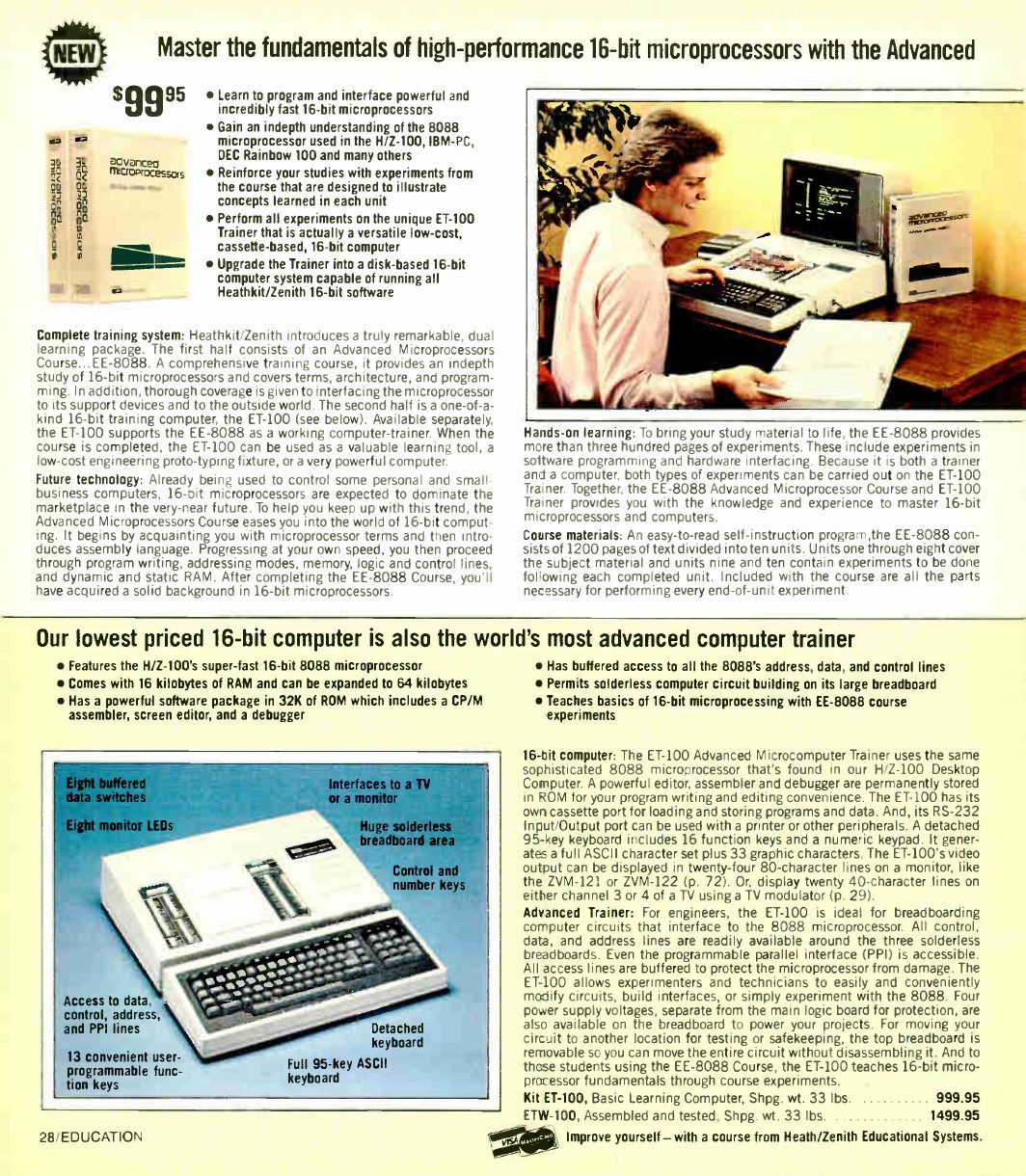
Two new trainers bracketed the ET-3400A. At the bottom was the ET-6800 Microprocessor Trainer of Winter 1981, $129.95 (reduced to $99.95 within a year), sold with the EC-6800 Introduction to Microprocessors course ($29.95) for students “with no electronics training”. It had a hexadecimal keypad, 256 bytes of RAM and a built-in 5-volt supply, and it came in “a rugged, attractive cardboard cabinet” that “holds the price to an absolute minimum” (Winter 1981, p. 42). It is the only Heath trainer found with a cardboard case. At the top was the ET-100 Advanced Microcomputer Trainer of Fall 1983. It had the 8088 of the H/Z-100 desktop computer, an editor, assembler and debugger in ROM, a detached 95-key keyboard, video output and three solderless breadboards with all the processor’s lines buffered to them. It cost $999.95 as a kit and $1,499.95 assembled, and an ETA-100 expansion accessory ($1,299.95) enlarged it further (Fall 1983, p. 28). The ET-100 later became the trainer for three computer-servicing courses (below).
3.6 Designing circuits: the ET-1000 and the Engineering Design Series
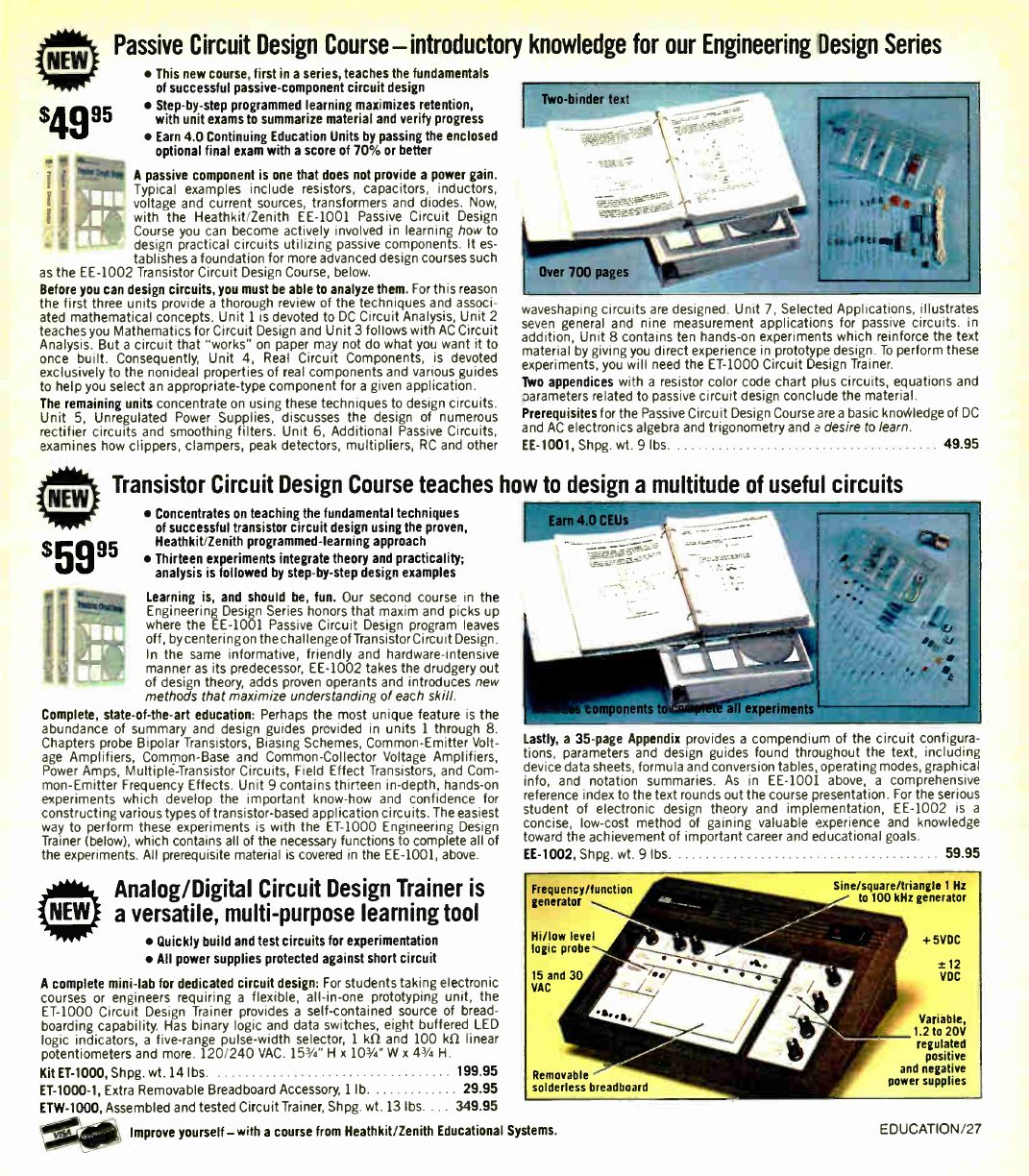
The Fall 1983 catalogue introduced a series aimed at people who already knew the theory and wanted to design. The Engineering Design Series began with EE-1001 Passive Circuit Design ($49.95, more than 700 pages, with unregulated supplies, clippers, clampers and “seven general and nine measurement applications”) and EE-1002 Transistor Circuit Design ($59.95). EE-1003 Analog Circuit Design ($69.95) followed by Fall 1985, and EE-1004 Digital Circuit Design ($99.95) by Spring 1986 (Fall 1983, p. 27; Fall 1985; Spring–Summer 1986).
Their trainer was the ET-1000 Circuit Design Trainer, $199.95 as a kit and $349.95 assembled. It combined the ET-3100’s analog facilities with the ET-3200’s digital ones: variable positive and negative supplies, a signal source with a five-range selector, 1 kΩ and 100 kΩ potentiometers, logic and data switches, eight buffered LED indicators, and a removable breadboard block (Fall 1983, p. 27). It was the first “two trainers in one”, as the 1993 catalogue called it, and it outlived the design courses. By 1987 it was the trainer for the Data Communications and Networks course (EB-8090), and it was still in the 1993 catalogue (volume 4).
3.7 Robots as trainers
The HERO robots were educational products first. Their name was an acronym, Heathkit Educational RObot, and they carried ET model numbers: the HERO 1 was the ET-18 and the HERO 2000 the ET-19. The robots themselves are documented in the Robots category (HERO 1 on the Robots site), and their place in the company story is in the history dive, volume 5. This section covers the courses written for them.
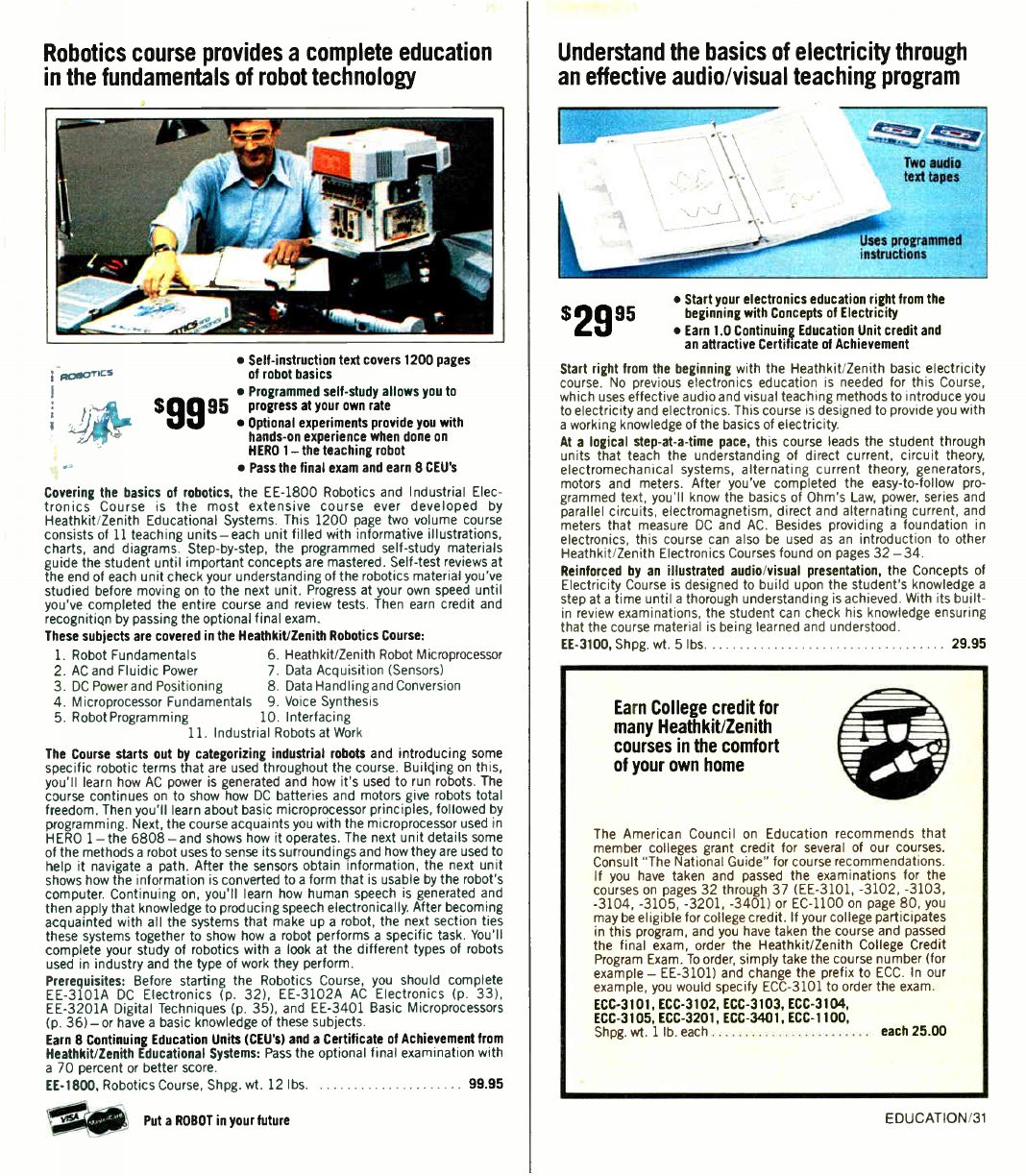
The first was EE-1800 Robotics and Industrial Electronics, found from Winter 1983 and priced at $99.95 in Fall 1983. The catalogue called it “the most extensive course ever developed by Heathkit/Zenith Educational Systems”: 1,200 pages in two volumes and eleven units, from robot fundamentals, AC and fluidic power, and DC power and positioning, through microprocessors and the HERO 1’s own 6808, to sensors, data conversion, voice synthesis, interfacing and “Industrial Robots at Work”. Its experiments were optional and were done on the HERO 1. It earned 8 CEUs, and its prerequisites were the DC, AC, Digital Techniques and Microprocessor courses or equivalent knowledge (Fall 1983, p. 31). The course and the robot together were sold as the EES-1800 at $1,374.70 in Fall 1985. EE-1812 Robot Applications ($99.95) and a HERO 1 Advanced Experiments book (EB-1802) followed (Fall 1985).
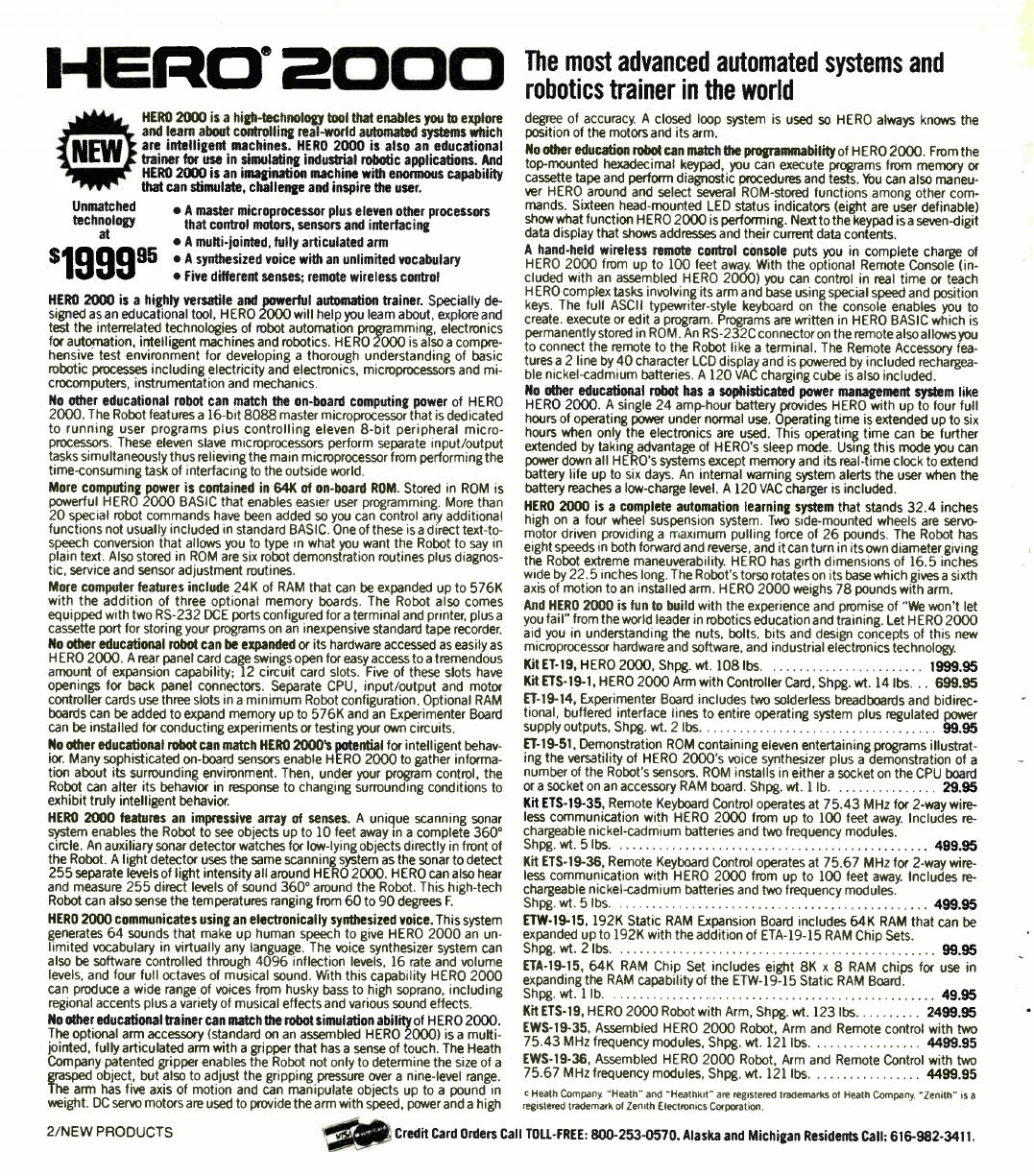
The HERO 2000 of Spring 1986 was sold explicitly as a trainer: “the most advanced automated systems and robotics trainer in the world”, “specially designed as an educational tool” for “robot automation programming, electronics for automation, intelligent machines and robotics”. It had an 8088 master processor controlling eleven 8-bit slave processors, an articulated arm, a speech synthesiser and five senses. The kit cost $1,999.95, $2,499.95 with the arm, and the assembled EWS-19-35 with arm and remote control $4,499.95 (Spring–Summer 1986, p. 2). Its courses were EE-1900 Intelligent Machines and EE-1901 Electronics for Automation, and a programming book (EB-1950). In the classroom course tables of 1986 and 1987 the “trainer” column for these courses is the assembled HERO 2000, at $4,499.95 (Fall 1987, p. 73).
3.8 Lasers, fibre optics and computer servicing, 1983–1987
The middle 1980s added subjects faster than any other period.
- Fibre optics. EE-4201, $99.95 in Fall 1983, was a five-unit course on optical energy, fibres, sources, receivers and complete systems. It included parts for a two-way fibre link, and it used an ET-3400 or ET-3200A as the trainer (Fall 1983).
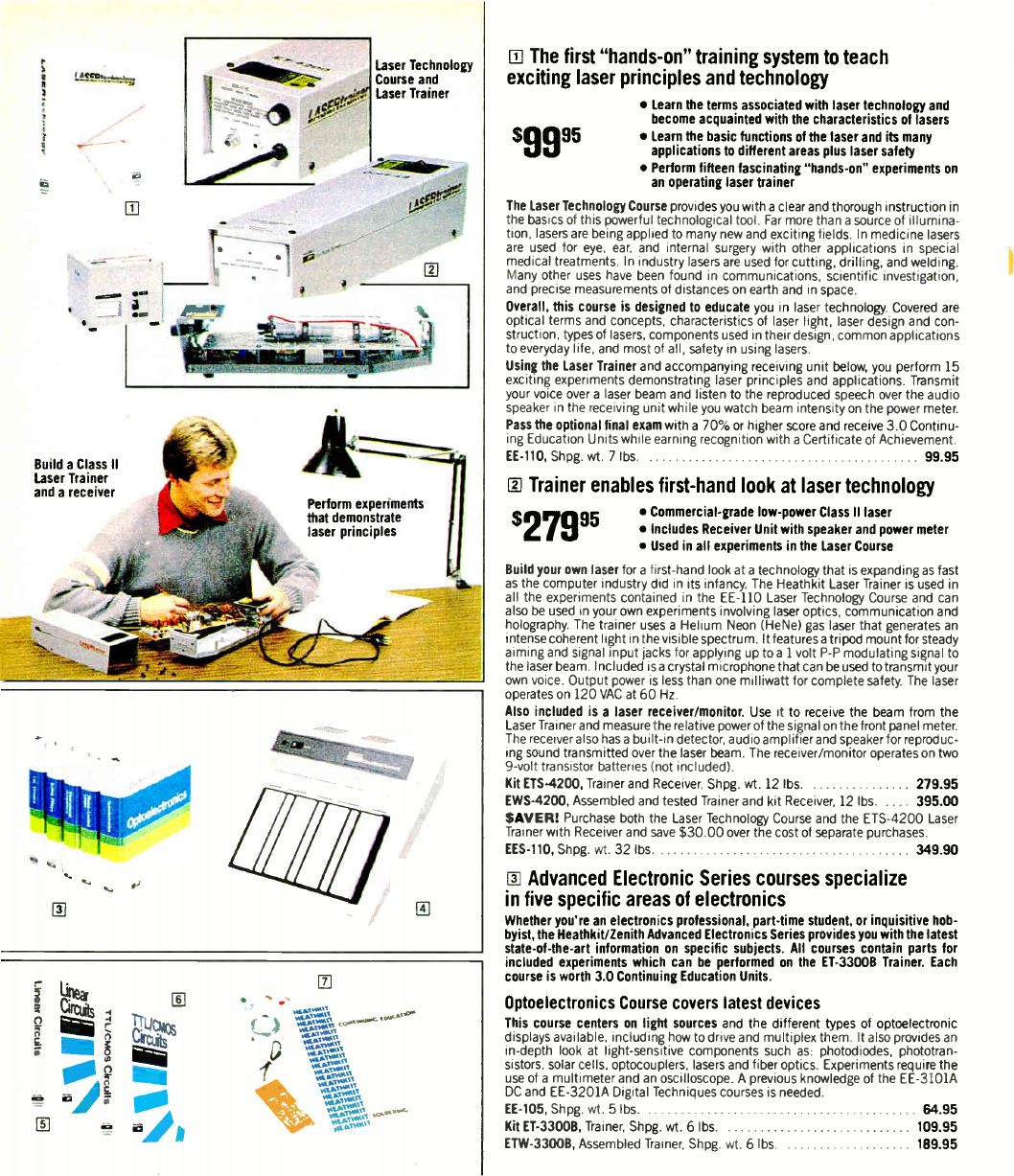
- Lasers. The ET-4200 Laser Trainer was in the catalogue by Fall 1985. By Spring 1986 it came with the EE-110 Laser Technology course ($99.95; “the first ‘hands-on’ training system to teach exciting laser principles and technology”). The kit (ETS-4200, $279.95) was a helium-neon Class II laser of under one milliwatt on a tripod, with a modulation input and crystal microphone, and a receiver with meter and speaker, so that a student could send speech over the beam and hear it at the receiver (Spring–Summer 1986). An Electro-optics course (EB-611) followed by 1987.
- Computer servicing. Spring 1986 introduced EC-2001 Computer Fundamentals, EC-2002 Computer Peripherals and EC-2003 Computer Maintenance, all on the ET-100 trainer. They were aimed at the growing trade of the computer technician (Spring–Summer 1986).
- Video. A “Heathkit Video Training Series” on Microprocessors, Digital Techniques and Soldering was offered from 1986, “through video animation techniques” (Spring–Summer 1986, p. 57).
- Software. Programming courses kept pace with the computers: Microsoft BASIC, Pascal, assembly language for the 8088, and an AutoCAD course (EB-609) for the H/Z-100 (Spring–Summer 1986).
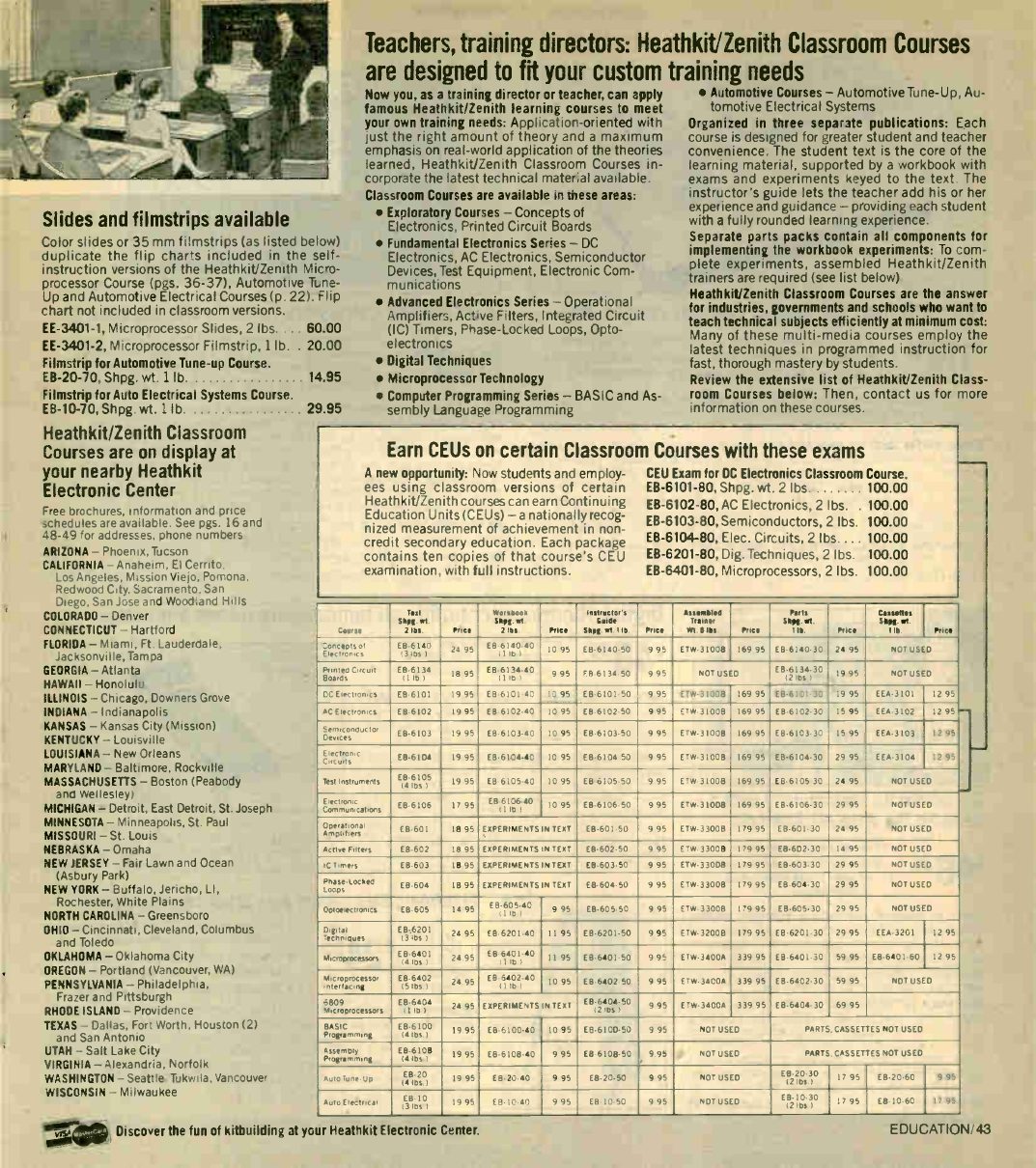
The Fall 1983 catalogue also showed where classroom courses could be seen: they were “on display at your nearby Heathkit Electronic Center”, and the page listed the stores state by state. Classroom students could now earn CEUs too, through a set of classroom examination packages (EB-6101-80 and so on) at $100 each (Fall 1983, p. 41).
3.9 The classroom trainers of 1987
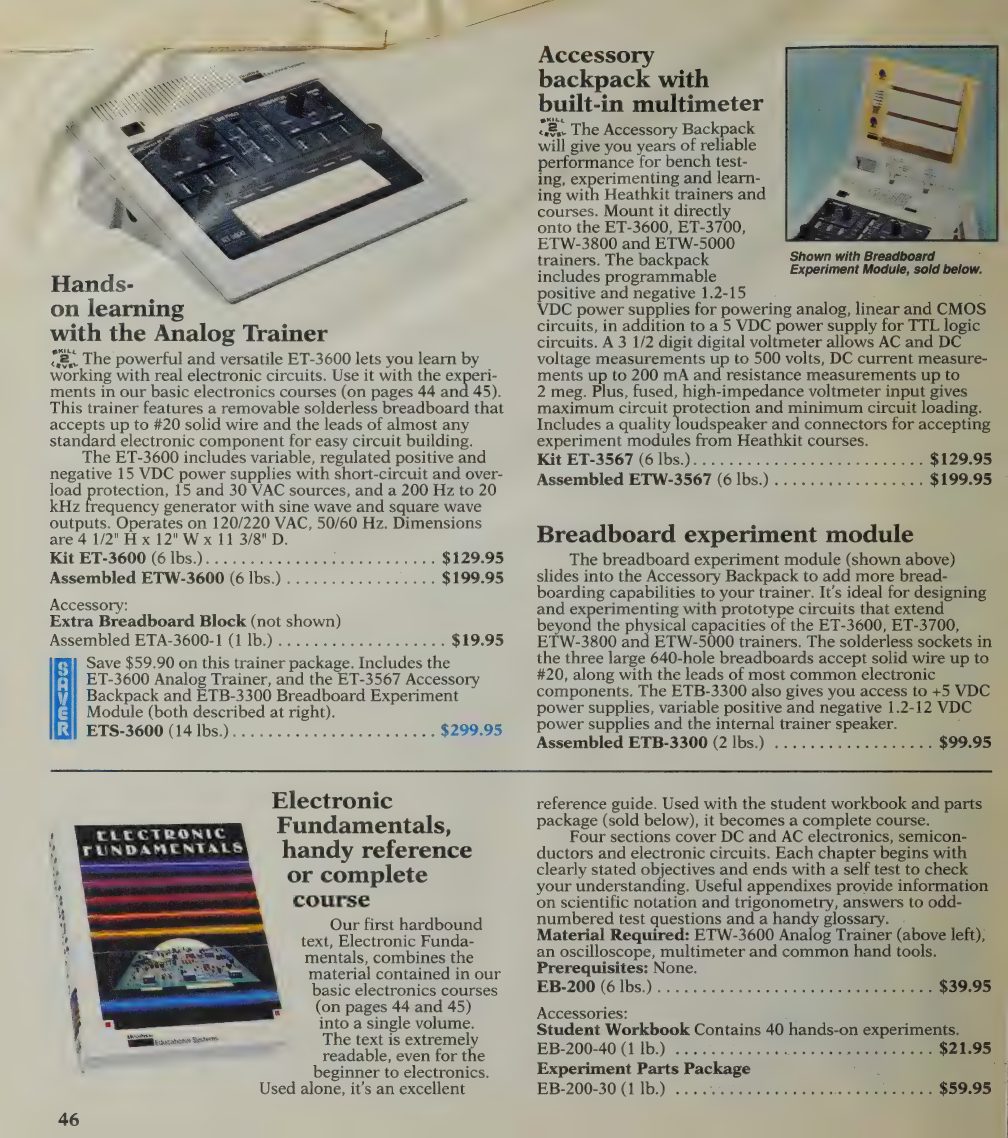
The largest hardware change of the Zenith years came in Fall 1987. The ET-3600 Analog Trainer and ET-3700 Digital Trainer replaced the ET-3100B and ET-3200B at $119.95 each as kits and $199.95 assembled. Both were designed to carry the ET-3567 Accessory Backpack, a unit that mounted on the trainer and added a digital multimeter, extra supplies, a loudspeaker and a slot for plug-in experiment boards. The kit dives describe them: the ET-3100 dive for the ET-3600 and the ET-3200 dive, volume 5 for the ET-3700 and its ETB-6201 pre-wired experiment board.
For the category the point is the change of method. The 1975 trainers were built for a student with a bag of loose parts. The 1987 trainers were built for a laboratory that had to reset thirty benches between classes. The pre-wired experiment boards let a student perform “40 prewired experiments”, and could serve “as a fault board for demonstrating trouble shooting techniques”. The new trainers had removable breadboard blocks, which, as the 1993 catalogue later put it, allowed “more than one student to build circuits at the same time”. The Fall 1987 catalogue listed all the classroom courses in one table with text, workbook, instructor’s guide, assembled trainer, parts and cassettes as columns (Fall 1987, p. 73). That table (reproduced in volume 6) is the most complete single list of the line at its peak.
3.10 The last kit years, 1988–1991
The kit catalogues shrank after 1987, and the education pages became a larger share of what was left. The Winter 1991 catalogue (No. 223), the last general catalogue in the World Radio History archive, gave education about eighteen pages (Winter 1991, pp. 44–59). It shows four changes:
- The name had become Heathkit Educational Systems, “licensed by the state of Michigan and accredited by the National Home Study Council”.
- The core courses had been rewritten again. The “newly revised” DC Electronics, EE-3101-B ($49.95), had 21 experiments and came with “5.25” and 3.5” MS-DOS course review disks”, and it now required the ET-3600.
- A new microprocessor trainer, the ETW-3800, took plug-in CPU modules: the ETC-6811 (Motorola 68HC11) or the ETC-8085 (Intel 8085). It had an RS-232 port, a built-in “sonic logic probe” and “data-saving circuitry”. With a module it cost $695 as the EWS-6811 or EWS-8085, and it had its own courses, EE-3810 8-Bit Microprocessor Programming and the 8085 series. The ET-3400A stayed in the catalogue beside it at $279.95.
- New subjects appeared in the course table: surface-mount technology (EB-3135), linear IC electronics (EB-615), “Applied Physics” (EW-4300 Fundamentals of Mechanical Devices, on an ET-4400 trainer at $649), and telecommunications (EB-5010 Telephone Systems and EB-5020 Communications Systems, on the ETW-5000 trainer).
The same issue carried a reply card for “your free copy of HomeWorks by Heathkit”, “the new home-study catalog”. That was a separate education catalogue for individual students, which the business would need once the kits had gone (volume 4).
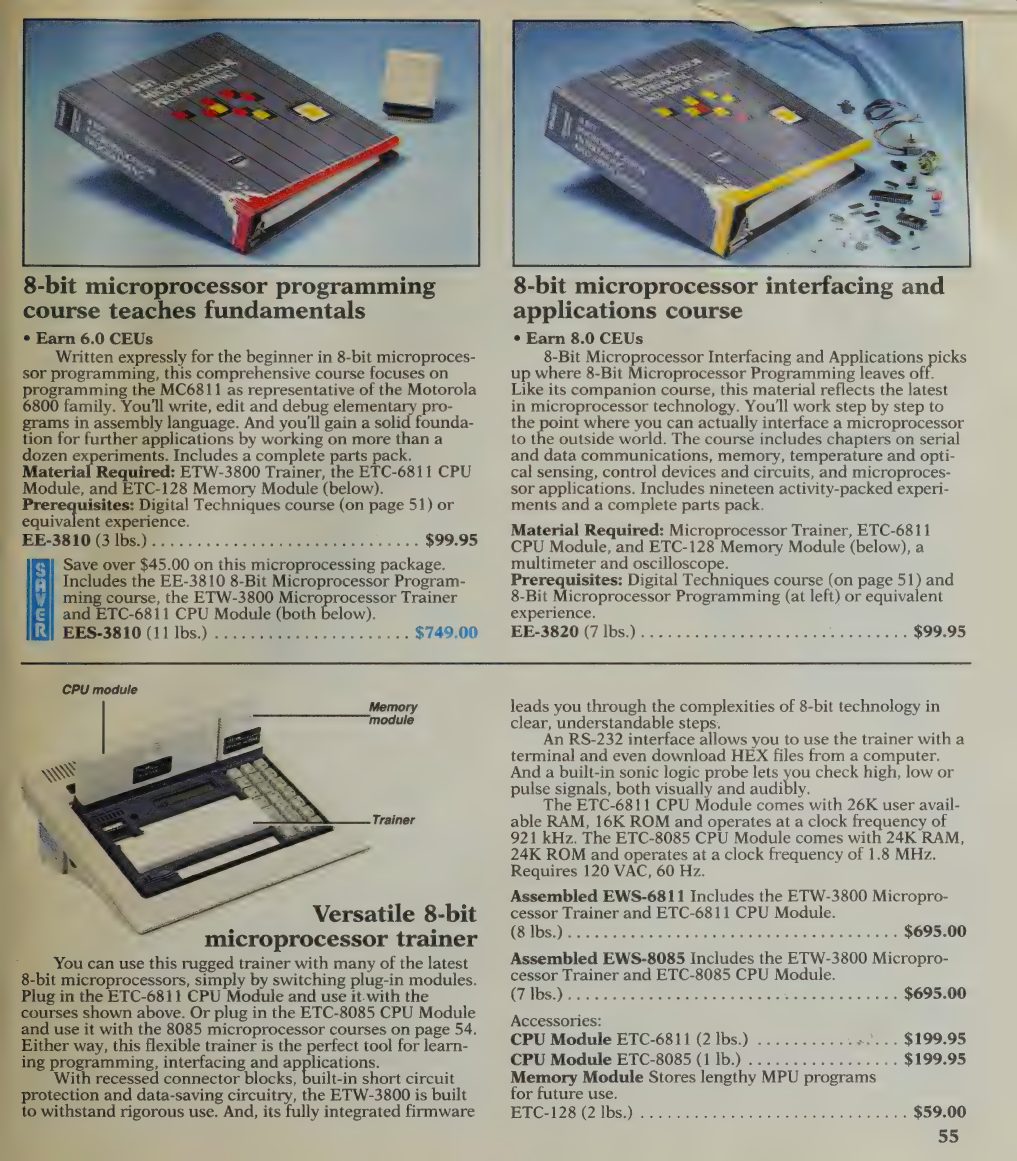
In March 1992 Heath announced the end of the kits (history dive, volume 6). The educational business was not part of that decision. It had by then its own name, its own catalogues, its own trainers and its own customers, and it carried on in the same building. Its next twenty years are the subject of volume 4.
Sources
- Frenzel, Lou. “The History of Personal Computers, Part 2: The Heathkit Story.” Electronic Design, 30 December 2013. https://www.electronicdesign.com/technologies/communications/article/21799215/the-history-of-personal-computers-part-2-the-heathkit-story
- Heathkit/Zenith Educational Systems & Instruments catalogue 811-29R (about 1980–81). https://www.worldradiohistory.com/Archive-Catalogs/Heathkit-Catalogs/Heathkit-1975-Zenith%20Educational%20Systems-811-29R.pdf
- Heathkit catalogues, World Radio History (https://www.worldradiohistory.com/Archive-Catalogs/Heathkit_Catalogs.htm): 1980 (848); Winter 1981; Christmas 1981; Winter 1981–82; Christmas 1982; Winter 1983; Fall 1983; Winter 1983–84; Spring 1984; Fall 1985; Spring–Summer 1986; Fall 1986; Fall 1987; Winter 1991 (223).
- ET-3100 dive: https://heathkit.fubsypoly.com/et-3100-analog-trainer/vol-1/ ; ET-3200 dive: https://heathkit.fubsypoly.com/et-3200-digital-trainer/vol-1/
- HERO 1 (ET-18), Robots site: https://heathkit.fubsypoly.com/hero-1-et-18/
- Heathkit history dive, volumes 5 and 6. https://heathkit.fubsypoly.com/heathkit/vol-5/
Comments (0)