ET-3200 Digital Trainer · Volume 1
The Digital Trainer That Came with a Course
The Heathkit ET-3200 Digital Design Experimenter is a flat, self-contained bench unit, about the size of a large hardcover book, that holds everything needed to build and watch simple logic circuits except the chips themselves. It has three regulated power supplies, four data switches, two debounced pulse switches, a three-speed clock, a mains-derived square wave, four LED logic indicators, and a solderless breadboard long enough for eight 14- or 16-pin ICs. Heath introduced it in the Christmas 1975 catalogue as the laboratory half of a new home-study course, EE-3201 Digital Techniques, and sold it in three versions (ET-3200, ET-3200A and ET-3200B) and as factory-wired ETW- models for more than a decade. Its successor, the ET-3700, kept its layout almost unchanged.
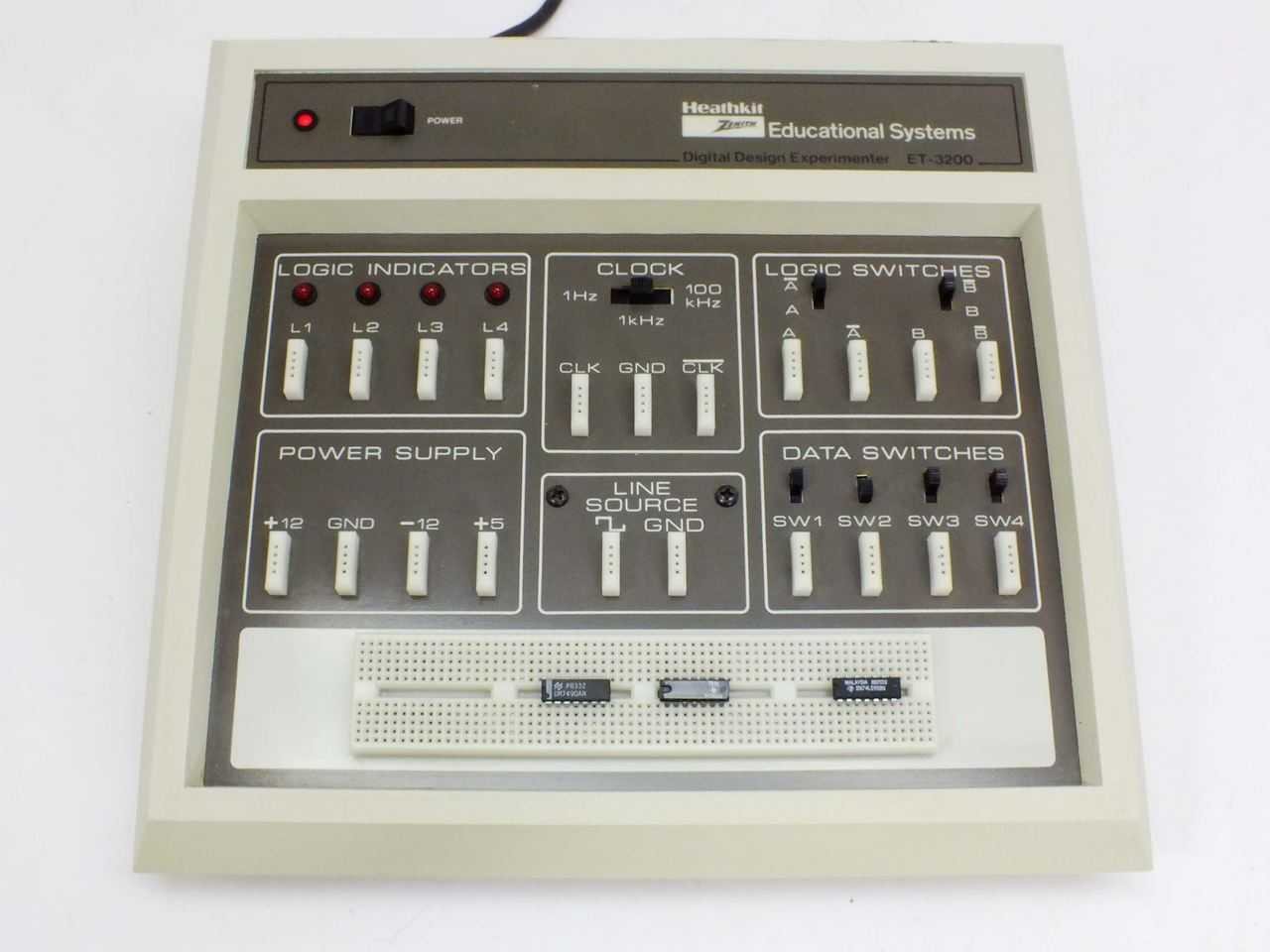
This volume places the trainer in Heath’s line, dates its launch and revisions from the catalogues, and sets out who it was for. The circuit is in volume 2, the kit build in volume 3, and the courses it served in volume 4. Volume 5 covers the ET-3400 microprocessor trainer and the later ET-3700. The Heath Company’s own story (Schlumberger ownership, the Zenith purchase of 1979 and the end of kits in 1992) is told in the site history dive and is not repeated here.
1.1 What the trainer is for
A digital circuit is easy to draw and awkward to try out. A student with a handful of TTL chips needs a clean 5-volt supply, some way of setting inputs to a definite 0 or 1, some way of seeing outputs, and a clock slow enough to watch. Before trainers like this one, each of those was a separate item on the bench: a power supply, a row of toggle switches with pull-up resistors, LEDs with their own drivers, and a pulse generator. The ET-3200 puts them all behind one panel and wires them to spring-contact terminal blocks, so a circuit on the breadboard is connected to them by short lengths of solid hook-up wire.
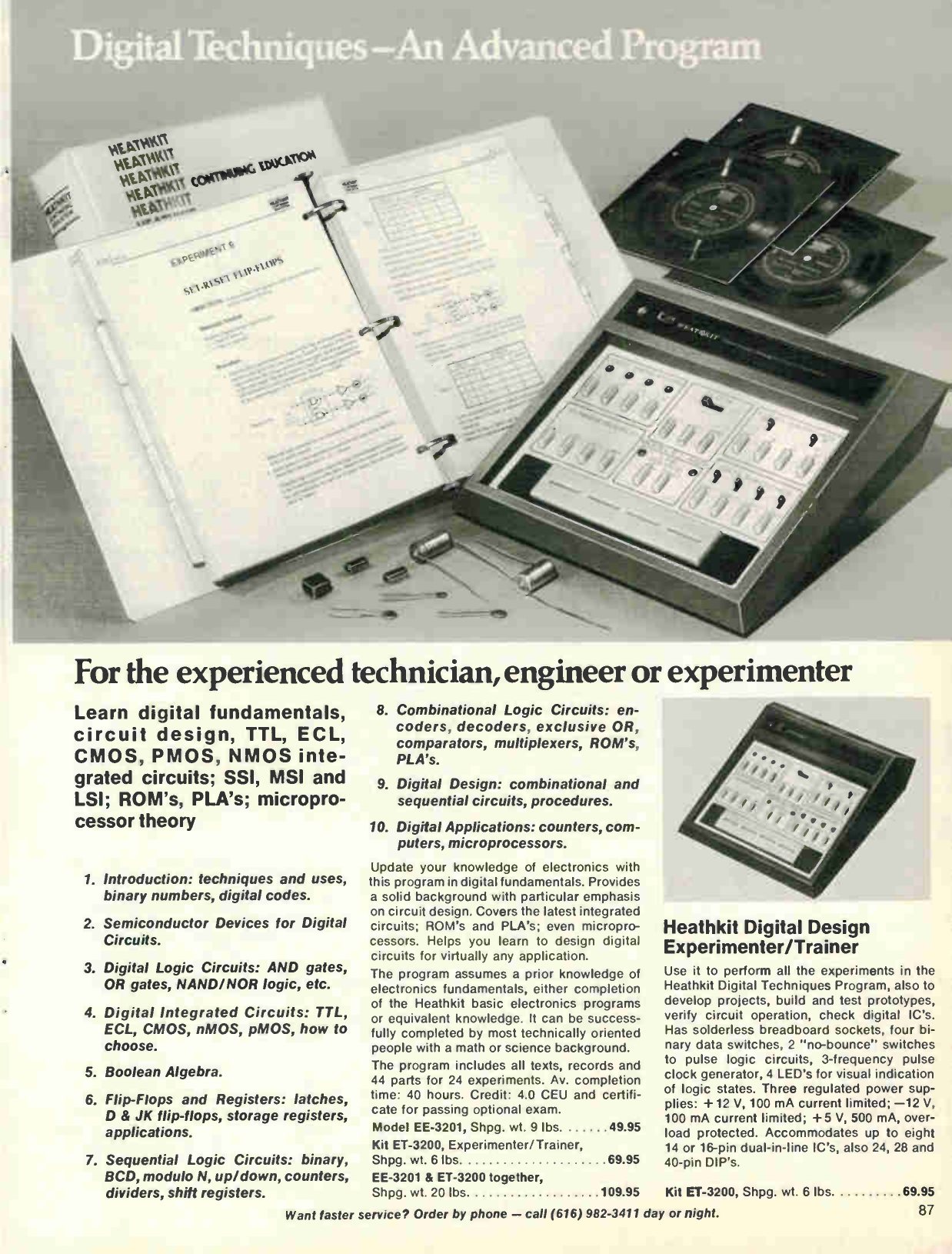
Heath listed the features in the first advertisement. The unit had three regulated supplies: +12 V at 100 mA and −12 V at 100 mA, both current-limited, and +5 V at 500 mA with overload protection. It had four binary data switches (+5 V or 0 V, 10 mA maximum each) and two “no bounce” spring-return logic switches for pulsing circuits. A three-frequency clock gave 1 Hz, 1000 Hz and 100 kHz within ±20 per cent, as a 5-volt rectangular wave in normal and complementary forms. Four red LEDs showed logic states. The breadboard socket had 128 five-point terminal strips arranged in 64 pairs. Heath claimed compatibility with DTL, TTL, CMOS, nMOS and pMOS, and said RTL and ECL could be accommodated “with minor circuit additions” (Christmas 1975 catalogue, p. 65).
The assembly manual adds one output the catalogue did not mention: a line-frequency square wave taken from the power transformer. It runs at 60 Hz (or 50 Hz abroad) and has the accuracy of the mains frequency, which the manual puts at 0.1 per cent. It gave students a known frequency against which to check a counter or divider (ET-3200 manual, Operation and Applications, p. 34).
1.2 Launch: Christmas 1975
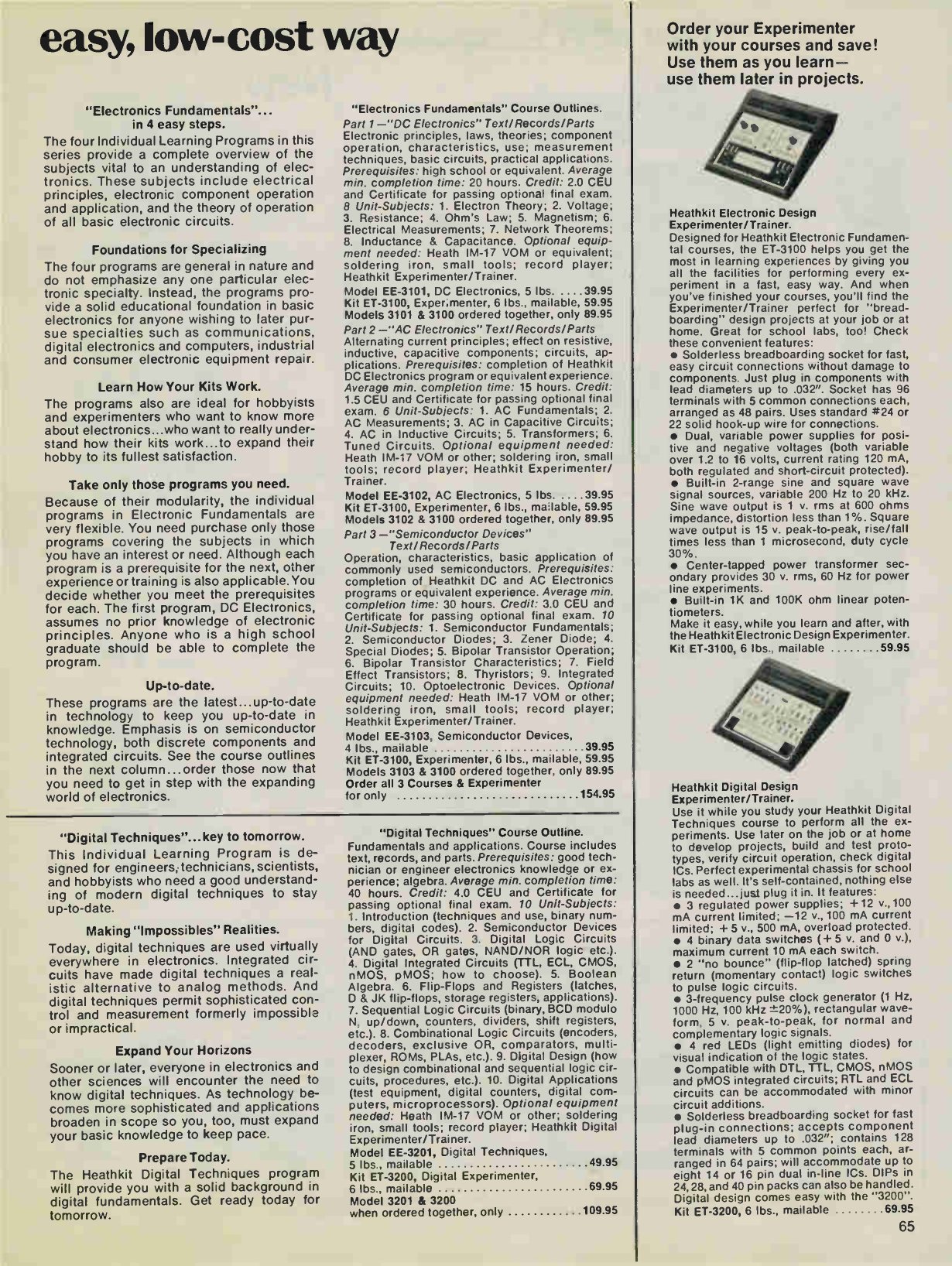
The trainer and its course arrived together, as part of the first announcement of Heathkit Continuing Education. The Christmas 1975 catalogue opened with a President’s Letter from David W. Nurse listing “three noteworthy milestones” for the issue. The first was “the introduction of the Heathkit Continuing Education series”, which he described as a new endeavour “created to bring you interesting, up-to-date individual learning programs and self-instructional products”. The other two were the AT-1’s twentieth anniversary with three new amateur transceivers, and the largest number of new products Heath had ever introduced at one time (Christmas 1975 catalogue, p. 51). Bob Eckweiler identifies the issue as catalogue No. 806 (Eckweiler, Heathkit of the Month #129).
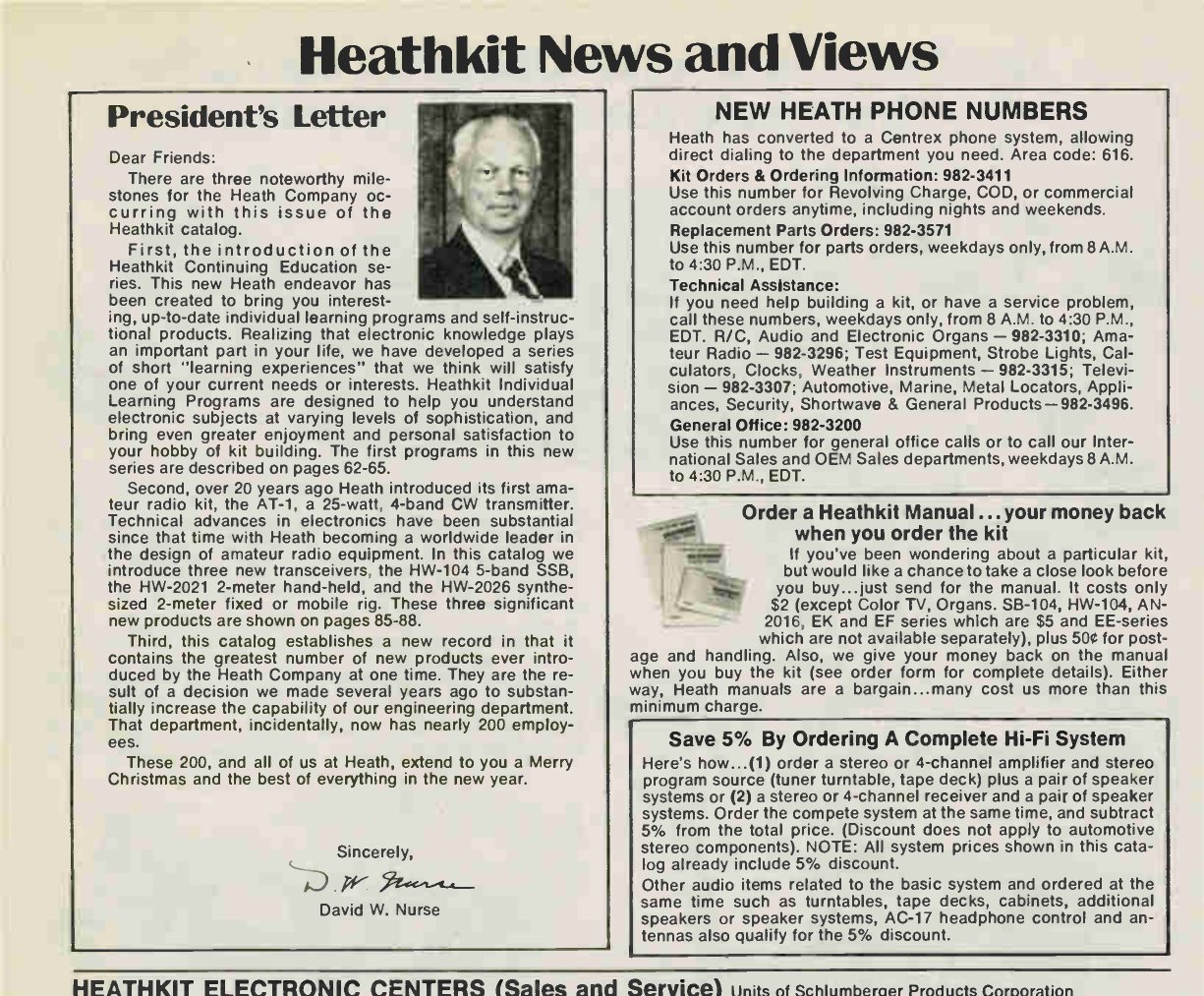
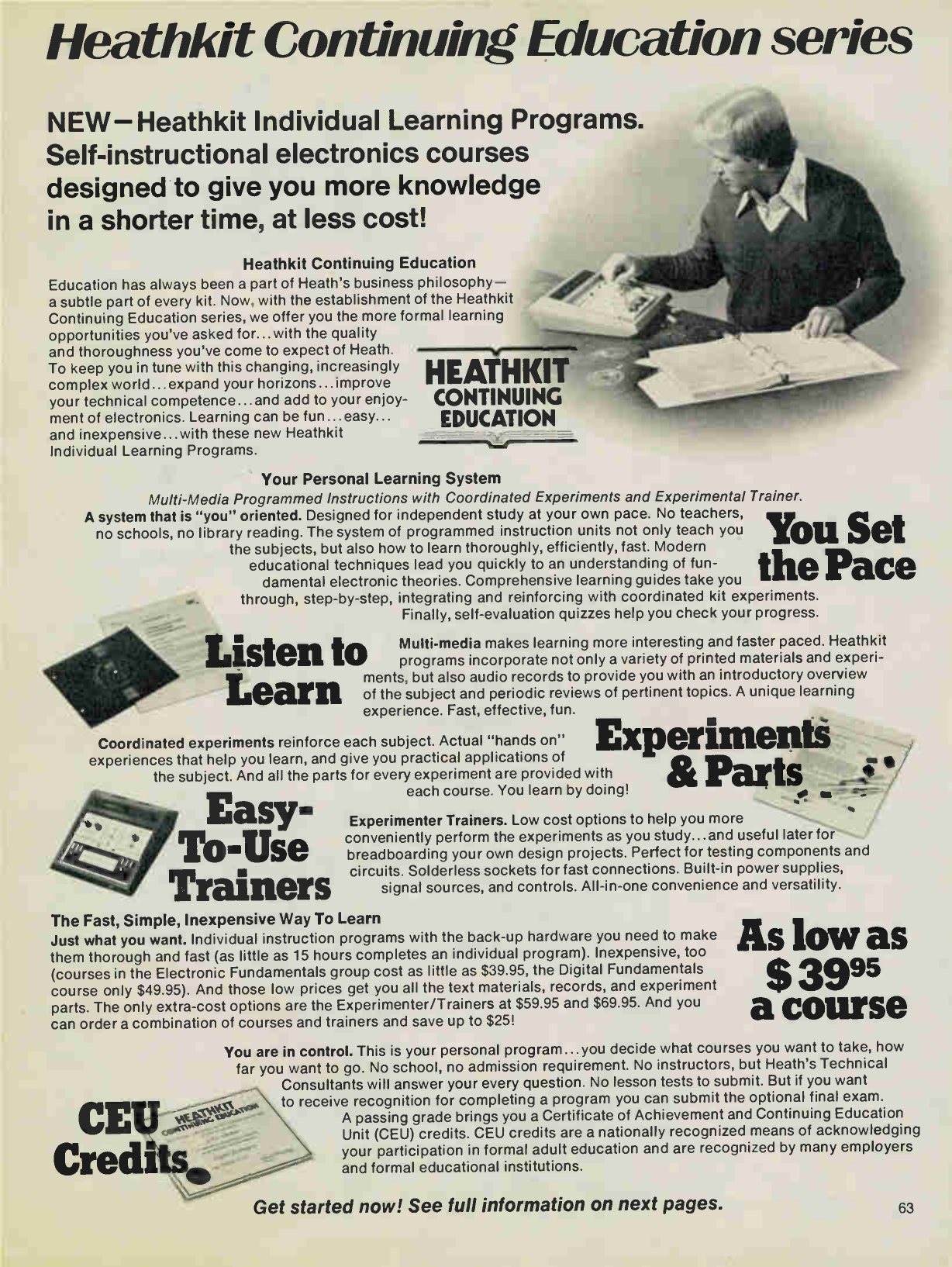
The course section ran to four pages. It set out the format: programmed texts in binders, audio records for spoken overviews and reviews, the parts for every experiment in the box, and an optional final examination. A pass earned a Certificate of Achievement and Continuing Education Units (CEUs), which the copy called “a nationally recognized means of acknowledging your participation in formal adult education”. There was no admission requirement and no instructor, but Heath’s technical consultants would answer questions. Two courses and two trainers were the core of the offer:
- Electronics Fundamentals, three courses at $39.95 each (EE-3101 DC Electronics, EE-3102 AC Electronics, EE-3103 Semiconductor Devices), all using the ET-3100 Electronic Design Experimenter at $59.95. A fourth course, Electronic Circuits, was promised for early 1976.
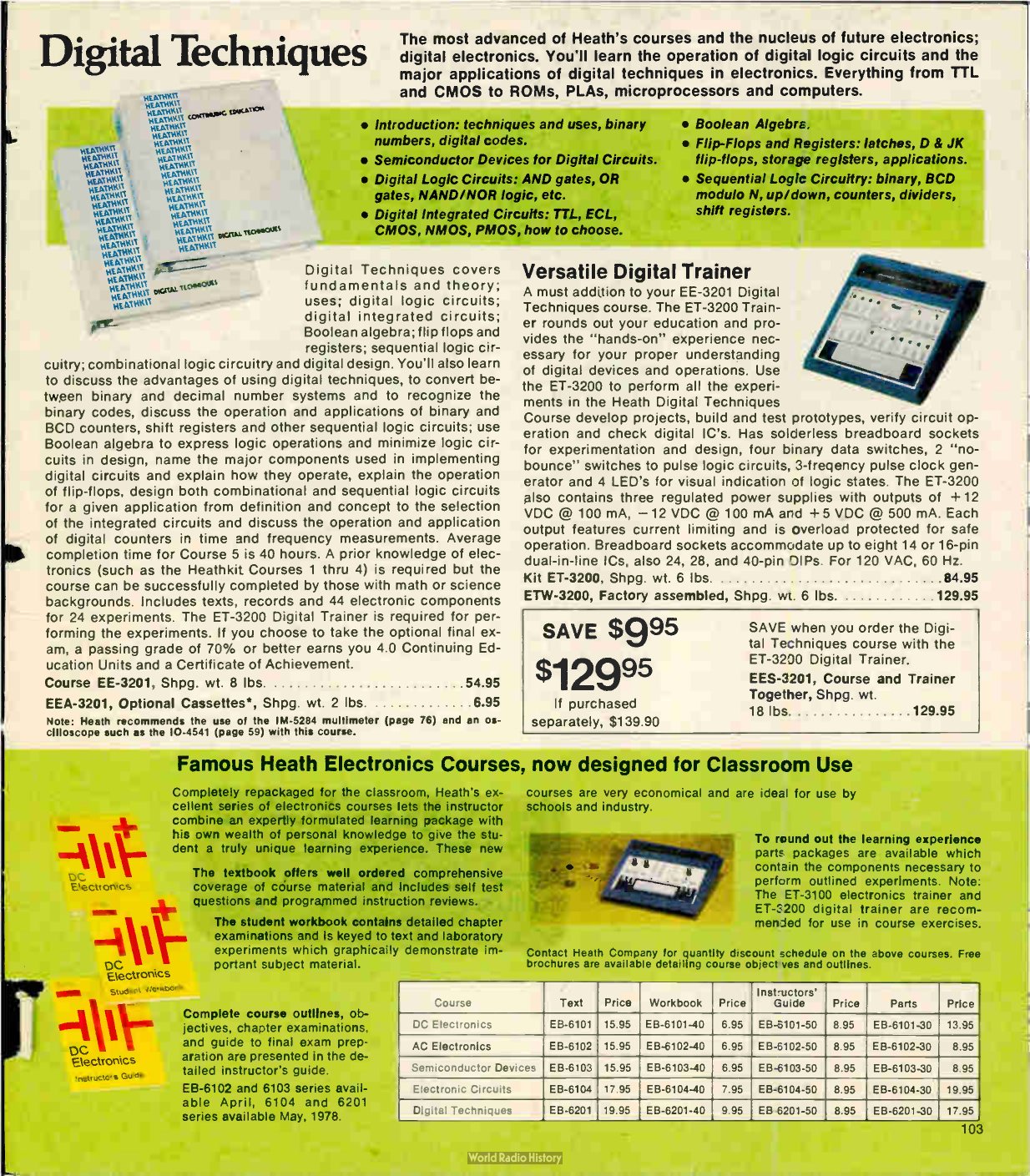
- Digital Techniques, one course at $49.95 (EE-3201), using the ET-3200 Digital Design Experimenter at $69.95. The two together cost $109.95.
The digital course was aimed higher than the fundamentals series. The catalogue said it was designed for “engineers, technicians, scientists, and hobbyists”, and its prerequisites were “good technician or engineer electronics knowledge or experience; algebra”. Average minimum completion time was given as 40 hours and the credit as 4.0 CEU (Christmas 1975 catalogue, pp. 63–65).
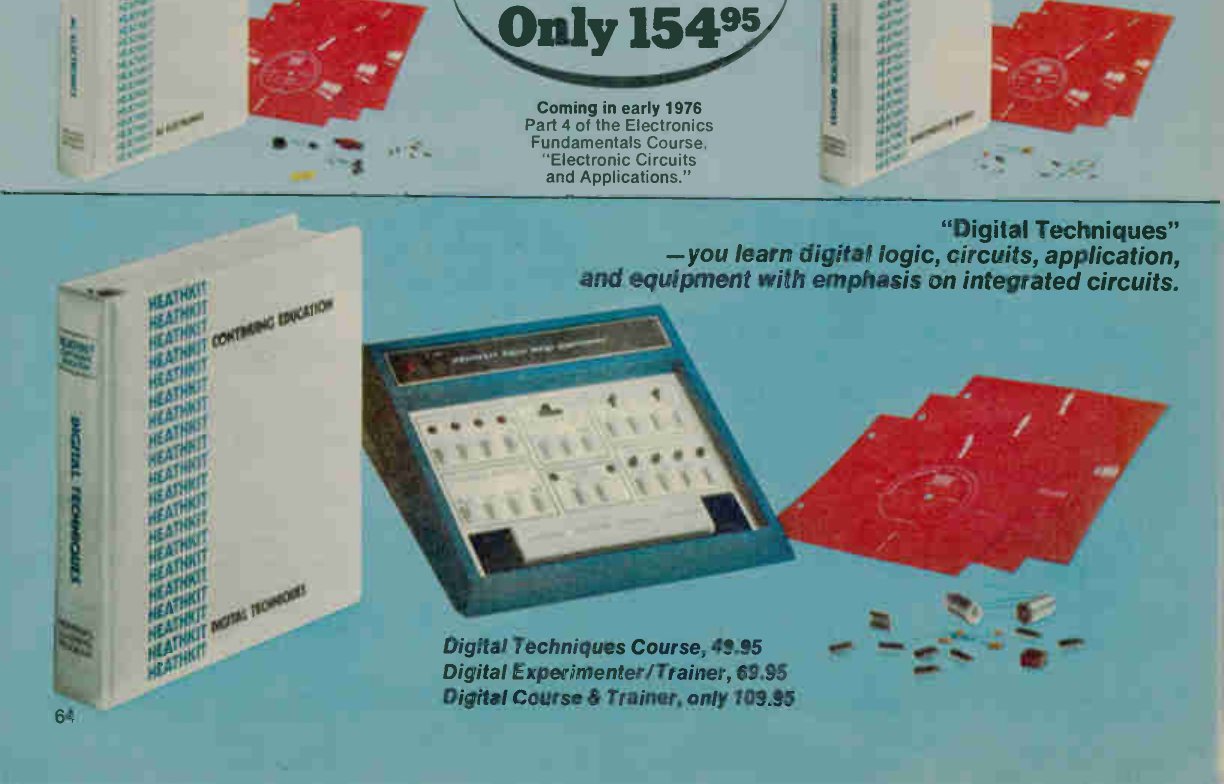
The manual confirms the date. Its title page carries “Copyright © 1975 Heath Company”, and the schematic in the illustration booklet carries the same line (ET-3200 manual; schematic). The March 1974 catalogue text and an OCR pass over the 1974 catalogue (No. 810-74) show no ET-series trainers.
1.3 Where the ET-3200 sat in Heath’s line
Heath had sold educational kits long before 1975. It sold the EC-1 analog computer, “How to use and understand” courses for its VTVM, oscilloscope and signal generator, and 1960s laboratory equipment for university physics and instrumentation courses (Eckweiler #129). What was new in 1975 was a numbered, sequenced curriculum sold by mail with a matching trainer for each branch of it. The model numbers show the plan. EE-31xx courses went with the ET-3100 analog trainer, EE-3201 with the ET-3200, and from Christmas 1977 EE-3401 with the ET-3400 microprocessor trainer. The number 3300 went to a general-purpose laboratory breadboard, the ET-3300, introduced in Spring 1976 “for experimenters, students and design engineers” and later required for the advanced analog courses (Spring 1976 catalogue).
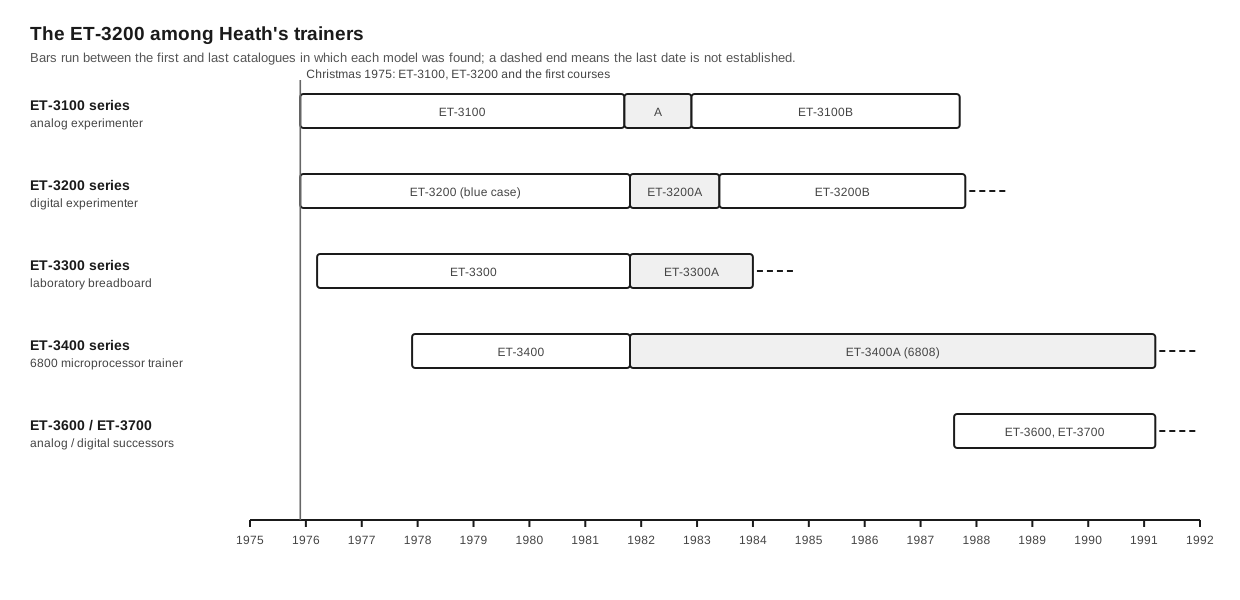
The ET-3200 is best understood beside its analog twin, the ET-3100. Both shared a cabinet size, 12⅛ × 11¾ × 3½ inches and about 4 lb (ET-3200 manual, Specifications; Eckweiler #129, Table I). Both put the controls on a sloping panel above a breadboard strip, and in both the single circuit board is also the front panel: its component side is silk-screened with the legends, and the cabinet top frames that area while hiding the strip of small components along the board’s upper edge (volume 3 describes the ET-3200’s version). They differed in what the panel offered. The ET-3100 had two variable supplies (1.2 to 15 or 16 V), a 200 Hz–20 kHz sine and square generator, a 15/30 V a.c. line source and two uncommitted potentiometers. The ET-3200 had fixed logic rails, switches, a clock and indicators. The analog trainer is documented in its own dive (ET-3100 Analog Trainer). The ET-3400 of 1977 used the same 12⅛ × 11¾ × 3½-inch cabinet dimensions and carried its own set of logic switches and LEDs, which made it a digital trainer with a microprocessor added (ET-3400 manual, Specifications).
1.4 Who bought it
The catalogue copy addressed three buyers, and the order changed over time.
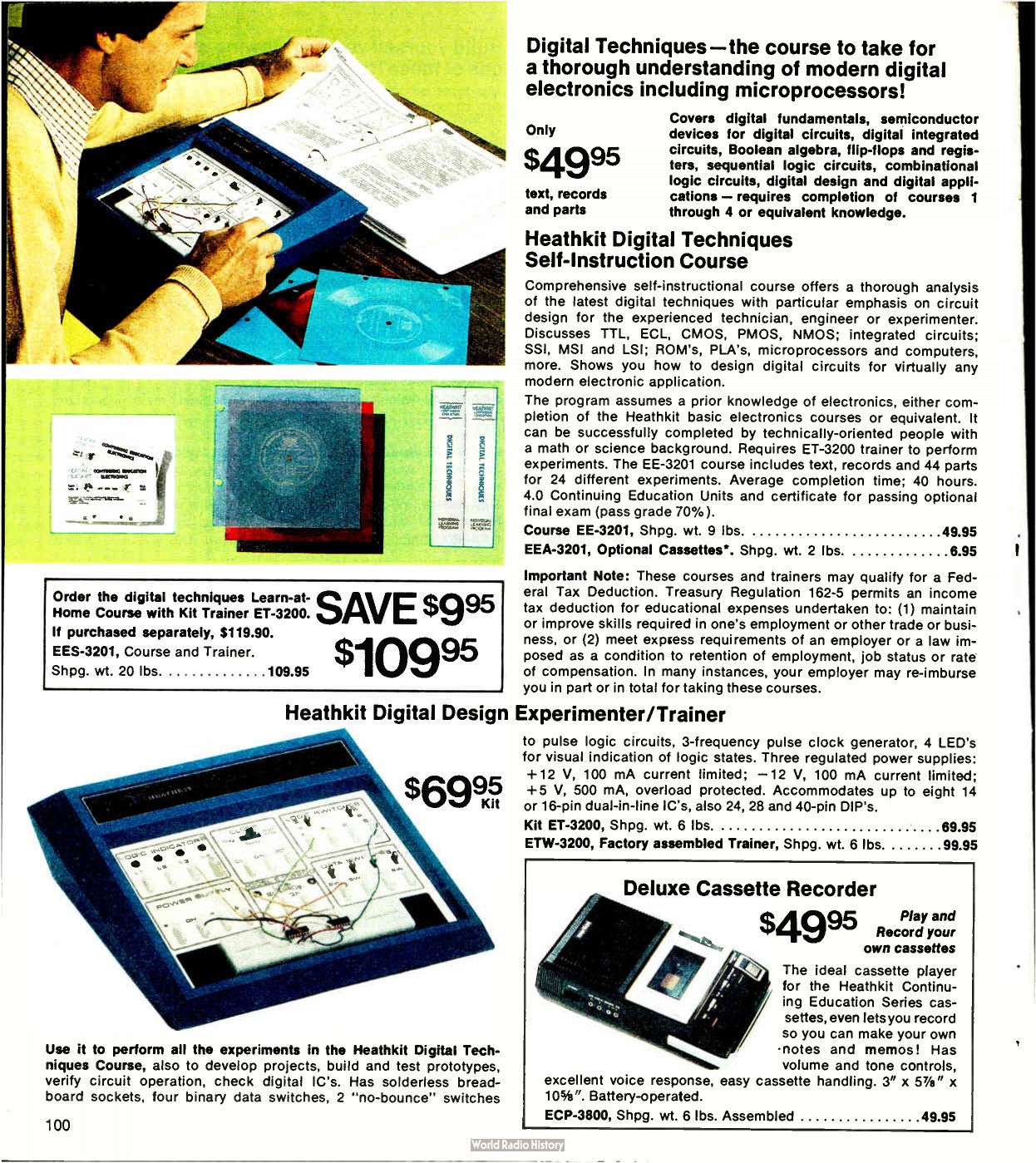
The first was the working technician or engineer who had learned electronics on discrete transistors or tubes and needed to catch up with integrated logic. The 1975 copy asked the reader to “expand your horizons”, because “sooner or later, everyone in electronics and other sciences will encounter the need to know digital techniques”. The Fall 1977 catalogue added a note that the courses and trainers “may qualify for a Federal Tax Deduction” under Treasury Regulation 162-5, as educational expenses undertaken “to maintain or improve skills required in one’s employment” (Fall 1977 catalogue, p. 100).
The second was the hobbyist and experimenter, who could use the trainer as a bench tool after the course was done. Every catalogue description said this in some form: “Use later on the job or at home to develop projects, build and test prototypes, verify circuit operation, check digital ICs” (Christmas 1975).
The third was the school. The 1975 copy called the trainer a “perfect experimental chassis for school labs”. By Fall 1977 Heath was selling a factory-wired ETW-3200 at $99.95, and by Fall 1979 the catalogue carried a page headed “Classroom versions of our Educational Programs — Ideal for schools and industrial training” (Fall 1979, p. 71). The classroom texts carried EB- numbers: EB-6201 for the Digital Techniques student text, with a workbook, instructor’s guide and parts pack. They were sold through a separate Heathkit/Zenith Educational Systems catalogue that listed the assembled ETW-3200 as the “Required Course Trainer” (Heathkit/Zenith Educational Systems catalogue 811-29R, p. 15). Classroom use is visible in surviving units. The ET-3200A photographed later in this volume carries a hand-written “DIGITAL #6” on its bottom label (shown in volume 6), the kind of number a school laboratory gives each bench.
1.5 Prices and versions
The trainer’s price rose steadily through the inflation of the late 1970s and early 1980s. The table gives what the catalogues show.
Table 1 — Prices and versions
| Catalogue | Kit | Factory-wired | Course EE-3201 | Notes |
|---|---|---|---|---|
| Christmas 1975 | ET-3200, $69.95 | — | $49.95 | course + trainer $109.95 |
| Spring 1976 | $69.95 | — | $49.95 | |
| Fall 1977 (817) | $69.95 | ETW-3200, $99.95 | $49.95 | first wired version seen |
| Christmas 1977 (818) | $79.95 | $119.95 | $49.95 | |
| Spring 1978 | $84.95 | $129.95 | $54.95 | EES-3201 course + trainer $129.95 |
| Fall 1979 | $84.95 | $149.95 | $59.95 | |
| 1980 (848) | $84.95 | $149.95 | $59.95 | |
| Winter 1981 | $89.95 | $159.95 | $79.95 | |
| Winter 1981–82 | ET-3200A, $89.95 | ETW-3200A, $159.95 | $79.95 | EES-3201A pair $154.90 |
| Christmas 1982 | ET-3200A, $94.95 | ETW-3200A, $169.95 | $79.95 | |
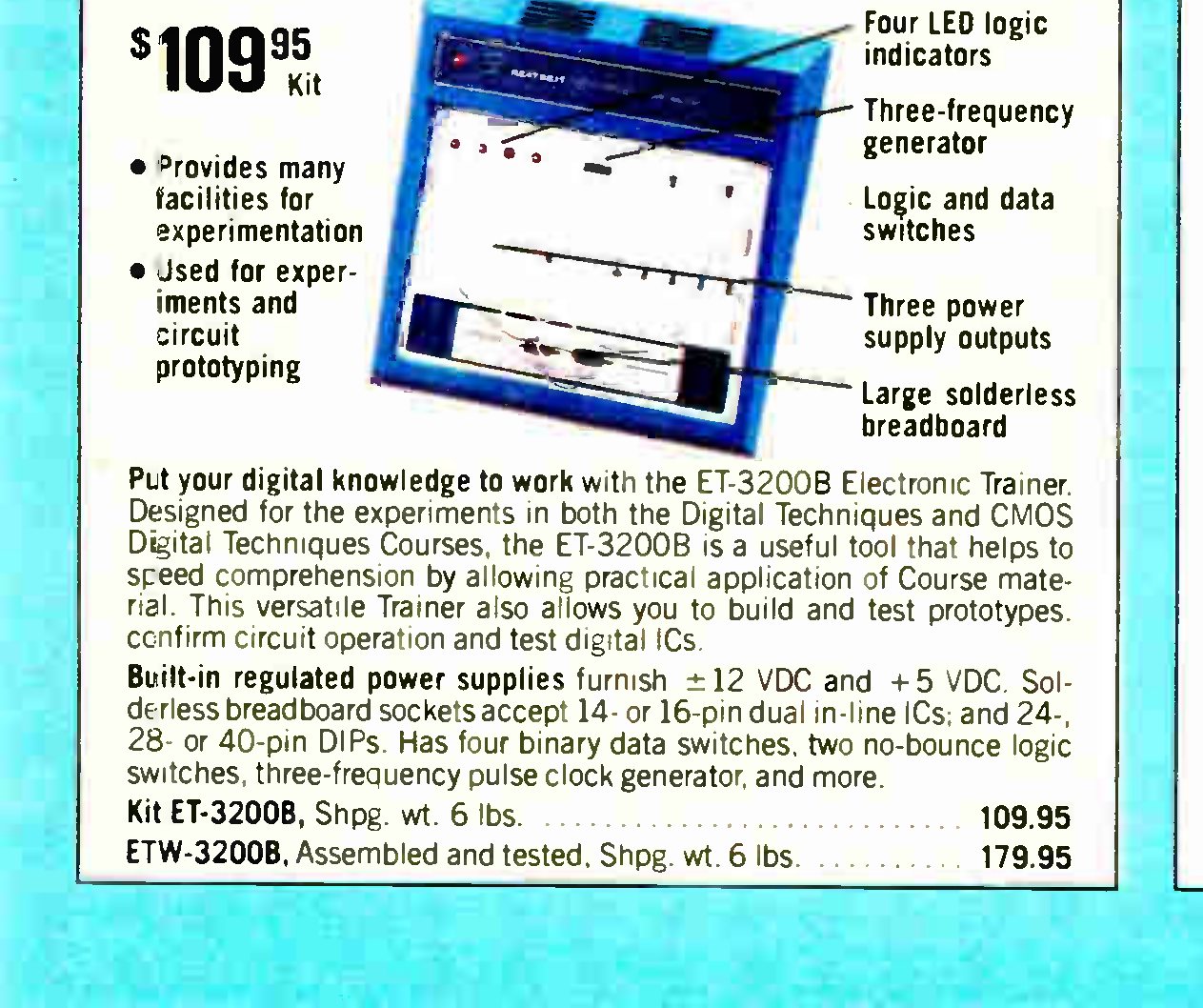
| Fall 1985 | ET-3200B, $109.95 | ETW-3200B, $179.95 | EE-3201A, $99.95 | |
| Fall 1987 | ET-3200-B still listed as an alternative | — | EE-3201-A, $99.95 | new ET-3700 at $119.95 |
Sources: the catalogues named, all at World Radio History. Prices are as printed; OCR of some scans was checked against the page images.
Three versions were sold:
Table 2 — Three versions were sold
| Model | First seen | Manual | Principal differences (see volume 2) |
|---|---|---|---|
| ET-3200 | Christmas 1975 | 595-1740, © 1975 | Original design. Blue cabinet, white panel. Two-wire line cord, neon pilot, fuse in clips inside a molded box, 1200 µF and 2000 µF filter capacitors. |
| ET-3200A | Christmas 1981 | not located | Same front panel and name. The surviving example has a three-wire line cord and an FCC Part 15, Subpart J (Class B computing device) verification label. |
| ET-3200B | 1983 | 595-2936, © 1983 | LED pilot lamp (D11) in place of the neon; mains filter (toroid L101 and capacitors C101–C103); panel fuse holder; three-wire cord; 150 kΩ base resistors added to the LED drivers; new circuit board 85-2572-3. |
The exact split between the A and B changes is not documented in any source found. Eckweiler’s account of the analog twin shows the pattern Heath followed. The ET-3100A, introduced in the Fall 1981 catalogue (No. 854), gained a three-wire cord, an externally accessible fuse holder and an LED pilot, and its circuit board is listed in Heath’s master parts list as “UL/CSA Screened” (Eckweiler #129). The ET-3100A board is 85-2571 and the ET-3200B board is 85-2572-3. That adjacency suggests the digital trainer’s safety-revised board was drawn at the same time as the analog one, in 1981, and that the “-3” is a later revision of it. This is an inference from part numbers, not a documented fact.
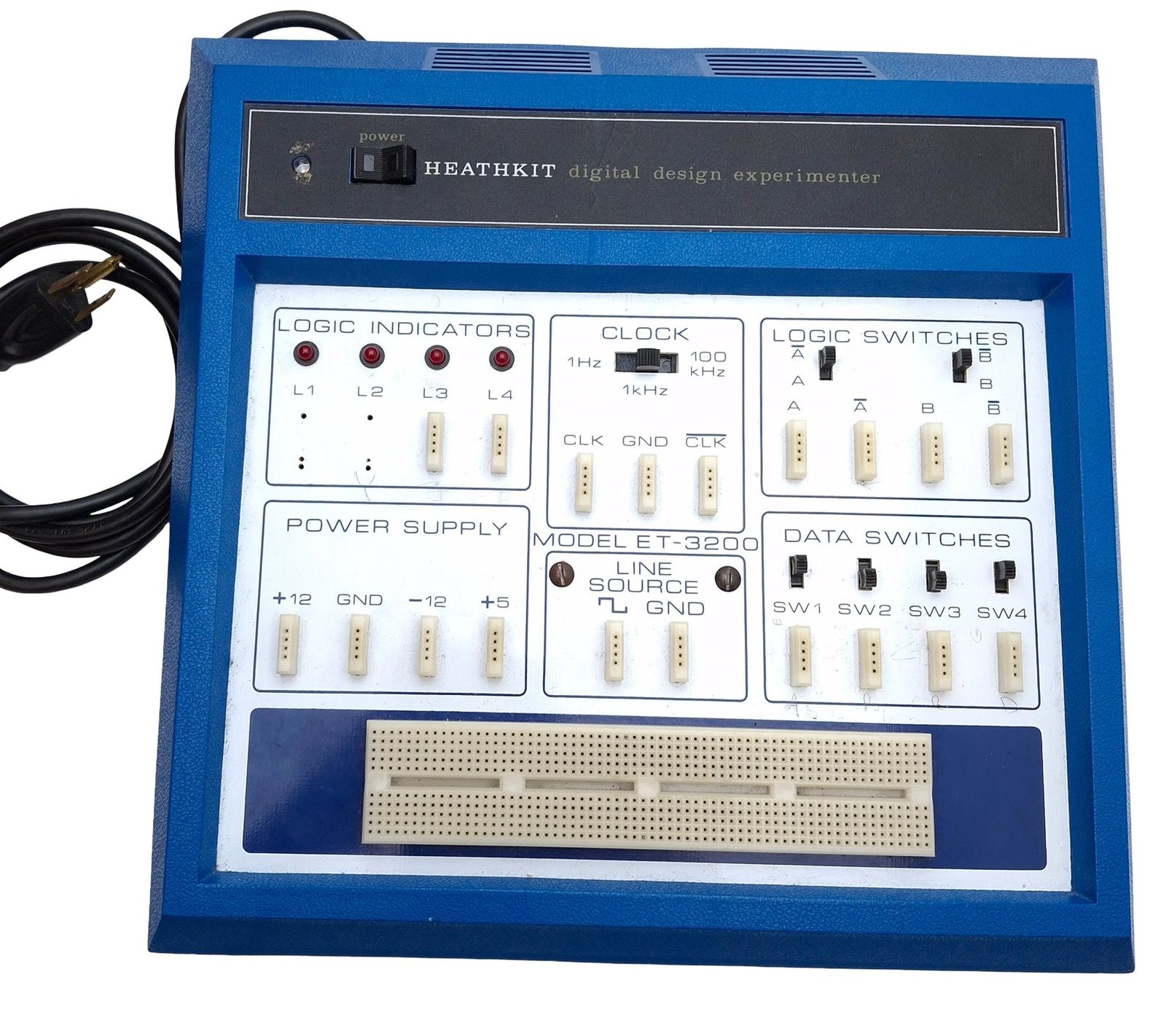
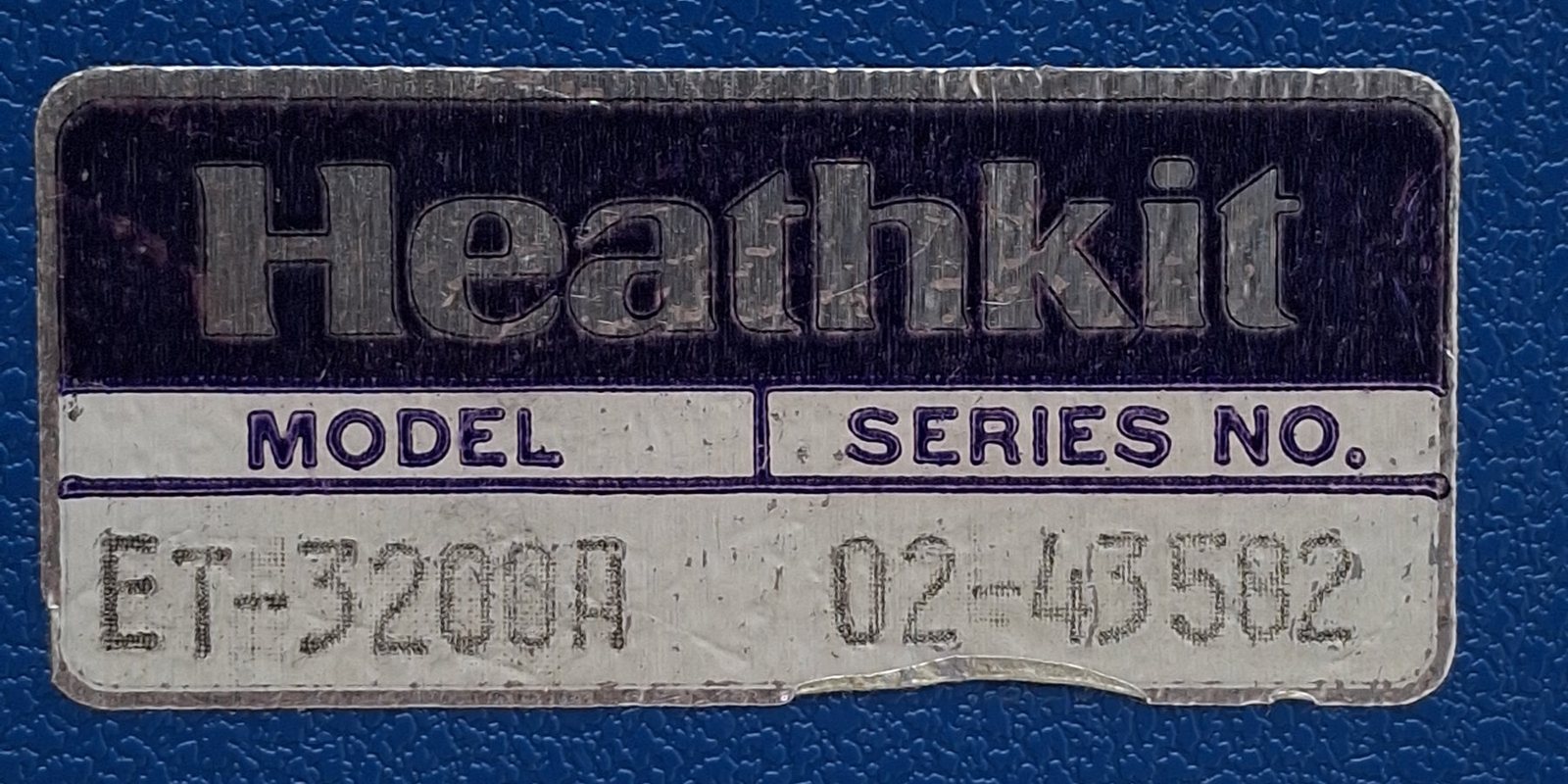
The cabinet colour also changed, but not in step with the model letter. The catalogue photographs from 1975 to 1982 show a blue cabinet with a white panel. The ET-3200A photographed above is blue with a white panel. Later units, like the one at the head of this volume, have a light-grey cabinet and a brown panel lettered “Heathkit/Zenith Educational Systems — Digital Design Experimenter ET-3200”. That branding cannot predate the Zenith purchase of October 1979 (history dive, volume 6). The grey unit’s panel carries no A or B suffix, and its model could not be confirmed from the listing photographs.
1.6 The end of the line
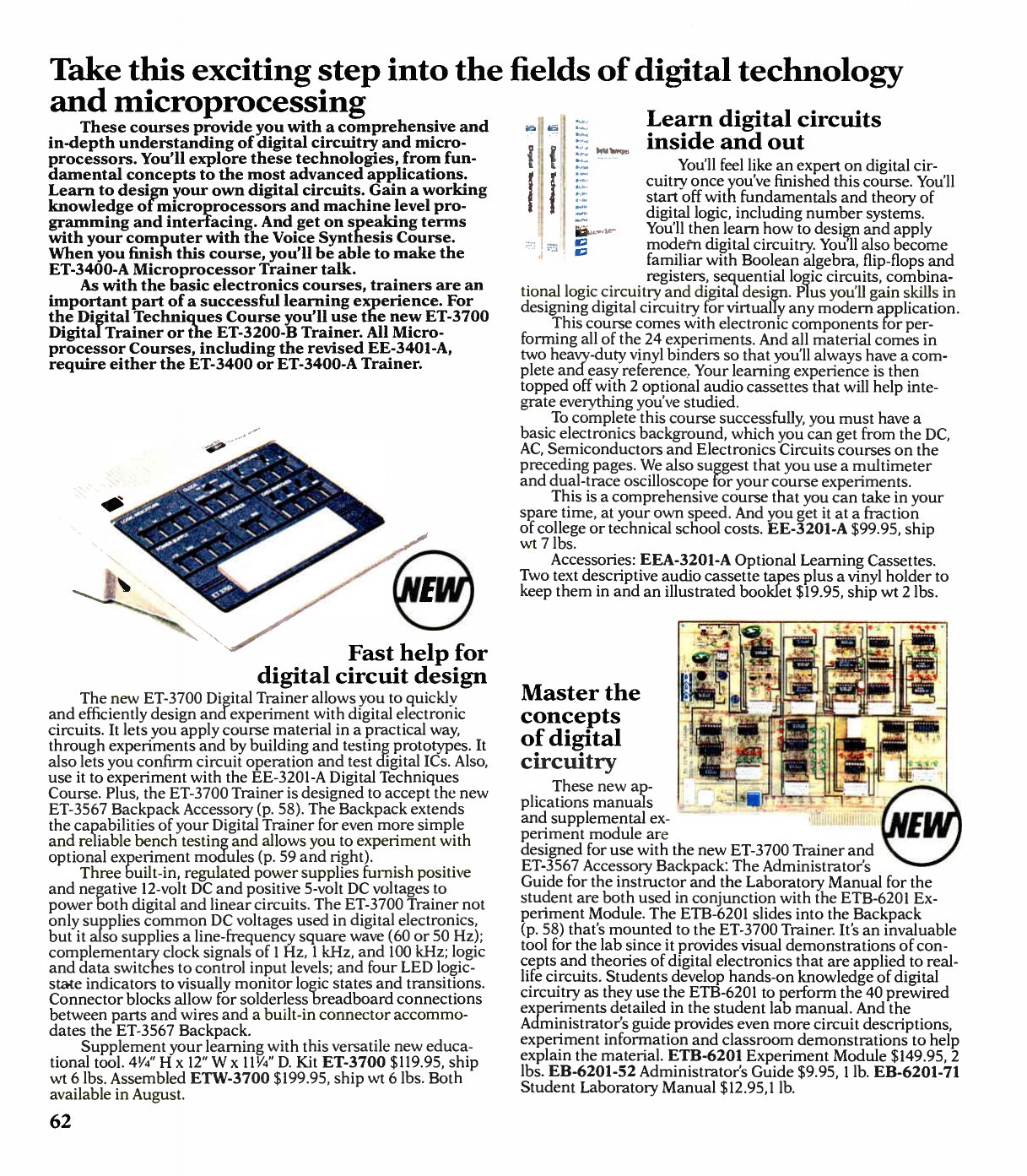
The ET-3200B was still in the catalogue in Fall 1987. That issue introduced its replacement, the ET-3700 Digital Trainer, at $119.95 as a kit or $199.95 assembled. It kept the three supplies, the 1 Hz / 1 kHz / 100 kHz complementary clock, the line-frequency square wave, logic and data switches and four LED indicators, and added a connector for the ET-3567 “Backpack” accessory and the ETB-6201 experiment module. The same page told course buyers they could “use the new ET-3700 Digital Trainer or the ET-3200-B Trainer” (Fall 1987 catalogue, pp. 58 and 62). The Digital Techniques textbook reprinted in 1998 still told students they would need “either the ET-3200 or the ET-3700” (EE-3201A textbook, p. IV). The last catalogue year of the ET-3200B has not been established; the 1990 and later catalogue scans have no text layer and were not searched page by page.
1.7 Headline specification
Table 3 — Headline specification
| Power supplies | +5 V d.c. at 500 mA, thermal overload protection; +12 V d.c. at 100 mA; −12 V d.c. at 100 mA |
| Load regulation | +12 and −12 V better than 1 %; +5 V better than 2 % |
| Data switches | four; +5 V or 0 V; 10 mA maximum each |
| Logic switches | two; momentary, spring-loaded; flip-flop latched against contact bounce; complementary outputs, +5 V and +0.2 V |
| Clock | 1 Hz, 1 kHz, 100 kHz ±20 %; 45 % duty cycle; 5 V peak-to-peak; normal and complement outputs |
| Line source | 60 or 50 Hz square wave at mains accuracy (0.1 %) |
| Logic indicators | four red LEDs; lit for logic 1, dark for 0 or open |
| Breadboard | solderless socket for up to eight 14- or 16-pin DIPs; 24-, 28- and 40-pin DIPs accepted; wire to #20 (0.032 in) |
| Terminal blocks | 21 small four-point connector blocks for the panel functions |
| Power | 105–130 V or 210–260 V, 50–60 Hz, 15 W maximum; 3/16 A slow-blow fuse |
| Size, weight | 12⅛ in wide × 11¾ in deep × 3½ in high; 4 lb net, 6 lb shipping |
| Price at launch | $69.95 kit (Christmas 1975) |
Source: ET-3200 manual, pp. 34 and 41, with the breadboard figures from the Christmas 1975 catalogue. The ET-3200B manual repeats the same specification (ET-3200B manual, p. 46).
Sources
- Heathkit catalogues, Christmas 1975 (No. 806), Spring 1976, Fall 1977 (No. 817), Christmas 1977 (No. 818), Spring 1978, Fall 1979, 1980 (No. 848), Winter 1981, Winter 1981–82, Christmas 1982, Fall 1985, Fall 1987. World Radio History. https://www.worldradiohistory.com/Archive-Catalogs/Heathkit_Catalogs.htm
- Heathkit/Zenith Educational Systems & Instruments catalogue 811-29R (filed by World Radio History as 1975; its contents, which include Z-89-based computer courses, date it to about 1980 or later). https://www.worldradiohistory.com/Archive-Catalogs/Heathkit-Catalogs/Heathkit-1975-Zenith%20Educational%20Systems-811-29R.pdf
- Heath Company. Heathkit Manual for the Digital Design Experimenter, Model ET-3200, 595-1740-03, © 1975. Internet Archive. https://archive.org/details/Heathkit_ET-3200_Digital_Design_Experimenter
- Heath Company. Heathkit Manual for the Digital Design Experimenter, Model ET-3200B, 595-2936-06, © 1983. Internet Archive (DLARC). https://archive.org/details/manualsplus_11835
- Heath Company. Heathkit Manual for the Microprocessor Trainer, Model ET-3400, 595-2021-03, © 1977. Internet Archive (DLARC). https://archive.org/details/manualsplus_11737
- Heathkit Educational Systems. Digital Techniques, EE-3201A textbook, 595-2931-09, © 1983, 1993, 1998. Internet Archive. https://archive.org/details/ee-3201-a-digital-techniques-individual-learning-system-textbook-1998
- Eckweiler, Bob (AF6C). “Heathkit of the Month #129: Heathkit ET-3100/A/B Electronic Design Experimenter/Trainer (and Associated Heath Offered Courses).” Orange County Amateur Radio Club, 2025–26. https://www.w6ze.org/Heathkit/Heathkit_129_ET3100B.pdf
- Recycled Goods, sales listing, ET-3200 (grey). https://recycledgoods.com/heathkit-et-3200-digital-design-experimenter/
- Next Day Automation, sales listing SB-202541, ET-3200A. https://www.nextdayautomation.com/products/used-heathkit-et-3200-a-digital-design-experimenter-laboratory-breadboard-120-240vac
Comments (0)