SB-104A Transceiver · Volume 1
Overview
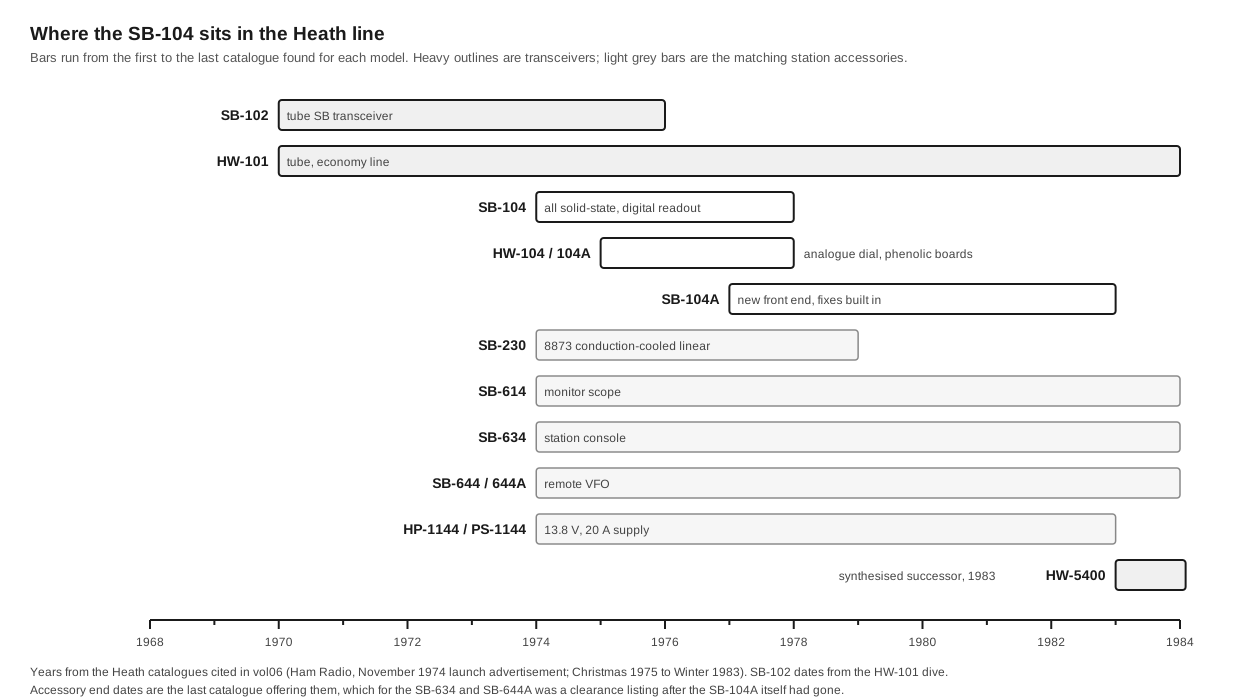
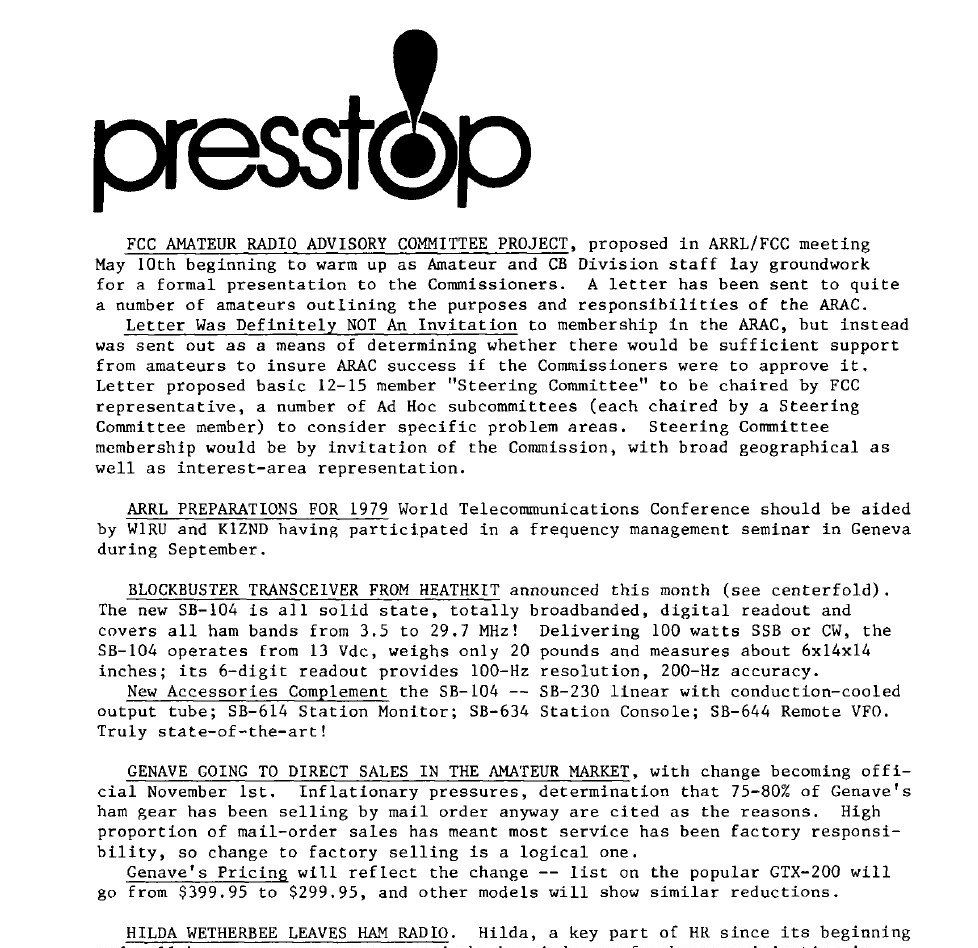
In November 1974 Ham Radio magazine’s news page carried a two-line headline in capitals: “BLOCKBUSTER TRANSCEIVER FROM HEATHKIT”. The rig was the SB-104, and the claim was fair. Every other five-band transceiver Heath had sold (the SB-100, SB-101, SB-102 and HW-101) had a pair of 6146 tubes in the final amplifier and three front-panel knobs to tune them. The SB-104 had no tubes at all. It had four transistors in a broadband final that needed no tuning, a receiver with diode-switched filters, and a six-digit counter that measured the real operating frequency instead of reading a dial. It ran from 13.8 volts, so it could go straight into a car. Heath priced the kit at $669.95 and promised deliveries in December.
It also went wrong on a scale Heath had not seen before. Factory service bulletins began on 3 January 1975, and by the end of August 1976 there were fifty of them. Owners reported birdies in the receiver, spurious signals in the transmitter, chirp, thumps, low power, display jitter and destroyed output transistors. The company’s own historians later wrote that “virtually none of the SB-104s could meet specifications.” Heath’s answer was a long run of running changes, a free sensitivity kit, an update kit, and finally a revised model. The SB-104A arrived in the Fall 1977 catalogue with a factory-built receiver front end and the fixes built in. It stayed on sale until the end of 1982.
This dive covers both models and the station built around them. The documented unit is an SB-104A.
1.1 What it is
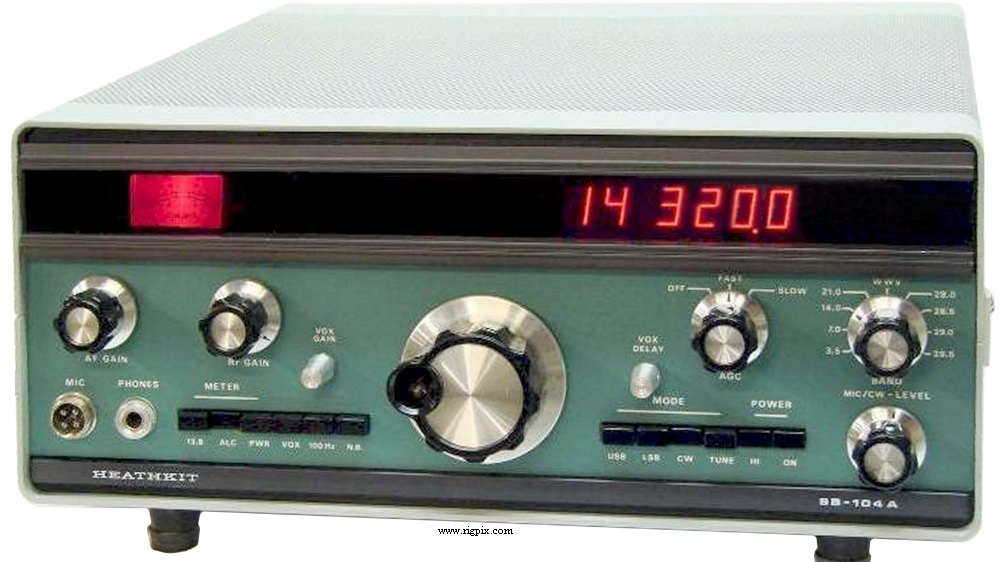
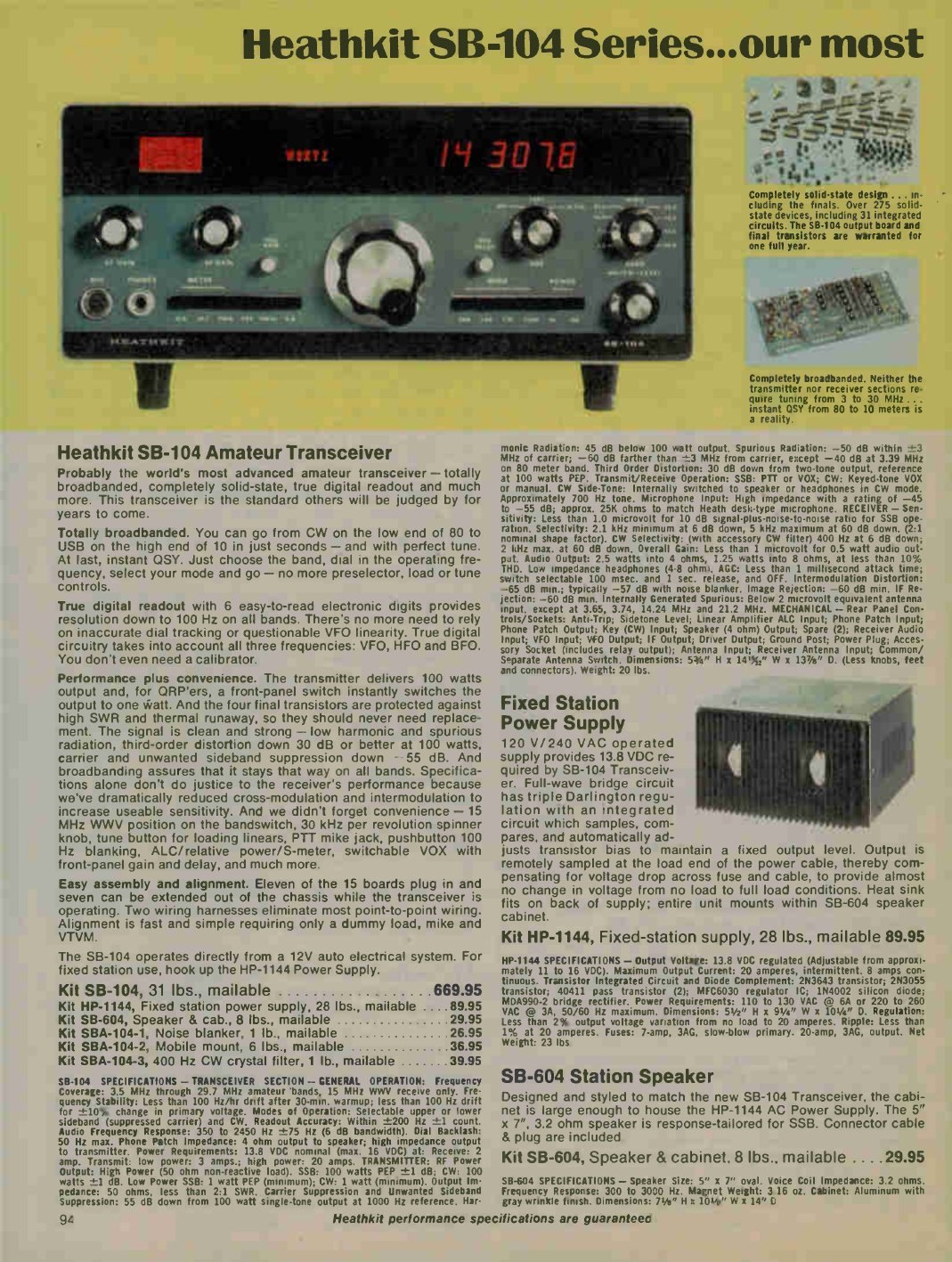
The SB-104 is a single-sideband and CW transceiver for the amateur bands from 3.5 to 29.7 MHz, with 10 metres split into four 500 kHz segments. The band switch also has a receive-only position for the 15 MHz time-and-frequency station WWV. It covers no AM, no FM and none of the WARC bands, which were not allocated until 1979. The transmitter gives 100 watts output on SSB and CW. One pushbutton drops it to one watt. At the one-watt level the transmit-receive switching is fully solid-state, and Heath sold that setting as a built-in QRP rig. The receiver is a double-conversion superheterodyne with a crystal-lattice filter at 3.395 MHz, the same intermediate frequency and the same filter as Heath’s tube SB line.
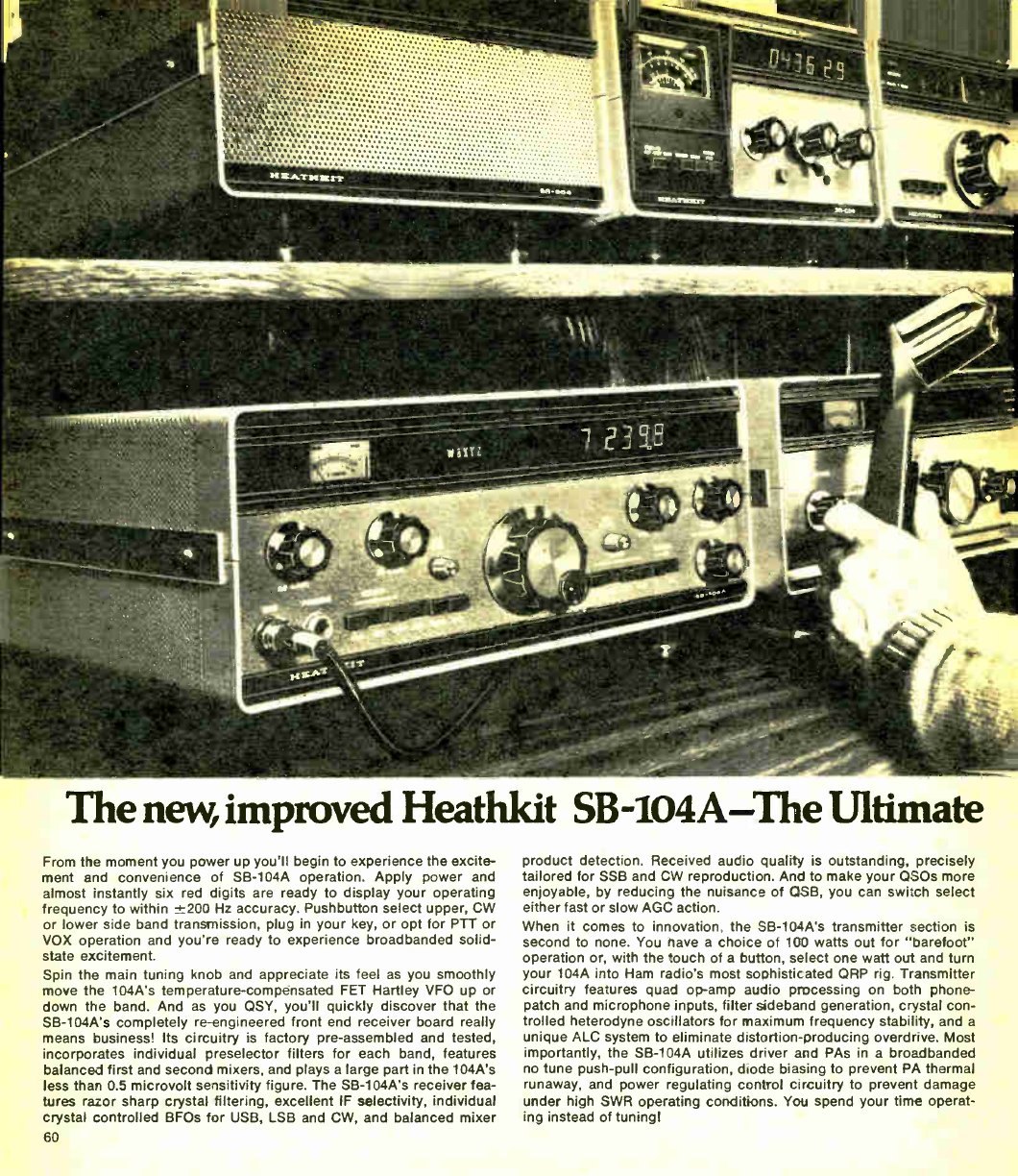
What was new was the way it was built. The launch advertisement counted “over 275 advanced solid-state devices, including 31 ICs, 75 transistors and 171 diodes”. It also counted “over 2800 parts” on fifteen glass-epoxy circuit boards. Eleven of those boards plug into edge connectors in a partitioned chassis, and seven can be raised out of it on an extender board while the set is running (Ham Radio, November 1974). Each board carries a letter from A to K, and those letters remain the working vocabulary of everyone who repairs one: the counter is board A, the regulators board B, the receiver front end board G, the power amplifier board H.
The Heath Company’s own story is told in the site history dive and is not repeated here. The SB-104 has a short section of its own in the Golden Age volume. The headline figures below come from the specification pages of the 1974 Operation manual and the 1977 SB-104A manual.
Table 1 — What it is
| SB-104 (1974) | SB-104A (1977) | |
|---|---|---|
| Bands | 3.5–4.0, 7.0–7.3, 14.0–14.5, 21.0–21.5, 28.0–29.7 MHz; WWV 15 MHz receive | same |
| Modes | USB, LSB, CW | same |
| RF output | 100 W PEP SSB, 100 W CW, ±1 dB; 1 W minimum in LOW | same |
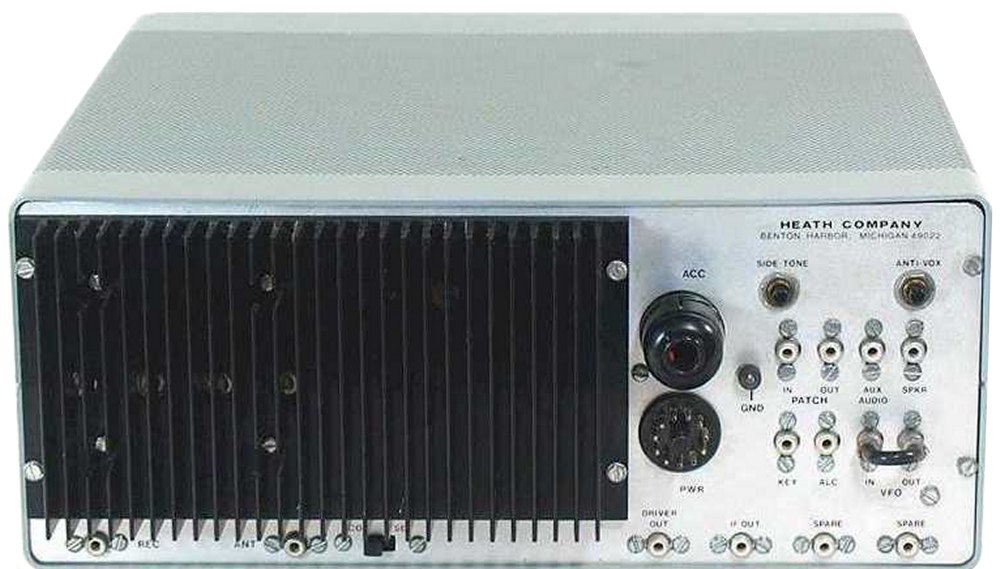
| Final amplifier | four RF power transistors, two push-pull pairs, broadband 3–30 MHz | same, with added stabilising capacitors |
| Receiver sensitivity | less than 1 µV for 10 dB S+N/N | less than 0.5 µV |
| Selectivity | 2.1 kHz at −6 dB, 5 kHz at −60 dB; 400 Hz with the SBA-104-3 CW filter | same |
| Frequency readout | six-digit gas-discharge display, 100 Hz resolution, within ±200 Hz ±1 count | same |
| Stability | under 100 Hz per hour after 30 minutes | under 100 Hz per 30 minutes after 30 minutes |
| Power | 13.8 V DC nominal (16 V max): 2 A receive, 3 A low power, 20 A high power | 12.6–16 V DC, same currents |
| Size, weight | 5¾ × 14 15/32 × 13⅞ in; 20 lb | same |
Three lines in that table define the rig. The transmitter needs no tuning, so an operator can move from the bottom of 80 metres to the top of 10 in seconds; the advertisement said so in exactly those terms. The readout counts the frequency rather than interpreting a dial, so an SB-104 that is working reads its operating frequency to within about 200 Hz on every band with no calibrator. And the rig draws 20 amperes at 13.8 volts on transmit. That is a car battery’s load, and a fixed station needs the separate HP-1144 supply.
1.2 Where it came from
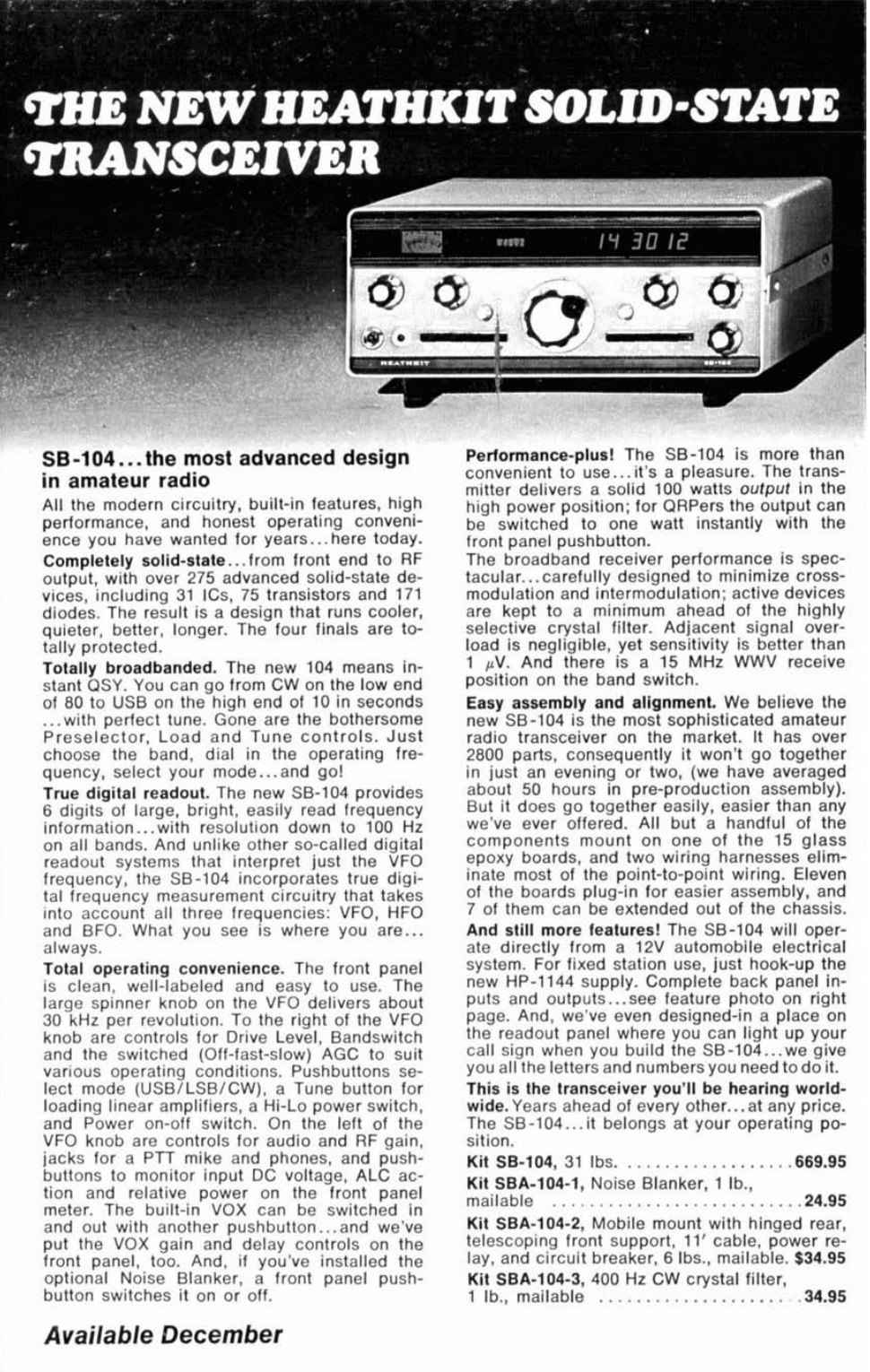
The SB-104 replaced the SB-102, the last of Heath’s tube SB transceivers. The SB line began in the mid-1960s as Heath’s answer to the Collins S-Line. Its ideas were a pre-built, pre-calibrated linear master oscillator, crystal-controlled heterodyning and a crystal filter at 3.395 MHz. The SB-100 of 1965 became the SB-101 and then the SB-102, whose story is told in the SB-102 dive. The cheaper HW-101, covered in its own dive, was a cost-reduced SB-101. The separate receiver and transmitter of the SB-301/SB-401 station came from the same family.
The SB-104 kept the family’s frequency scheme almost unchanged. It used the same 3.395 MHz IF, the same 2.1 kHz filter part and a VFO covering 5.0 to 5.5 MHz on every band. It kept the SB name and the idea of a matched station. Everything else changed. The tube rig’s three transmitter tuning controls (driver preselector, final tune and final load) disappeared into broadband transformers and a bank of switched low-pass filters. The mechanical dial gave way to a counter and a spinner knob that moved about 30 kHz per turn. The cabinet was new too. It was lower and wider, in a two-tone grey with a dark-green panel, and it set the style of a new generation of matching accessories. Bob Eckweiler’s survey of the SB family calls this “the late SB-line” and dates the SB-104A update to 1977 (Eckweiler, Heathkit of the Month #30).
One photograph caption by a collector says the design began as an “SB-103” with tube finals, which was redesigned as fully solid-state before production (Bill Hammond, AK5X, Flickr, 2014). No Heath document naming an SB-103 transceiver has been found, and the claim is reported here only as a claim.
1.3 The launch
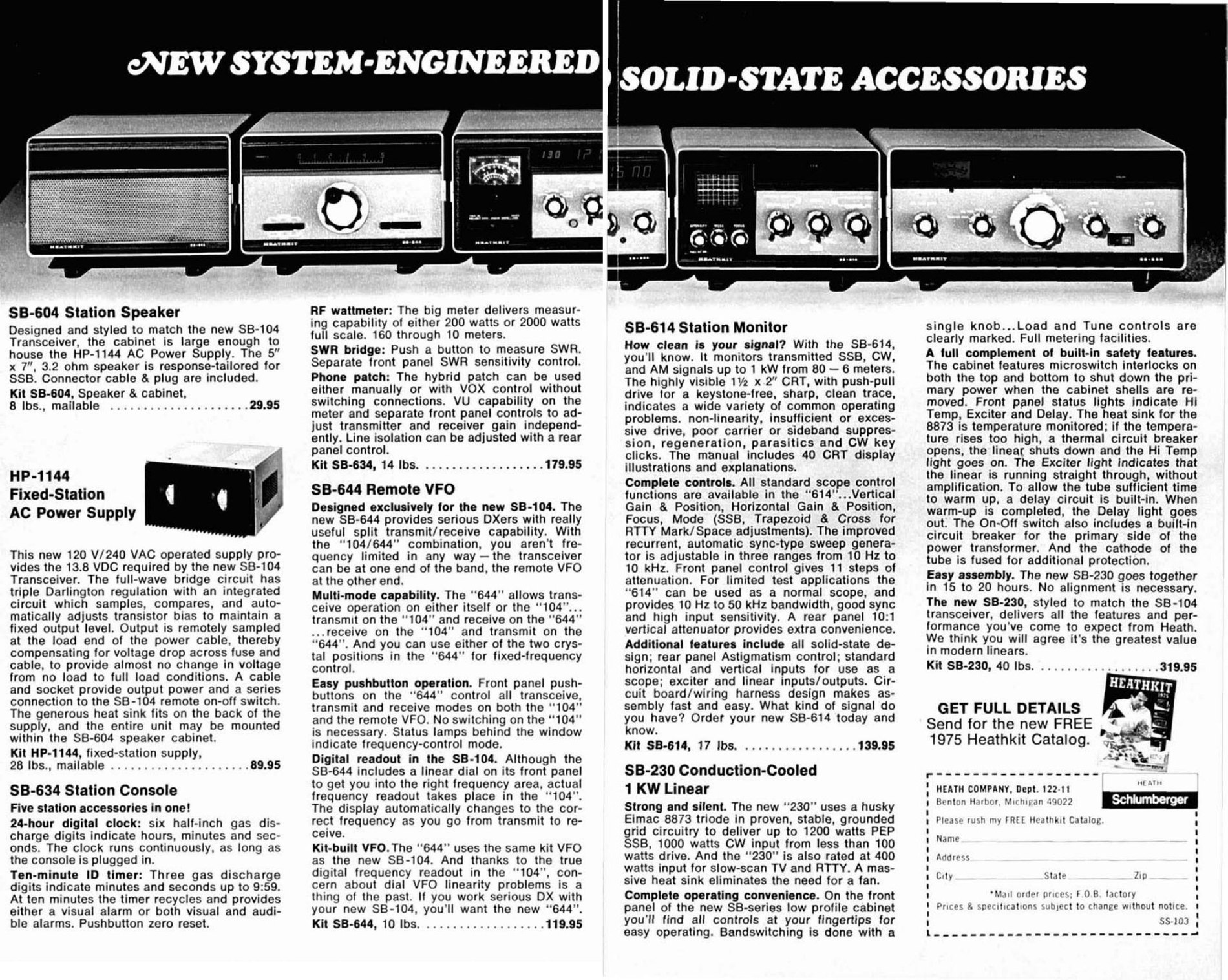
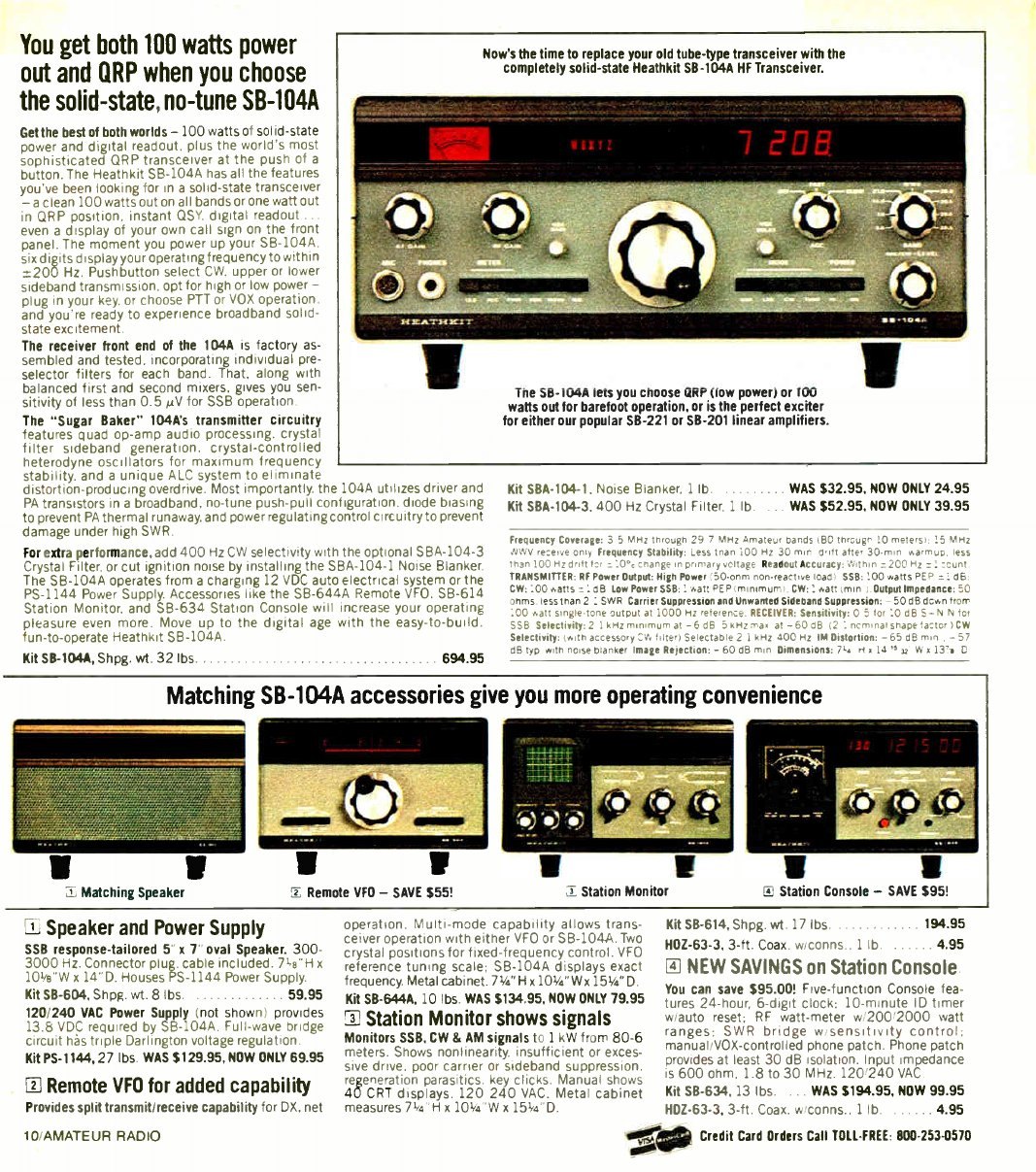
Heath announced the rig in a five-page colour spread in the November 1974 amateur magazines. Ham Radio’s news editor pointed readers to “the centerfold”. The spread sold a complete station: the transceiver, the SB-604 speaker, the HP-1144 AC supply that fits inside the speaker cabinet, the SB-614 monitor scope, the SB-634 station console, the SB-644 remote VFO and the SB-230 linear amplifier. The prices in that advertisement are the launch prices used throughout this dive.
Table 2 — The launch
| Kit | Launch price, November 1974 |
|---|---|
| SB-104 transceiver | $669.95 |
| SBA-104-1 noise blanker | $24.95 |
| SBA-104-2 mobile mount | $34.95 |
| SBA-104-3 400 Hz CW filter | $34.95 |
| SB-604 station speaker | $29.95 |
| HP-1144 fixed-station supply | $89.95 |
| SB-614 station monitor | $139.95 |
| SB-634 station console | $179.95 |
| SB-644 remote VFO | $119.95 |
| SB-230 conduction-cooled linear | $319.95 |
The SB-104’s price is sometimes given as $699.95. That figure appears in a 2019 company history (Brueschke and Mack, AWA Review 32) and in a 2025 retrospective (EEJournal, part 3). Heath’s own launch advertisement and its Christmas 1975 and Spring 1976 catalogues all give $669.95. The $699.95 figure first appears in the Winter 1978 catalogue, as the price of the SB-104A. The launch price is therefore $669.95.
Heath gave two numbers about the build in the launch copy. It had “averaged about 50 hours in pre-production assembly”, and the kit “won’t go together in just an evening or two”. It also promised that the rig “does go together easily, easier than any we’ve ever offered”. The first of those statements proved accurate. The Building the Kit volume deals with the second.
1.4 Who it was for
The SB-104 was aimed at the upper end of the kit market. At $669.95 the transceiver alone cost more than two and a half HW-101s ($259.95 in March 1974). A complete station with supply, speaker, console, remote VFO and monitor came to about $1,230 before the linear. Heath’s copy offered the buyer three things no tube kit could: a rig that needed no tuning between bands, a readout that could be trusted to 200 Hz, and a single box that worked the same on the kitchen table, in the car and at the station desk. It also offered the builder a new kind of kit, with almost everything on circuit boards and two pre-laced wiring harnesses.
The rig was also meant for mobile use from the start. It ran directly from a car’s 12-volt system, the SBA-104-2 mount had a hinged rear and telescoping front support, and the SBA-104-1 noise blanker was sold for ignition noise. The manual has a full section on mobile installation, including a warning that alternator and regulator wiring varies from car to car.
1.5 The troubles
The story of what went wrong is told in detail in the Restoration volume, which works through the service bulletins. In outline, the problems fell into four groups.
- Spurious signals. The transmitter produced a spur at 3.395 MHz on 80 metres and spurious output on 40, 20 and 10 metres. Bursts of RF appeared on keying and unkeying, and the 10-metre stages oscillated during alignment. The receiver suffered from birdies. Some of them came from the counter and the display’s DC-DC converter, and several are admitted in the specification itself.
- The output stage. The four final transistors were expensive and could not tolerate much abuse. Bulletin SB-104-2 (13 January 1975) told service staff to replace all four as a matched set if any one had failed under power. The Operation manual imposed a duty-cycle rule unlike anything on a tube rig: never more than 30 seconds with both HI and TUNE pressed, followed by five times as long in receive.
- The receiver front end. Its sensitivity fell short on the higher bands, and it was touchy to align. Heath issued a free sensitivity modification, SBM-104-1, in 1975, and later redesigned the board completely.
- Supply and control problems. These included an 11-volt regulator that sagged, VFO frequency modulation on battery power, thumps and “pops” on VOX changeover, chirp on CW, talkback (transmitted audio heard in the receiver) and a display that jittered on 10 metres.
Heath’s historians summed it up bluntly. Parts tolerances “turned out to be more critical than had been envisioned”, random sampling of incoming parts was not enough, and even testing every part did not solve the problem. “Many were sent back to Heath several times and still would not work right.” They cite Chuck Penson’s guide to Heath’s amateur products for this passage (Brueschke and Mack, AWA Review 32). Chas Gilmore, who worked at Heath at the time, was gentler: the rig “turned out to be fairly difficult to build”, and builders had “a fair number of difficulties” because of its complexity and parts count (EEJournal, part 3). Collectors’ summaries put the cause down to a rushed Christmas release and to Heath’s inexperience with broadband and digital design (Radio Alpha collection notes). That explanation is plausible, but it is an interpretation rather than a documented fact.
Heath did not abandon the model. The Operation manual shipped with a special service policy. The VFO, the regulator board and the carrier generator could be posted back to Benton Harbor in a red-marked carton packed in the kit, with a promised 48-hour turnaround and a flat $5 labour charge out of warranty. The power amplifier board carried a one-year warranty (SB-104 Operation manual, 1974, “Circuit Board Service Policy”). K5BCQ, whose repair notes are the standard modern reference, was told that Heath always reworked returned units to the latest level (K5BCQ).
1.6 The HW-104
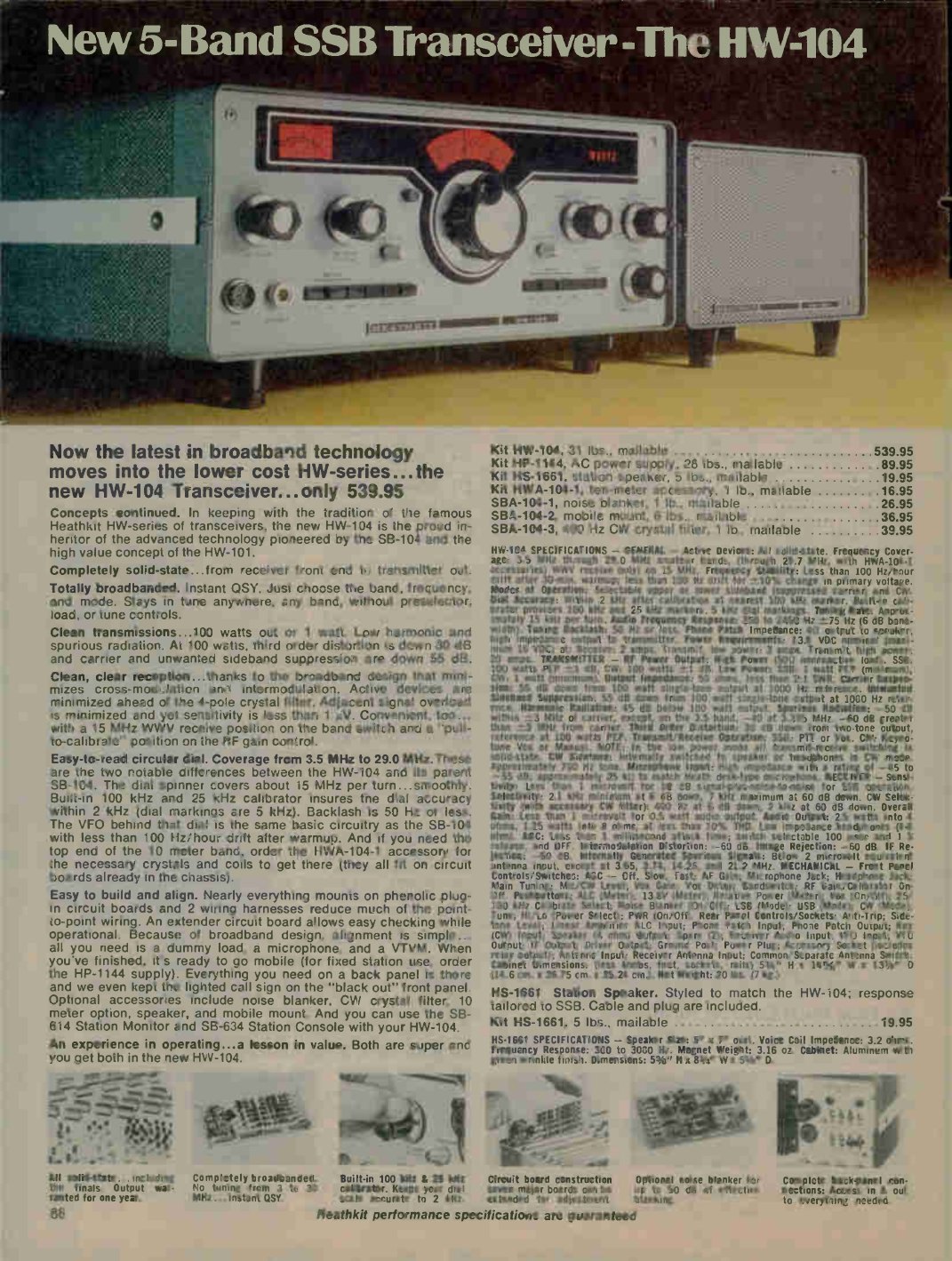
In the Christmas 1975 catalogue Heath brought the design into its cheaper HW line. The HW-104 cost $539.95, which was $130 less than the SB-104. Heath described it as the “proud inheritor of the advanced technology pioneered by the SB-104 and the high value concept of the HW-101”. It used the same VFO circuit and the same broadband transmitter. The digital readout was replaced by a circular dial covering about 15 kHz per turn, calibrated by a built-in 100 kHz and 25 kHz crystal calibrator. The boards were phenolic instead of glass-epoxy, and 10-metre coverage stopped at 29.0 MHz as standard. The HWA-104-1 accessory supplied the crystals and coils for the rest of the band (Christmas 1975 catalogue, p. 84).
With no counter and no 180-volt display converter on board, the HW-104 was spared a whole class of the SB-104’s birdies. K5BCQ notes that it has “a few less ‘birdies’ as a result” (K5BCQ). By the time it shipped, many of the early fixes were already in production. Bulletin SB-104-32 of March 1976 remarks that “all production units” of the HW-104 already carried the corrected regulator resistor. The Christmas 1977 catalogue lists an HW-104A with “new front end board for improved sensitivity” at $489.95. Neither HW model appears in the Winter 1978 catalogue.
1.7 The SB-104A
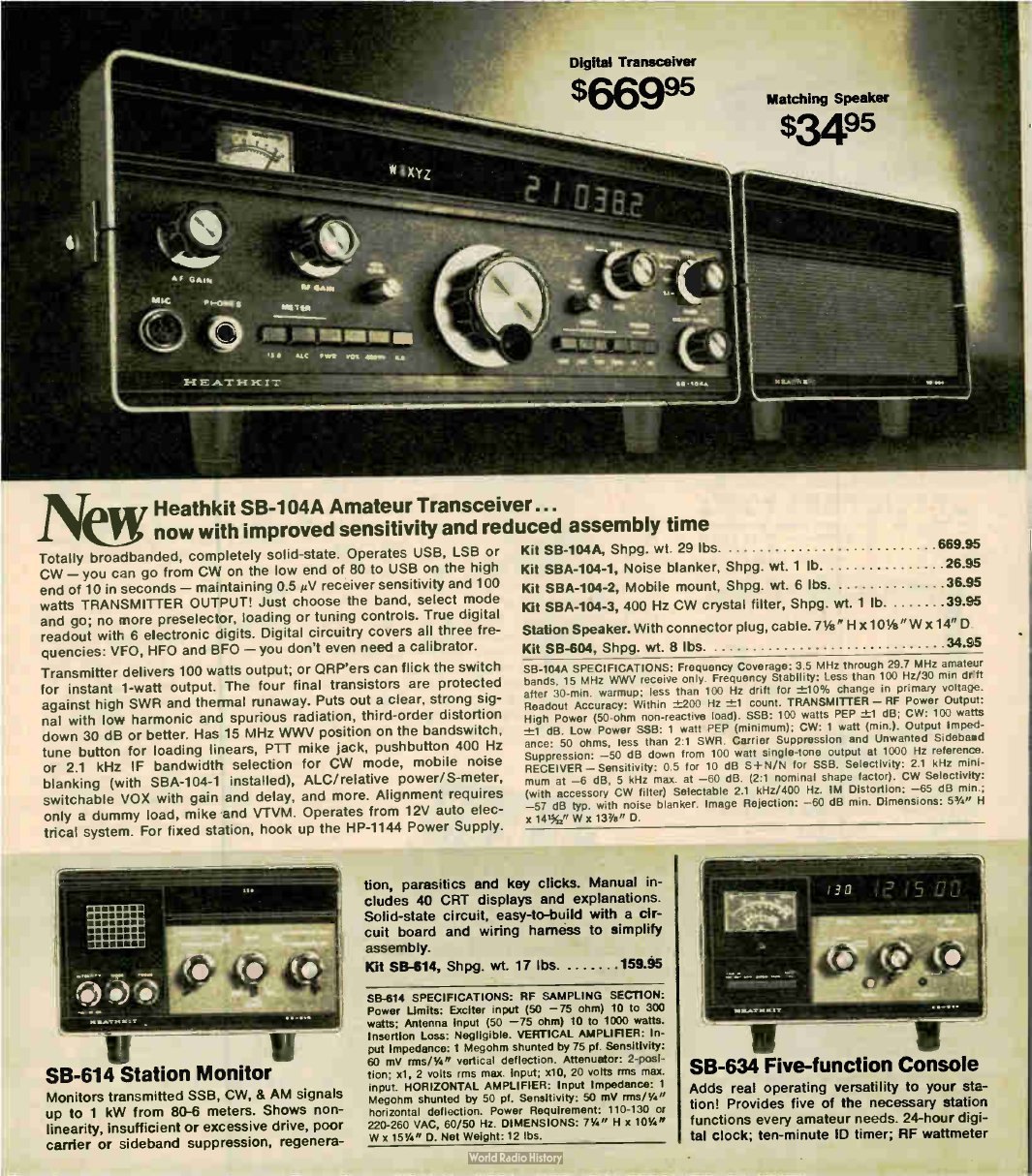
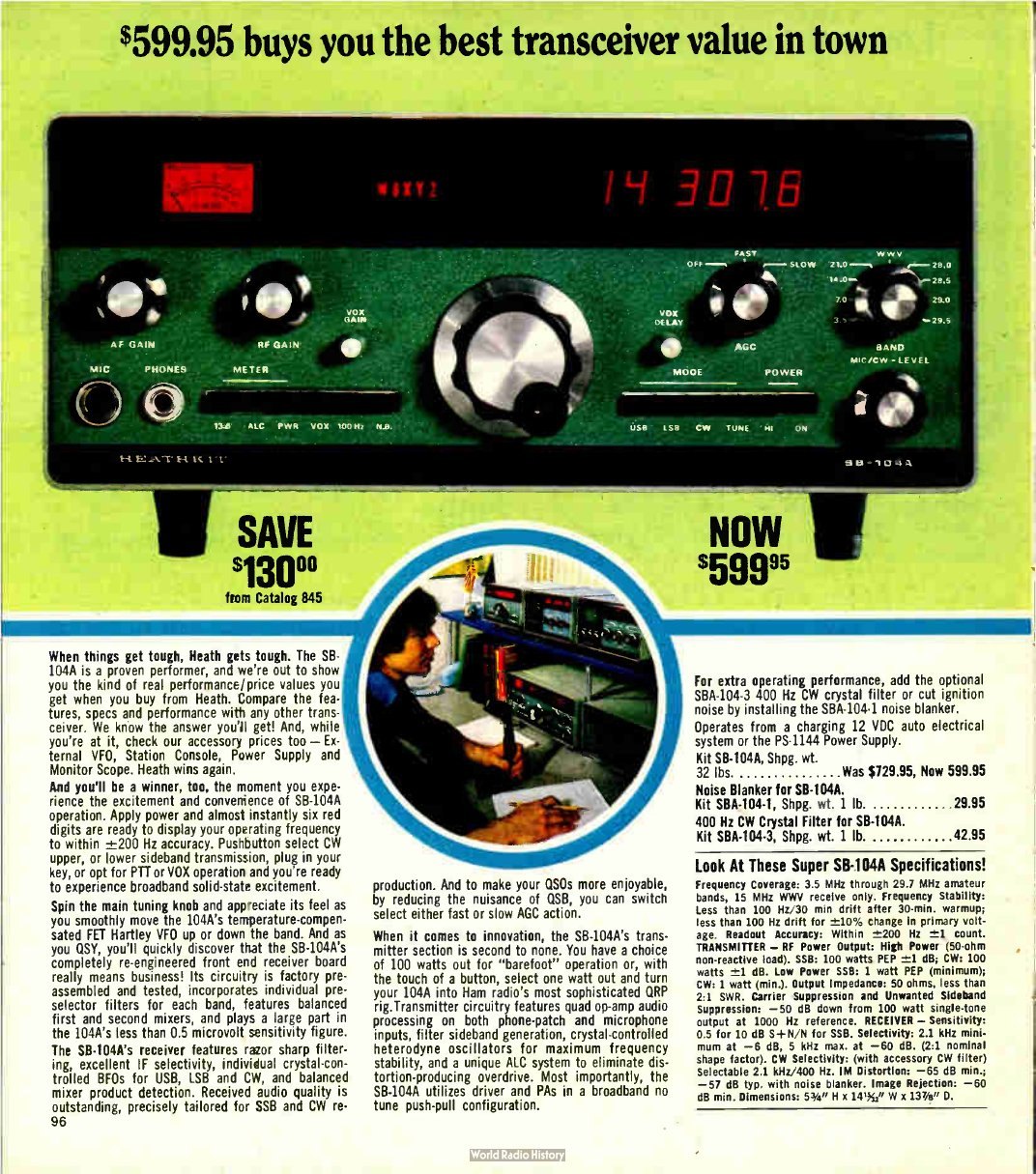
The SB-104A first appears in the Fall 1977 catalogue (No. 817), headed “now with improved sensitivity and reduced assembly time”, at the unchanged price of $669.95. The single largest change was the receiver front end, board G, which was “completely re-engineered” in the words of the Winter 1978 catalogue. The new board used diode double-balanced first and second mixers, and a single bipolar amplifier replaced the original’s dual-gate MOSFETs. It arrived factory-assembled and instrument-aligned. The transmitter IF board C, the other board most sensitive to builder error, was also supplied ready-built and factory-tested, and the two together account for the “reduced assembly time”. The published sensitivity improved from 1 µV to 0.5 µV. The other changes were an accumulation of bulletin fixes, new board revisions for the transmitter IF, VFO filter and ALC/filter boards, and stabilising capacitors on the power amplifier. The How It Works and Restoration volumes list them in detail.
Heath also sold the change as a retrofit. The SBM-104-2 modification kit (Heath part 830-24, manual 595-2016) brought an SB-104 up to SB-104A level. Its manual was reissued several times while bulletins corrected it (bulletins SB-104-60 and SB-104-78). Because the boards plug in and were so often swapped, K5BCQ warns that “just because it says ‘SB-104A’ on the front, doesn’t mean that everything inside is ‘SB-104A’” (K5BCQ).
The SB-104A’s specification is more candid than the SB-104’s. Sensitivity doubled on paper. Harmonic suppression, however, was relaxed from 45 dB to 40 dB below 100 watts, and close-in spurious output from −50 dB within ±3 MHz to −40 dB within ±4 MHz. The list of internally generated receiver birdies grew from four frequencies (3.65, 3.74, 14.24 and 21.2 MHz) to seven, adding 28.46, 28.9 and 29.33 MHz. The frequency-stability figure was redefined from 100 Hz per hour to 100 Hz per 30 minutes. The published figures now matched what production units actually measured.
1.8 Eight years in the catalogue
Table 3 — Eight years in the catalogue
| Catalogue | Model | Kit price |
|---|---|---|
| Ham Radio launch advertisement, November 1974 | SB-104 | $669.95 |
| Christmas 1975 | SB-104 | $669.95 |
| Spring 1976 | SB-104 | $669.95 |
| Fall 1977 (No. 817) | SB-104A | $669.95 |
| Christmas 1977 | SB-104A | $669.95 |
| Winter 1978 | SB-104A | $699.95 |
| Fall 1979 | SB-104A | was $749.95, now $729.95 |
| No. 848, 1980 | SB-104A | was $729.95, now $599.95 |
| Winter 1981 | SB-104A | $689.95 |
| Winter 1981–82 | SB-104A | $694.95 |
| Christmas 1982 | SB-104A | $694.95 |
| Winter 1983 | — | transceiver gone; SB-634 and SB-644A cleared |
(The Spring 1978 catalogue’s text layer reads $899.95, which is an OCR error for $699.95.)
The late catalogues sold the rig as the way out of tubes. The Winter 1981–82 and Christmas 1982 pages open “Now’s the time to replace your old tube-type transceiver with the solid-state SB-104A”. By Christmas 1982 the accessories were being cut: the SB-634 console from $194.95 to $99.95, the SB-644A remote VFO from $134.95 to $79.95 and the PS-1144 supply from $129.95 to $69.95. The Winter 1983 catalogue still clears the console and the remote VFO but no longer lists the transceiver. Heath’s next HF transceiver was the synthesised HW-5400, which appears in that same Winter 1983 catalogue. The factory-built SS-9000 had appeared in Christmas 1982.
1.9 How many were built
No production figure for the SB-104, HW-104 or SB-104A has been found. Heath’s catalogues, which printed “over 30,000” for the HW-101, make no comparable claim for the solid-state rigs. The bulletins give one indirect clue. Bulletin SB-104-82 (27 August 1979) says that “two hundred ‘D’ boards” in SB-104As of series number 04840, built in November and December 1978, may have the wrong transistor fitted. That is a single two-month batch, and it cannot be extrapolated. K5BCQ, writing in 2002, thought production figures “would be interesting” and observed only that “there are plenty out there”.
1.10 The SB-104A as a machine to own
The design’s strengths are the ones Heath advertised. It needs no tuning, it reads its own frequency, it works from a battery, and it offers a one-watt setting at the touch of a button. The whole rig is board-swappable. K5BCQ’s advice is that the quickest diagnosis is to substitute a known-good board, “which is why so many SB-104(A) owners have a ‘spare’”. Its weaknesses are those of a first-generation solid-state design. The receiver is overloaded by strong signals, and the noise blanker makes that worse even when switched off. Regulators fail when the supply is reversed, as it is easily reversed without protection. The final transistors will not survive a mismatch at full power, and exact replacements are now scarce. The Restoration volume treats all of these.
It is also a historic machine. It was Heath’s first all-solid-state HF transceiver and its first transceiver with a frequency counter built in (the SB-650 display of 1973 had been a separate accessory for the tube rigs). In it, Heath first ran into the limits of what an unequipped home builder could align. The company history dive treats the SB-104 as the point at which “the quality foundation was beginning to crumble” (history dive, vol. 4). The SB-104A is what that crisis produced once it had been fixed.
Sources
- Ham Radio, November 1974: “Presstop” news column and the Heathkit centre spread (launch advertisement, specifications, station accessories, design features). PDF, World Radio History
- Heath Company. Heathkit Operation Manual, Single Sideband Transceiver Model SB-104, cover number I-595-1270 (copyright 1974). Internet Archive (DLARC)
- Heath Company. Heathkit Manual for the Single Sideband Transceiver Model SB-104A, Operation, 595-1994-06 (copyright 1977). RigPix
- Heath Company. Heathkit Manual for the Single Sideband Transceiver Model SB-104A, Assembly, 595-1992-06 (copyright 1977). PDF, retronik.silicium.org
- Heath Company, SB-104 service bulletins SB-104-1 to SB-104-103 (1975–1989), transcribed from microfiche by Joe W7LPF. Nostalgic Kits Central
- Heathkit catalogues, World Radio History: Christmas 1975 · Spring 1976 · Fall 1977, No. 817 · Christmas 1977 · Winter 1978 · Spring 1978 · Fall 1979 · No. 848, 1980 · Winter 1981 · Winter 1981–82 · Christmas 1982 · Winter 1983 · March 1974
- Brueschke, Erich E., and Michael Mack. “The History of the Heath Companies.” AWA Review 32 (2019). Internet Archive
- Leibson, Steven. “‘H’ is for Heathkits and Hams: Part 3 – The 1970s.” EEJournal, 10 February 2025. Link
- Eckweiler, Bob (AF6C). “Heathkit of the Month #30: The Amateur Radio SB-Line Overview.” PDF
- K5BCQ (Kees). “Heathkit SB-104, HW-104, SB-104A Transceiver Repair” (last updated January 2002). Link
- Radio Alpha collection, “Heathkit SB-104(A)” catalogue entry. Link
- Hammond, Bill (AK5X). “Heath SB-104 and station accessories” (photograph and caption, 2014). Flickr
- RigPix, “Heathkit SB-104A” (photographs, manuals). Link
Comments (0)