Ham Radio · Volume 5
On the Air Today
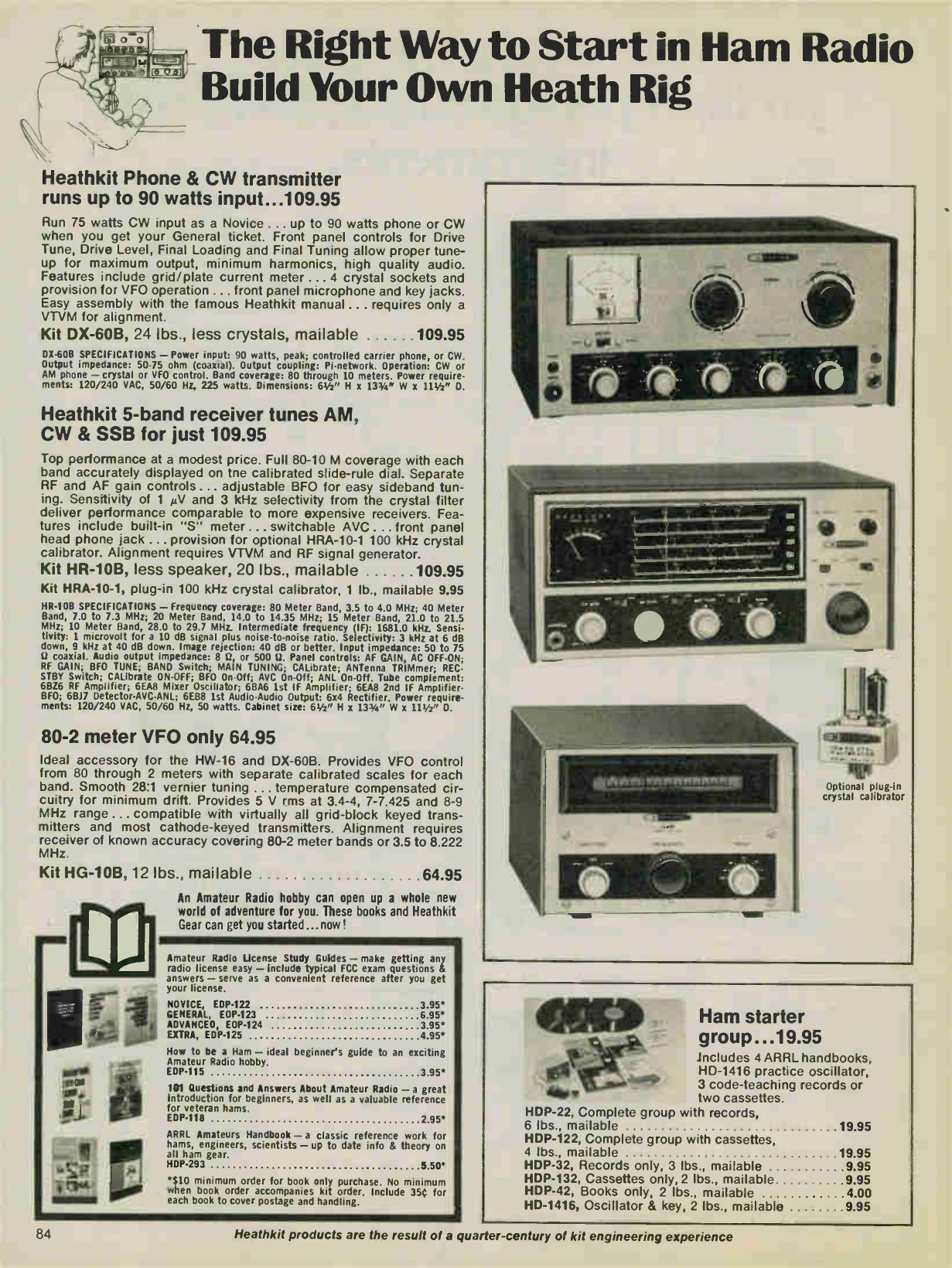
Heath’s amateur kits have outlived the company that designed them by more than thirty years, and many of them are still in use. Chuck Penson, the leading historian of the line, wrote in 1997 that Heath “brought tens of thousands of new hams into the hobby” and that “hundreds–if not thousands–of Heathkit transmitters and receivers are still in active duty” (Penson, “Heathkit’s 50th: The Green Turns to Gold”). That remains true. The DX-100 remains one of the commonest rigs on the amateur AM nets of 160, 80 and 40 metres (DX-100 dive); the HW-8 and HW-9 are still used for low-power CW; and SB and HW transceivers are among the cheapest ways to put a full-power tube station on the air. This volume describes how the line is collected, restored and used, and where its documents and its community are found. The company’s own story after 1992, including the revival of the Heathkit name, is in the company history.
5.1 What survives, and why
Several features of the Heath line explain why so much of it survives in working order.
- Numbers. Heath claimed more than 30,000 HW-101s by late 1981 (Winter 1981–82 catalogue), and Gilmore says Heath sold “more than a couple of hundred thousand” Cantennas and more than 15,000 GD-1 grid dippers in two years (Leibson, EEJournal, parts 1 and 2). Penson’s count of the whole line is “more than 150 kits, the largest amateur radio product line ever amassed by a single company”.
- Documentation. Every kit came with a manual that explained its circuit, gave its voltages and resistances, and showed every part in a pictorial. The owner of a fifty-year-old HW-101 usually has better service information than the owner of a ten-year-old factory-built transceiver.
- Construction. The tube rigs were built for home assembly and home repair: chassis with room between parts, circuit boards that lift out, and standard tubes. The 6146 final tubes of the DX-100, Apache, SB and HW transceivers are still made or plentiful.
The solid-state rigs of the 1970s and 1980s survive less well. The SB-104’s board-level faults and its transistor finals make it a specialist’s radio, and its restoration depends on the notes of a few experienced owners, especially K5BCQ (K5BCQ, “SB-104”). The SB-104A dive covers the problem in detail.
5.2 Restoring the tube rigs
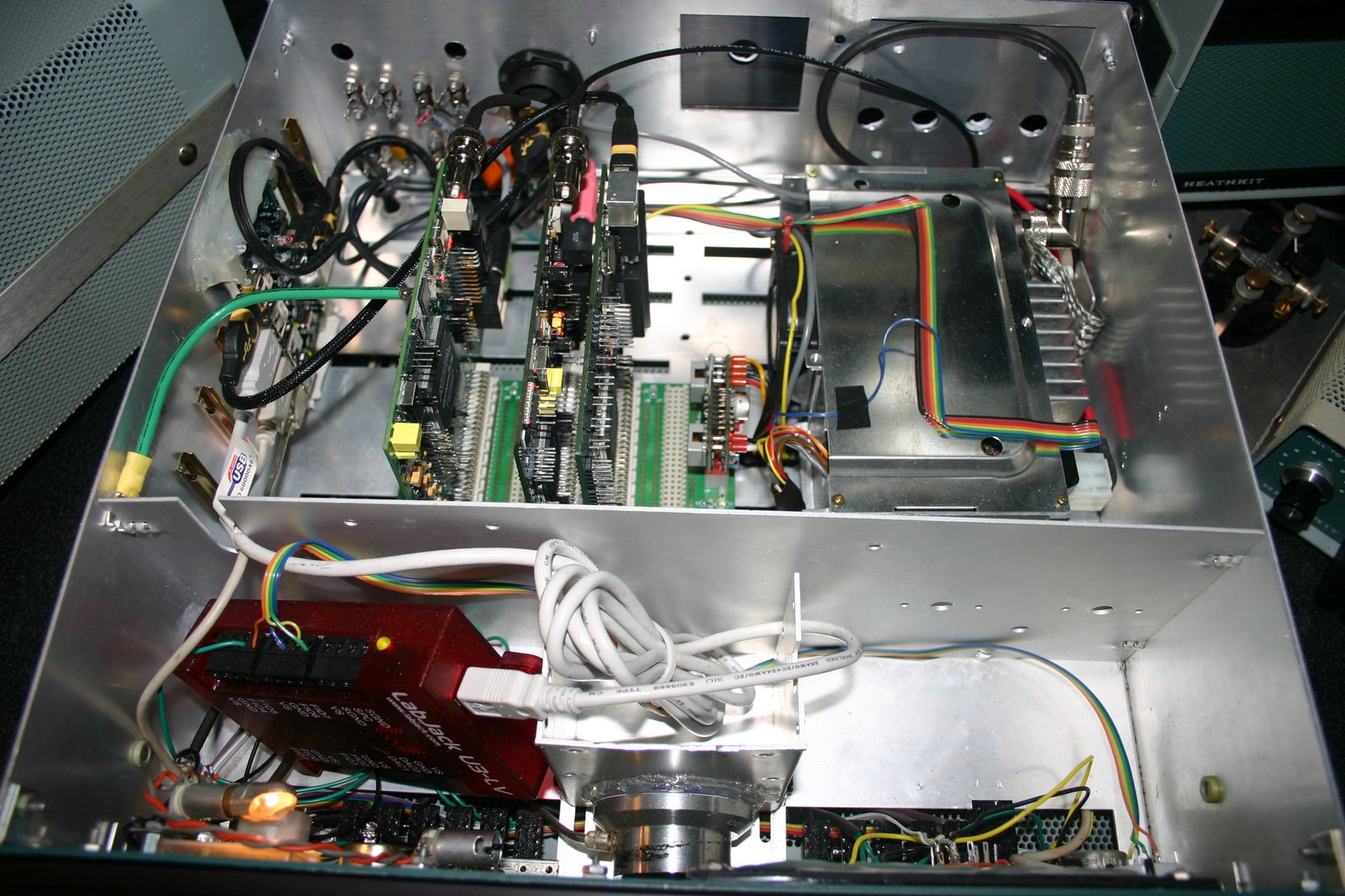
The kit dives on this site each have a restoration volume, and their advice is consistent across the line. What follows is a summary; the details, with the service bulletins, are in the DX-100, SB-301/SB-401, SB-102 and HW-101 dives.
- Survey before power. A Heathkit of the 1950s to 1970s was built by its first owner, and its present condition depends on that builder’s skill and on every later owner’s modifications. The manual is the reference against which the rig is checked.
- Bring it up slowly. Filter capacitors that have sat unused for decades are reformed on a variac or a dim-bulb tester rather than switched straight on to full mains voltage.
- Replace what ages. Electrolytic capacitors, high-value resistors that have drifted, selenium rectifiers in the older rigs, relays and pilot lamps are the common failures, and tubes are tested rather than assumed good.
- Know the substitutions. In the HW-101 and its relatives, Heath’s own bulletin HW-101-18 of 1978 warned against the 6146B as a replacement final, because it could not be neutralised on 10 and 15 metres in a circuit designed for the 6146A (HW-101 dive, vol. 5). The SB-line LMO is a sealed factory assembly and is not opened casually.
- Mechanics. The SB dial drives and the SB-104’s plug-in boards need as much attention as the electronics. Eckweiler’s advice on the SB dials is that “if done right, the dial feels like velvet”, and that most can be readjusted (Heathkit of the Month #30).
The standard modern reference for the most common HF transceivers is the Heathkit HW-101 and SB-10x Restoration and Troubleshooting manual compiled by Robert Kembel, W5RKL, and contributors (W5RKL). The QRP rigs have their own literature: the HW-8 attracted modifications in QST for more than twenty-five years, and owners today commonly fit a modern audio amplifier and a better antenna connector (WD8RIF, “Heathkit HW-8”; W6CSN, QRPer, 2026).
5.3 Safety
The tube rigs and linear amplifiers of the Heath line carry lethal voltages. The DX-100 runs its finals at about 740 volts; the SB-220 at 2.5 to 3 kilovolts, from a supply with large filter capacitors that hold their charge after the mains is switched off (Eckweiler, Heathkit of the Month #49; DX-100 dive, vol. 5). The external supplies of the SB and HW transceivers deliver 700 to 850 volts on an ordinary cable. Every restoration volume on this site begins with safety for this reason. The rule is the same for all of them: discharge the high-voltage supply with a grounded probe and confirm with a meter before touching anything inside the cabinet, and do not work on a live high-voltage circuit alone.
A second safety point is regulatory. The SB-200 and SB-220 were withdrawn in 1978 because the FCC barred amplifiers that could be used on 10 metres, after amateur amplifiers found their way on to the 11-metre Citizens Band (Eckweiler, #33). The later SB-201 and SB-221 lack 10 metres by design. Their use on the WARC bands, which were allocated in 1979 after they were designed, needs care and modification.
5.4 Using them on the air
Heath equipment is used today in three main ways.
- AM. High-level plate-modulated transmitters such as the DX-100 and the Apache are prized for AM phone, which survives on a few frequencies on 160, 80 and 40 metres. The DX-100 dive’s modification table lists the audio and screen-circuit changes that AM operators have circulated for decades (DX-100 dive, vol. 5).
- CW and QRP. The HW-8 and HW-9, and the HW-16 as a Novice-era CW rig, are used by low-power operators.
- SSB with tubes. The SB and HW transceivers remain serviceable SSB stations on 80 through 10 metres. They lack the WARC bands, digital readout and receiver incremental tuning, and they need a separate power supply, but their receivers are still well regarded (SB-102 dive).
The linear amplifiers are still in wide use with modern transceivers. The SB-200, SB-220 and their successors work with almost any HF rig, and Eckweiler notes that they “are still popular amplifiers” (#30). So is the Cantenna.
5.5 Books, archives and communities
Books. The standard reference is Chuck Penson’s Heathkit: A Guide to the Amateur Radio Products. The first edition was published by Electric Radio Press in 1995 and the second by CQ Communications in May 2003. The third, of September 2021, runs to 426 pages and is arranged by category: HF transmitters, receivers and transceivers, amplifiers, tuners, VHF equipment, power supplies, scopes, meters and accessories (Eckweiler, review of the third edition, Heathkit of the Month #A06). Penson, WA7ZZE, is also the former archivist of the Titan Missile Museum. Brueschke and Mack’s history in The AWA Review 32 (2019) covers the company as a whole (Internet Archive).
Articles. Bob Eckweiler’s Heathkit of the Month, written for the Orange County Amateur Radio Club newsletter since 2008, had reached 133 installments by 2026, many of them on amateur products, each with its history, circuit and restoration notes (OCARC index). Steven Leibson’s four-part series in EEJournal, “‘H’ is for Heathkits and Hams”, was built on interviews with Chas Gilmore, Penson and Terry Perdue (part 1).
Catalogues. World Radio History hosts about 120 Heath catalogues and flyers from 1947 to 1993; this dive was written from them (World Radio History). Some are misfiled: the “Summer 1951” flyer is from 1953 (see the first volume), the “1963 Supplement 80-33” file also contains the March 1966 supplement 800/62, and the “1963 Fall-Winter” catalogue 81-30 is the 1962–63 issue, with prices effective 15 August 1962. The Nostalgic Kits Central model matrix lists first and last years and prices for more than 1,400 Heath model numbers (NKC), and the Heathkit Virtual Museum presents the ham line by category (Heathkit Virtual Museum).
Manuals. The current owner of the Heath name claims copyright in all Heath publications and sells paper reprints through Data Professionals. Free scans are widely available, notably in the Internet Archive’s Heathkit manuals collection and its Digital Library of Amateur Radio and Communications, and at W5RKL’s ham-focused archive (Internet Archive, Heathkit manuals; W5RKL manuals). Tubular Electronics withholds about thirty titles it believes are still in copyright, among them the HW-9, HW-16, SB-610 and SB-1000 (Tubular Electronics). The position is surveyed in the company history’s field guide, and the hosting data for the documents used in this dive are in the Reference volume.
Communities. The old Heathkit email lists have moved to groups.io, where there are general Heathkit and Heathkit ham lists and groups for single models (company history, vol. 7). The heath mailing list archives of the 1990s and 2000s remain online and are the source of many service-bulletin compilations used in this site’s kit dives (heath list archive, example). eHam carries owner reviews of most of the transceivers (eHam, SB-102).
5.6 The Heathkit name and amateur radio today
The restarted Heathkit company returned to amateur radio in 2025 with the AMSAT CubeSatSim Heathkit Edition, a satellite simulator for classrooms, and it sells upgrade parts for some classic kits, including a replacement dial for the HG-10 VFO (company history, vol. 7). It has not reissued any of the old amateur kits. The ham line of 1952 to 1992 survives through its owners, its manuals and the people who write about it.
Sources
- Penson, Chuck (WA7ZZE). “Heathkit’s 50th: The Green Turns to Gold.” Electric Radio, January 1997; QST, April 1997. Heathkit Virtual Museum
- Penson, Chuck. Heathkit: A Guide to the Amateur Radio Products. Electric Radio Press, 1995; CQ Communications, 2003; third edition, 2021. Reviewed by Eckweiler: Heathkit of the Month #A06
- Eckweiler, Bob (AF6C). Heathkit of the Month, OCARC. Index · #30 · #33 · #49
- Leibson, Steven. “‘H’ is for Heathkits and Hams”, parts 1–4. EEJournal. Part 1 · Part 2
- Kembel, Robert W. (W5RKL), and contributors. Heathkit HW-101 and SB-10x Restoration and Troubleshooting, revised 17 December 2021. PDF
- K5BCQ. SB-104 repair notes. Link
- WD8RIF. “Heathkit HW-8.” Link
- W6CSN. “Vintage QRP with the Heathkit HW-8.” QRPer, January 2026. Link
- World Radio History, Heathkit catalogues. Index
- Nostalgic Kits Central, Heathkit model matrix. Link
- Internet Archive, Heathkit manuals collection. Link · W5RKL manuals archive. Link · Tubular Electronics. Link
- Site dives: DX-100 · SB-301/SB-401 · SB-102 · SB-104A · HW-101 · company history vol. 7 and vol. 9
Comments (0)