HERO 2000 (ET-19) · Volume 1
Overview — Heathkit's Multiprocessor Robot
1.1 What it is
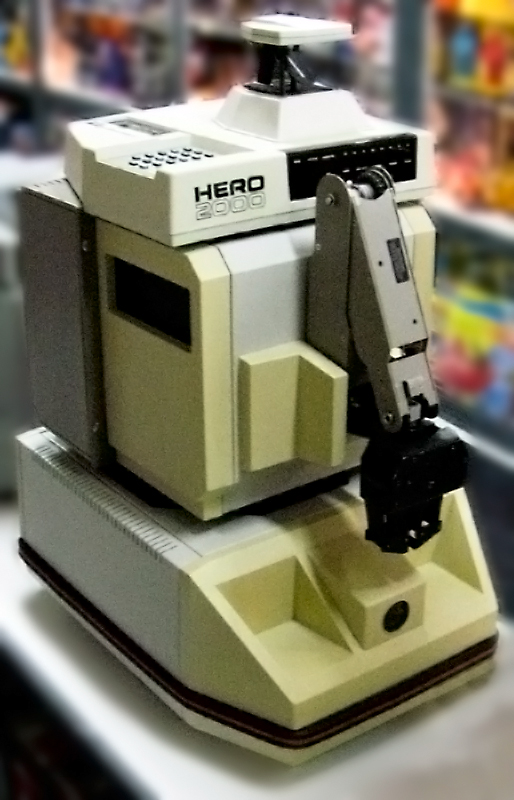
The HERO 2000 is the largest, most capable, and most expensive robot Heathkit ever
built — a 1986 educational and automation-training machine that bears little
resemblance, under the skin, to the 6808-based HERO 1 and HERO Jr that preceded it.
Where those earlier robots ran a single 8-bit microprocessor, the HERO 2000 is a
multiprocessor computer on wheels: an Intel 8088 master delegating motion,
sensing, speech, and communication to a set of dedicated slave processors, all
plugged into a passive backplane the way the cards of a desktop computer plug into a
motherboard (hero.dsavage.net HERO 2000 spec sheet; theoldrobots.com; Wikipedia,
“HERO (robot)”).
It is also a physically different class of machine. The HERO 2000 stands roughly 32 inches tall and weighs about 78 pounds with its arm fitted — a waist-high robot rather than the 19-to-20-inch tabletop machines that came before (HERO 2000 spec sheet). A 360-degree ring of sonar and light sensors lets it perceive its surroundings in every direction at once; a multi-jointed optional arm gives it reach; and a speech subsystem turns ordinary typed text directly into spoken words. The robot was sold both as a kit and assembled, and it was the platform for Heath/Zenith Educational Systems courses in robotics and automation (Computer History Museum; Heathkit catalogue, Spring–Summer 1986, p. 2).
The robot’s place in Heath’s robot line — the catalogues, the prices, the courses and the Robot Arm Trainer that grew out of it — is told in the Robots History.
1.2 A note on the model number
This dive refers to the machine as the HERO 2000, model ET-19. That is the Heathkit model number — it follows ET-18, the HERO 1 — and it is the designation on the factory manuals. Heath’s catalogues use it for the kit: “Kit ET-19, HERO 2000” at $1,999.95, without the arm, and “Kit ETS-19, HERO 2000 Robot with Arm” at $2,499.95 (Heathkit catalogue, Spring–Summer 1986, p. 2). The assembled robot, always sold with its arm and remote console, carried three successive numbers: EWS-19-35 / EWS-19-36 in 1986 (the suffix giving the remote’s frequency, 75.43 or 75.67 MHz), EWS-19-45 / EWS-19-46 in Fall 1987 (Heathkit catalogue, Fall 1987), and ETW-19-A from Christmas 1987, “No assembly required — can be operated directly out of shipping crate” (Heathkit catalogue, Christmas 1987, p. 80). Some secondary sources and collector listings give the kit as “ET-19W”; that number appears in no Heath catalogue examined. The name “ET-2000” appears informally — in some references and listings — but it does not appear to be the machine’s actual Heathkit model number; “ET-19” is. Where “ET-2000” is encountered it should be read as a common name for the HERO 2000, not as the model code.
1.3 Headline facts
Table 1 — Headline facts
| Attribute | Value | Source |
|---|---|---|
| Name / model | HERO 2000 — kit ET-19 (no arm), ETS-19 (with arm); assembled EWS-19-35/-36, EWS-19-45/-46, then ETW-19-A | Heathkit catalogue, Spring–Summer 1986, p. 2; Heathkit catalogue, Christmas 1987, p. 80 |
| Maker | Heath Company / Heath-Zenith Educational Systems | CHM; Wikipedia |
| Year | 1986 (first catalogued Spring–Summer 1986; one source says 1987) | Heathkit catalogue, Spring–Summer 1986, p. 2; robotworkshop |
| Price | $1,999.95 kit / $2,499.95 kit with arm / $4,499.95 assembled | Heathkit catalogue, Spring–Summer 1986, p. 2; robotworkshop |
| Units produced | ~3,000 (unverified; no Heath figure found) | Wikipedia |
| Line discontinued | 1995 | Wikipedia |
| Main CPU | Intel 8088, 16-bit, ~5 MHz (one source 4.77 MHz) | spec sheet; secondary |
| Slave processors | Intel 8042 UPIs; “eleven 8-bit peripheral microprocessors” per the catalogue, 6 base and 11 with the arm per the spec sheet (Vol. 2) | Heathkit catalogue, Spring–Summer 1986, p. 2; spec sheet |
| RAM | 24 KB, expandable to 576 KB via cards | theoldrobots; robotworkshop |
| ROM | 64 KB (monitor + HERO 2000 BASIC + routines) | spec sheet; theoldrobots |
| Backplane | Passive, up to 12 plug-in cards | theoldrobots; Selectric |
| Sonar | 24 bearings, 15° apart (360°); ~4–4.5 in to 10.5 ft (catalogue: “up to 10 feet”); auxiliary low-level sonar | spec sheet; theoldrobots; Heathkit catalogue, Spring–Summer 1986, p. 2 |
| Light | 255 levels at 24 bearings | spec sheet |
| Sound / temperature | 255 levels / +60°F to +90°F | spec sheet |
| Arm (optional) | Five axes + gripper with touch sensing, up to 1 lb; torso rotation adds a sixth axis | Heathkit catalogue, Spring–Summer 1986, p. 2; spec sheet |
| Speech | Direct text-to-speech (SSI 263A per spec sheet; “SPA-256” per others) | spec sheet; secondaries |
| I/O | Two RS-232 ports; remote console; ~100 ft radio link | spec sheet; theoldrobots |
| Drive | Two servo-driven side wheels on a four-wheel suspension; pulls ~26 lb; eight speeds | Heathkit catalogue, Spring–Summer 1986, p. 2; theoldrobots |
| Power | 12 V, 24 Ah battery: up to 4 h normal use, 6 h electronics only, up to 6 days in sleep mode (spec sheet: 14 Ah) | Heathkit catalogue, Spring–Summer 1986, p. 2; spec sheet |
| Dimensions / weight | 16.5 × 22.5 × 32.4 in; ~78 lb with arm | spec sheet |
Several of these rows carry a conflict between sources — the 8088 clock, the slave
type and count, the speech chip, the sonar near-range, and the year. The battery
conflict is settled by Heath’s own catalogue, which gives 24 amp-hours. This
deep dive flags each conflict where it arises rather than silently choosing one
figure, and ties the chip-level details to the transcribed factory spec sheet
(hero.dsavage.net), which is the most technically specific source available; the
factory ET-19 Technical Manual is the authoritative primary a reader should
consult for the definitive numbers.
1.4 What sets it apart
For all that it shares the HERO name, the HERO 2000 is a generational leap, and three features carry most of the difference.
It is a multiprocessor. The defining architectural fact is that no single processor does everything. An Intel 8088 master — the same processor family as the IBM PC/XT and the Heath/Zenith Z-151 computers (selectric.org) — runs the user’s program, while a set of Intel 8042 UPI slave processors each take charge of one subsystem: one drives the motors, one runs the sonar, one handles the keypad and display, one manages communications, and, with the optional arm fitted, one more runs the arm (HERO 2000 spec sheet). Heath’s catalogue describes “a 16-bit 8088 master microprocessor … controlling eleven 8-bit peripheral microprocessors” without tying the count to the arm (Heathkit catalogue, Spring–Summer 1986, p. 2); the spec sheet gives six in the base robot and eleven with the arm. Vol. 2 sets out both. Vol. 2 takes up this architecture in detail.
It senses in every direction. Rather than a single forward-facing sonar like the HERO 1 and HERO Jr, the HERO 2000 carries a 360-degree ring of sonar and light sensing — 24 bearings spaced 15 degrees apart — so it can map the ranges and light levels all around it without turning (HERO 2000 spec sheet). Vol. 5 covers the ring.
It speaks from text. The HERO 1 and HERO Jr spoke through Votrax phoneme synthesizers that had to be fed streams of phoneme codes. The HERO 2000 instead offers direct text-to-speech: a program hands it ordinary text and the robot says it (HERO 2000 spec sheet). Vol. 7 covers the speech subsystem and the chip-identity conflict in the record.
1.5 Where it sat in the HERO line
The HERO 2000 was the top of the line and the end of it. At $1,999.95 as a kit and $4,499.95 assembled it was far costlier than the $599.95 HERO Jr kit or the $999.95–$2,499.95 HERO 1, and at about 3,000 units (by Wikipedia’s unverified count) it sold in smaller numbers than either; Heathkit supported the HERO family until 1995 (Wikipedia; robotworkshop; Heathkit catalogue, Spring–Summer 1986, p. 2). It was aimed not at the living room, like the HERO Jr, but at serious education and industrial-automation training — the kind of setting that would use its dual serial ports, its expandable memory, and its programmability in HERO 2000 BASIC and assembly.
The contrast with its siblings is the quickest way to place it:
Table 2 — The contrast with its siblings is the quickest way to place it
| HERO 1 (ET-18) | HERO Jr (RT-1) | HERO 2000 (ET-19) | |
|---|---|---|---|
| Year / market | 1982 educational | 1984 consumer | 1986 advanced trainer |
| CPU | 6808 @ 1 MHz | 6808 @ 1 MHz | Intel 8088 + eleven 8-bit slaves (catalogue) |
| RAM / ROM | 4 KB / 8 KB | 2 KB→24 KB / 32 KB | 24 KB→576 KB / 64 KB |
| Sonar | 4 in–8 ft, 1 bearing | Polaroid, 1 bearing, to 13 ft | 360°, 24 bearings, to 10.5 ft |
| Speech | Optional Votrax | Built-in Votrax | Direct text-to-speech |
| Size / weight | 20″ / 39 lb | 19″ | 32″ / ~78 lb |
| Price | $999.95–$2,499.95 | $599.95 kit | $1,999.95 / $4,499.95 |
The Robots History follows the HERO 2000 through the catalogues. The volumes that follow open each layer of the machine: Vol. 2 the multiprocessor architecture and the backplane; Vol. 3 the memory and the card cage; Vol. 4 the dual-servo drive; Vol. 5 the 360-degree sensing ring; Vol. 6 the optional arm; Vol. 7 the text-to-speech subsystem; Vol. 8 the I/O, communications, and programming; and Vol. 9 acquiring and restoring one today. Vol. 10 is the cheatsheet.
Comments (0)