ET-3400 Microprocessor Trainer · Volume 1
Heath's Microprocessor Trainer
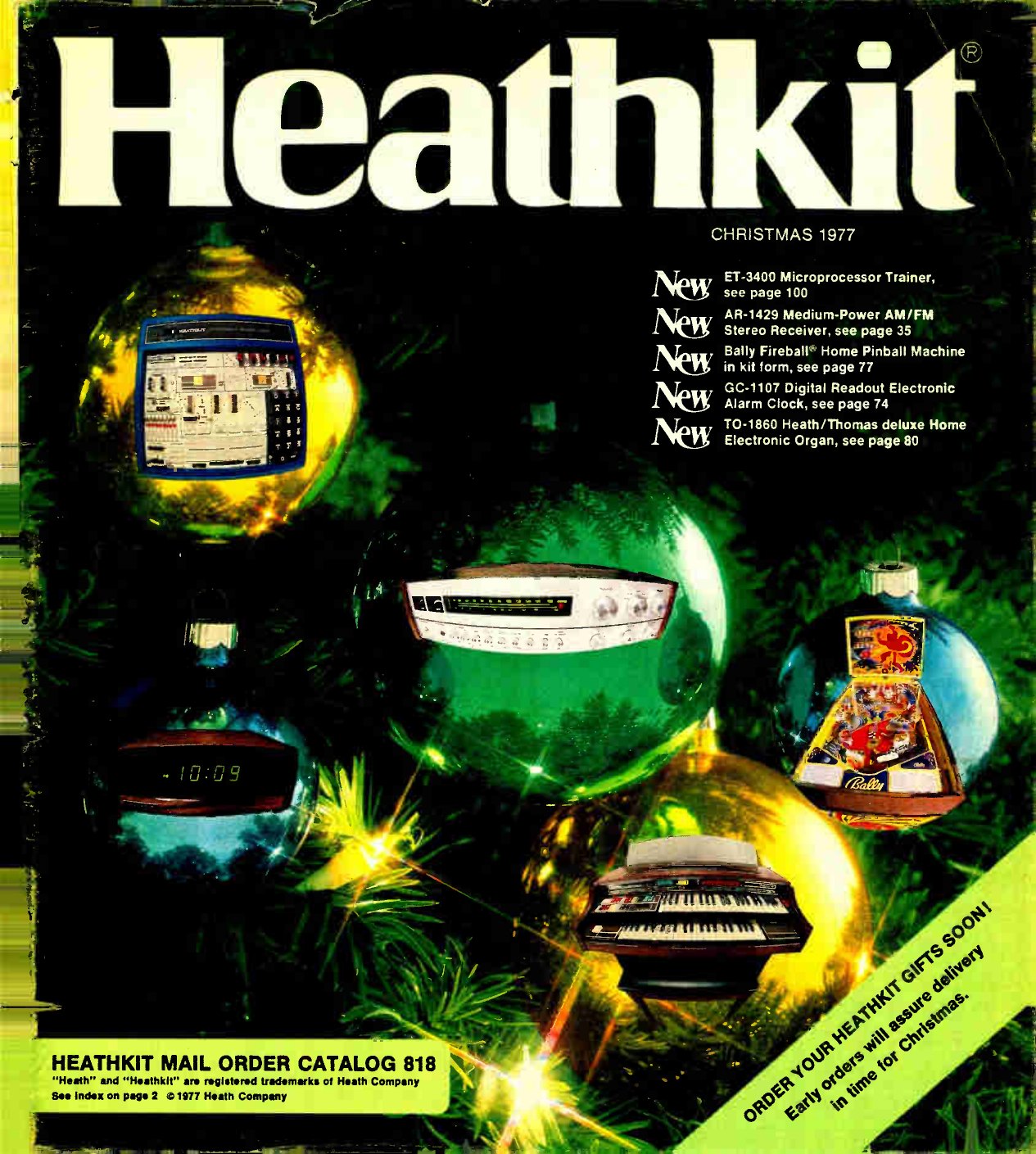
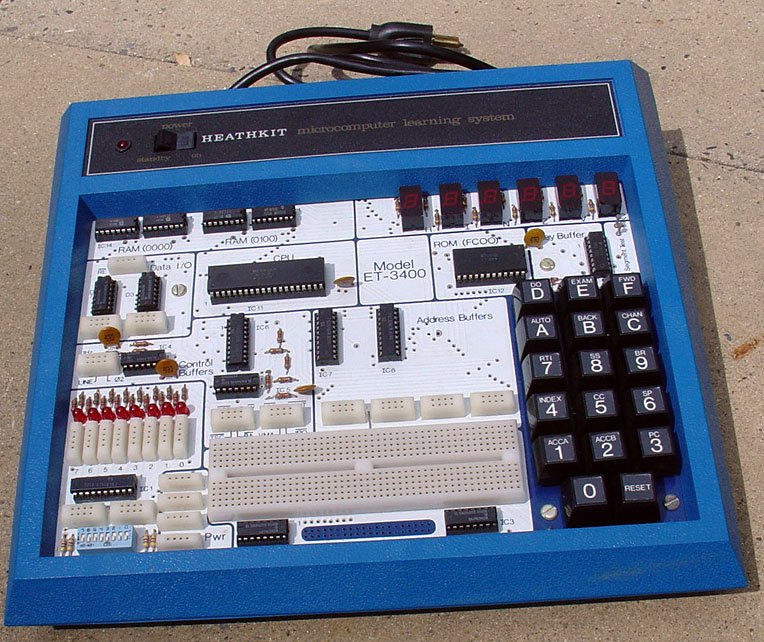
The Heathkit ET-3400 Microprocessor Trainer is a small computer in a blue tray. It has a Motorola 6800 processor, a 1K monitor program in ROM, 256 bytes of memory (with sockets for 256 more), six seven-segment LED digits, and a 17-key hexadecimal keypad. The lower half of the panel is a digital trainer in its own right, with a solderless breadboard, eight logic LEDs, eight data switches and +5, +12 and −12 volt supplies, and with every address, data and control line of the processor brought out to spring terminals beside the breadboard. Heath introduced it in the Christmas 1977 catalogue as the laboratory for a home-study course, EE-3401 Microprocessors. For many thousands of students, the ET-3400 is where machine code first stopped being theory: they keyed a program in byte by byte, pressed DO, and watched the six digits answer.

This volume places the trainer in Heath’s line, dates its launch and its revisions from the catalogues, and sets out who it was for. The circuit is in volume 2, the kit build in volume 3, the EE-3401 course and the keypad monitor in volume 4, and programs (including a scrolling tickertape, run in an emulator written for this dive) in volume 5. The Heath Company’s own story, including the decision that put an Intel 8080 rather than a 6800 into Heath’s first computer, is in the site history dive; the education business as a whole is in the Education History.
1.1 What the trainer is for
A microprocessor in 1977 was a 40-pin chip that did nothing on its own. To learn one, a student needed memory, a way to put a program into that memory, a way to see what the processor had done, and a way to stop it and look inside. Professional development systems of the day (Motorola’s own EXORciser among them) did all of this but cost thousands of dollars. Single-board “evaluation kits” such as the MOS Technology KIM-1 of 1976, on which many people first learned machine code, were cheaper but came as a bare board (KIM-1, Iconic Machines).
Heath’s answer was to put a complete small computer and a digital laboratory into one case. The manual’s introduction calls the ET-3400 “a practical, low cost microprocessor trainer, designed as a learning tool to teach microprocessor operation, programming, and applications”, made to accompany the EE-3401 Individual Learning Program, and adds that it “is a flexible, general-purpose training unit and microprocessor breadboard” (ET-3400 manual, 595-2021-03, p. 3). Its 1K monitor program let the student examine and change memory and registers from the keypad, enter programs, set up to four breakpoints, single-step, and run. The breadboard area let the same student wire an address decoder, an output latch or a digital-to-analog converter to the processor’s buses and then drive it from software. That second half is what separated the ET-3400 from a keypad computer: the course’s later units are about interfacing, and the trainer was built for them.
1.2 Launch: Christmas 1977
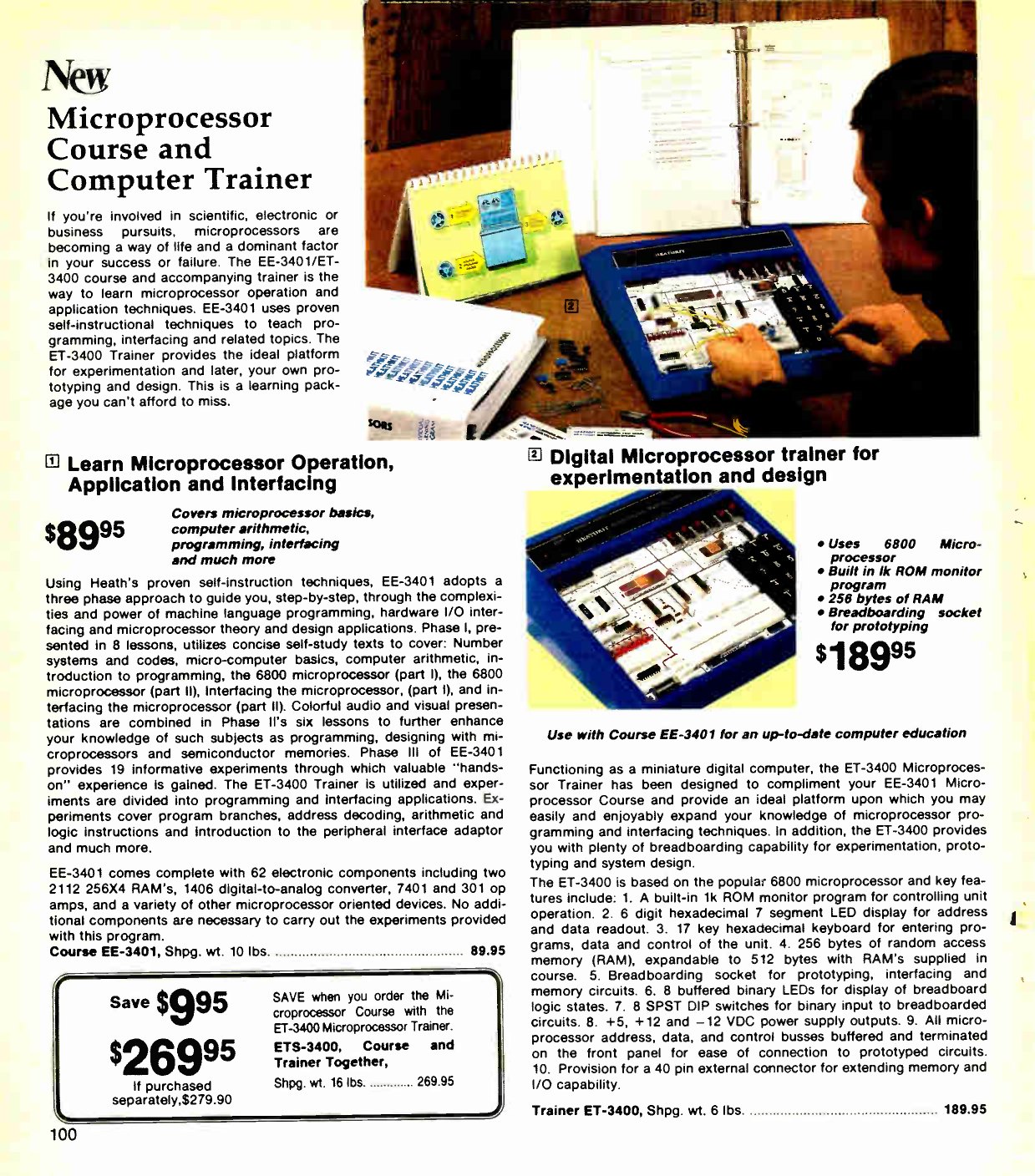
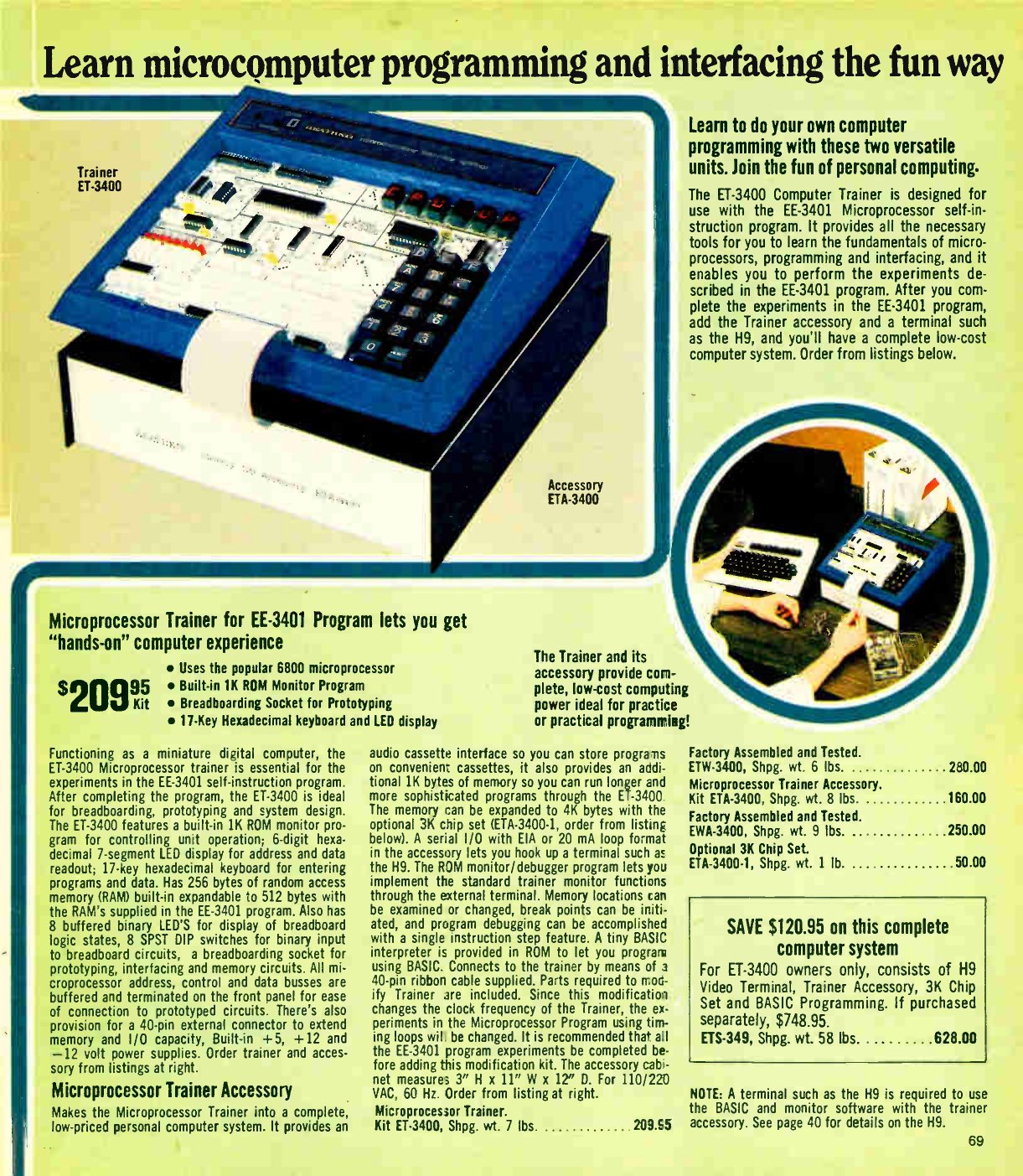
The trainer and its course appeared together as “New” products in the Christmas 1977 catalogue. The page was headed “Microprocessor Course and Computer Trainer”. The course, EE-3401, cost $89.95; the trainer kit, ET-3400, cost $189.95; and the two ordered together as ETS-3400 cost $269.95, a saving of $9.95 on the separate prices (Christmas 1977, p. 100). The trainer’s feature list ran to ten numbered points: the 6800, “a built-in 1k ROM monitor program for controlling unit operation”, the six-digit hexadecimal LED display, the 17-key keyboard, 256 bytes of RAM “expandable to 512 bytes with RAM’s supplied in course”, the breadboarding socket, eight buffered LEDs, eight SPST DIP switches, +5, +12 and −12 volt supplies, buffered buses “terminated on the front panel”, and “provision for a 40 pin external connector for extending memory and I/O capability”.
The Fall 1977 catalogue (No. 817), the first to feature Heath’s H8 and H11 computers, still offered only the ET-3200 for digital work, so the date of 1976 sometimes given for the ET-3400 is too early (history dive, volume 5). The manual’s title page carries “Copyright © 1977 Heath Company” (manual, title page). The model-number scheme was the education department’s: EE-31xx courses used the ET-3100 analog trainer, EE-3201 the ET-3200 digital trainer, and EE-3401 the ET-3400 (ET-3200 dive, volume 1).
Lou Frenzel, who started Heath’s education business, wrote that its first microprocessor product was “a microprocessor trainer and course based on the Motorola 6800”, and that the ET-3400 “was the result and it was a huge success”, because “microprocessors being new to electronics there was an overwhelming need for education” (Frenzel, Electronic Design, 2013). The choice of processor is worth noticing. Frenzel had overruled engineers who preferred the 6800 for Heath’s first general-purpose computer, the H8, and chose the 8080 for its larger software base (history dive, volume 5). The education side went the other way. The 6800’s two accumulators, single index register and regular instruction set were easier to teach, and the 6800 family stayed Heath’s teaching processor for fifteen years, through the 6808-based ET-3400A and the HERO 1 robot.
1.3 Where the ET-3400 sat in Heath’s line
The ET-3400 grew out of the ET-3200 Digital Design Experimenter of 1975. Its manual gives the same cabinet size, 12⅛ × 11¾ × 3½ inches, and the same 4 lb weight, and it keeps the ET-3200’s facilities for the student’s own circuits: logic indicators, data switches, supplies and a breadboard, in larger numbers (ET-3200 dive, volume 5). The course worked the same way. A student who had wired counters and decoders on the ET-3200 in the Digital Techniques course went on to wire them to a processor on the ET-3400; the 1978 catalogue says EE-3401 “assumes a knowledge of electronics equivalent to Heath’s Digital Techniques Program” (Fall 1978, p. 88).
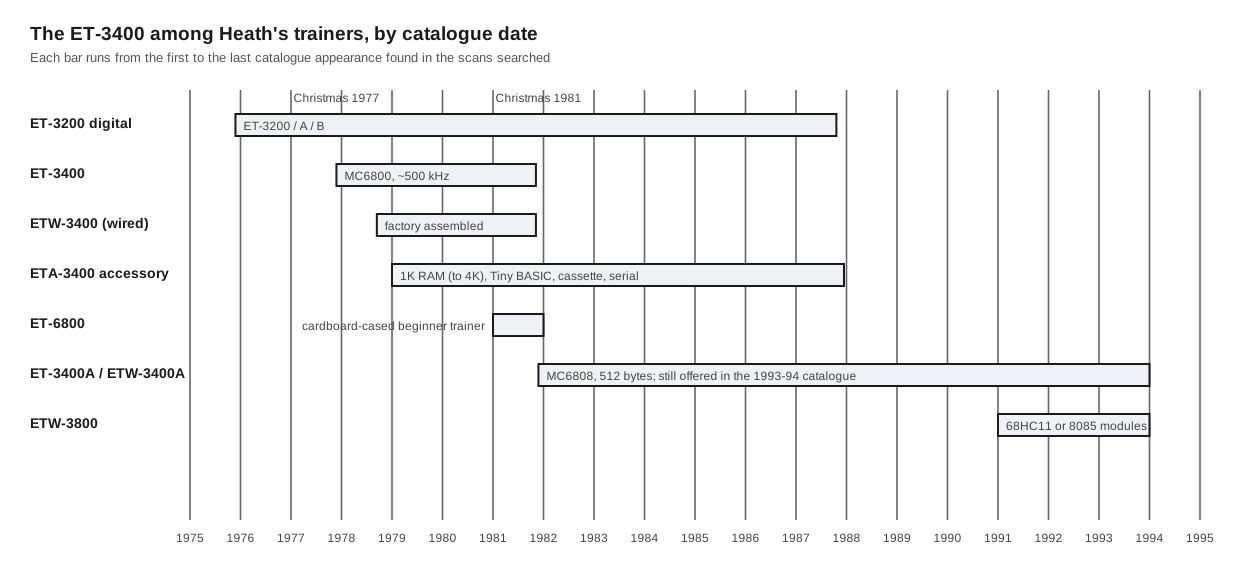
Around it Heath built a family:
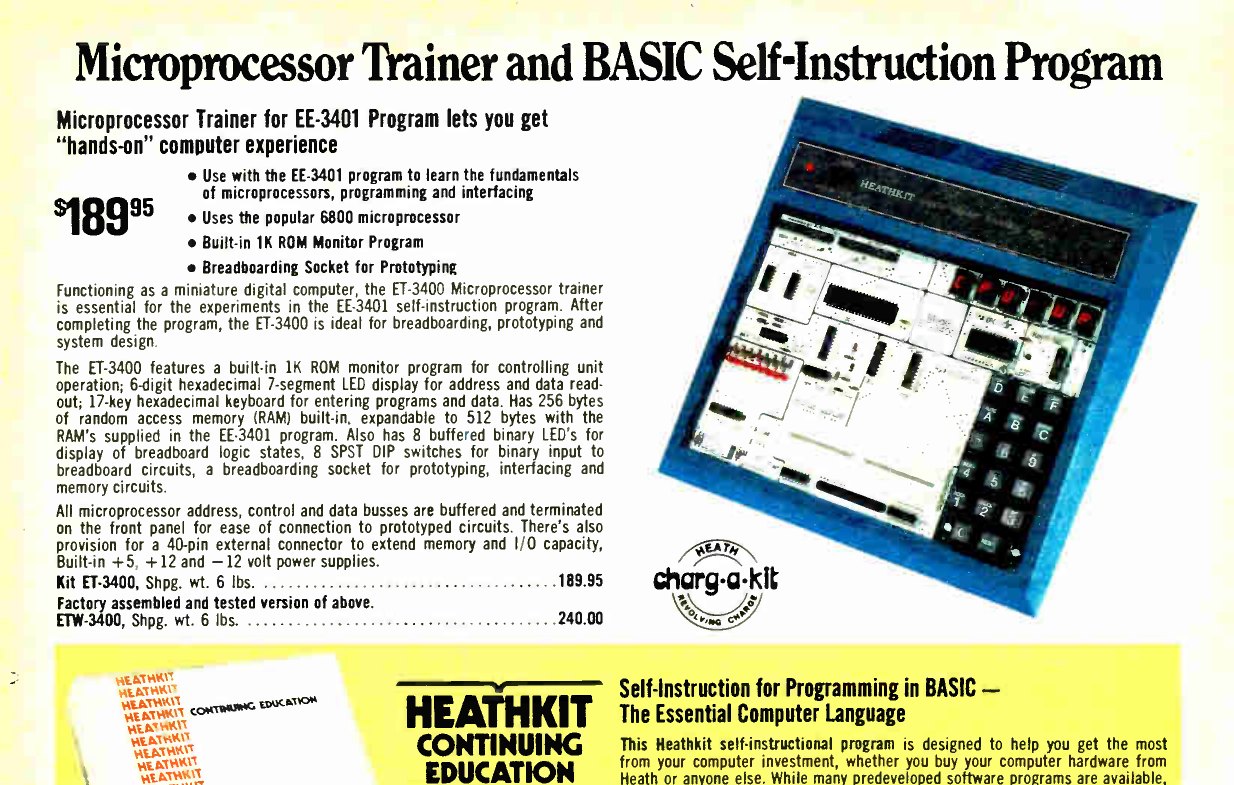
- ETW-3400, the factory-assembled trainer, first found in the Fall 1978 catalogue at $240.00 (Fall 1978, p. 89).
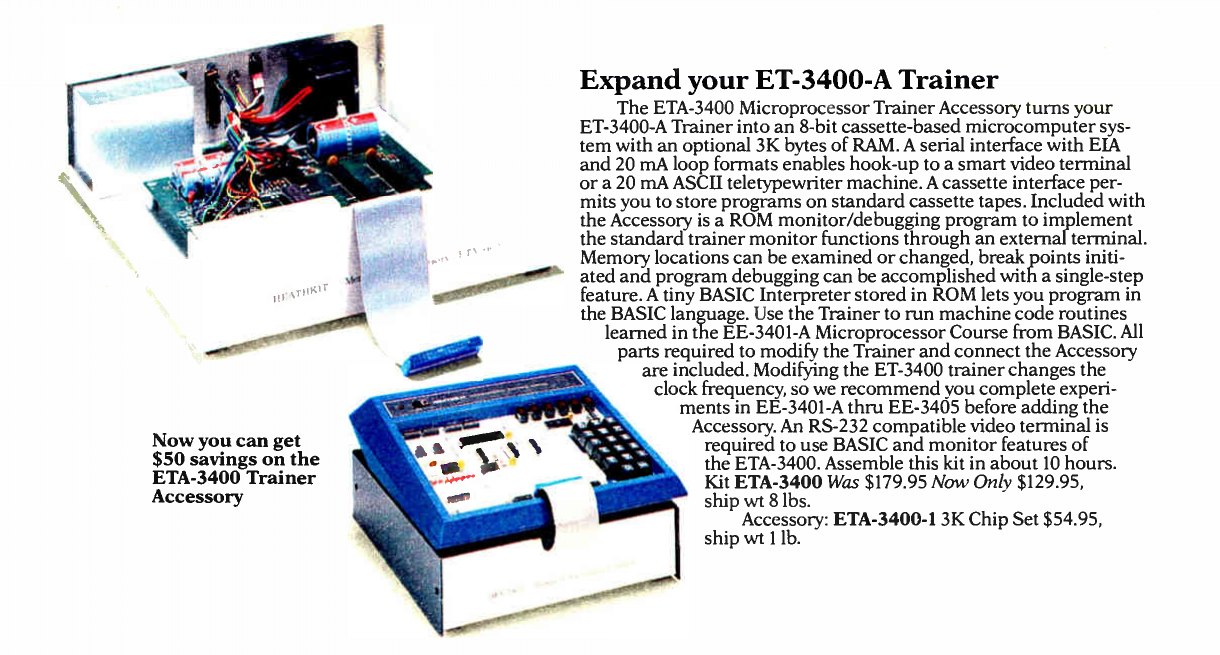
- ETA-3400 Microprocessor Trainer Accessory, first found in Winter 1979 at $150.00. It was a separate box under the trainer, joined by a 40-pin ribbon cable, that added 1K of RAM (expandable to 4K with the ETA-3400-1 chip set), a cassette interface, a serial port for a terminal such as Heath’s H9, a ROM monitor/debugger and Tom Pittman’s Tiny BASIC in ROM (Winter 1979; Fall 1979, p. 69). Volume 4 describes it.
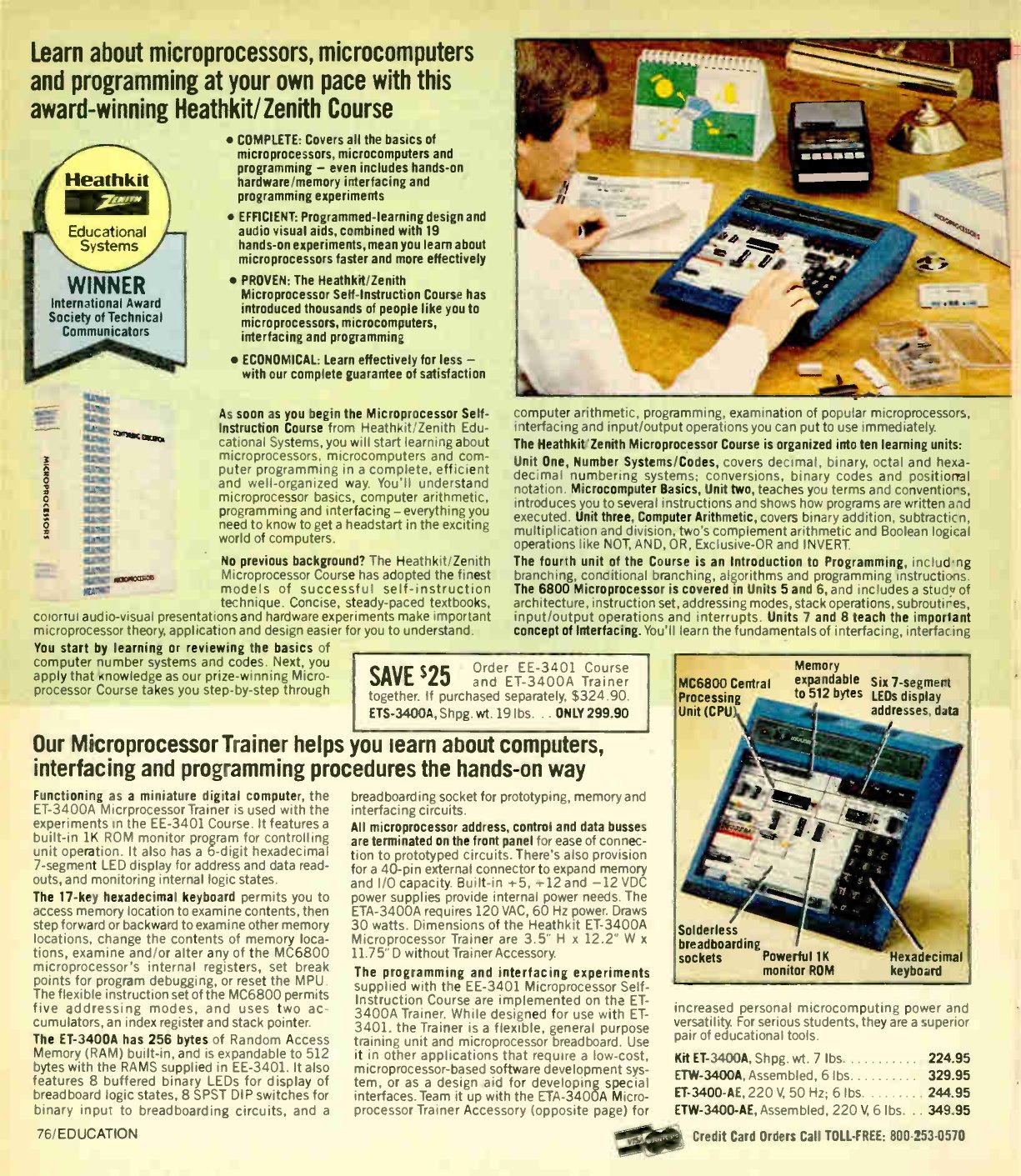
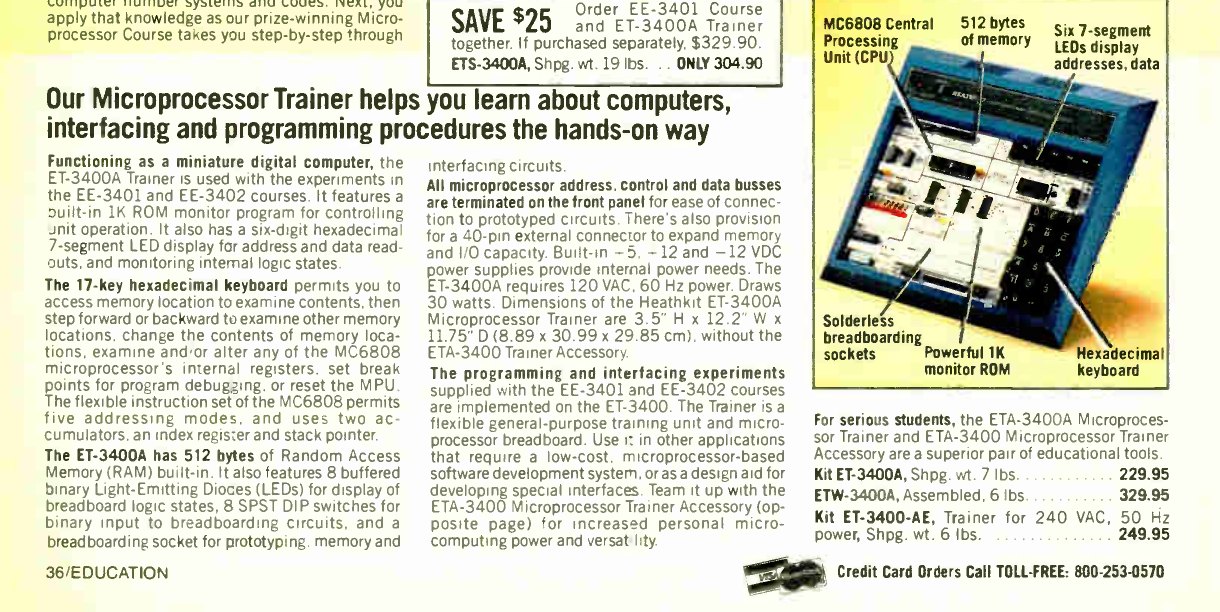
- ET-3400A, the revised trainer, first in the Christmas 1981 catalogue. By Christmas 1982 the catalogue’s callouts give an MC6808 processor and 512 bytes of memory (Christmas 1982, p. 36). A 220-volt, 50 Hz version was sold as the ET-3400-AE, and an assembled one as the ETW-3400A.
- EB-6401, the classroom version of the course, sold through Heathkit/Zenith Educational Systems to schools and industry; its textbook Microprocessors (EB-6401A, © 1978, 1985) was still in print in 1988 (Internet Archive).
1.4 Who bought it
The catalogue addressed three readers, as it had for the ET-3200.
The first was the working engineer or technician. The launch copy opened: “If you’re involved in scientific, electronic or business pursuits, microprocessors are becoming a way of life and a dominant factor in your success or failure” (Christmas 1977, p. 100). The course carried Continuing Education Units: a pass of 70 per cent or better in the optional final examination earned 8.0 CEUs and a Certificate of Achievement (Fall 1978, p. 88).
The second was the hobbyist. Every description promised that “after completing the program, the ET-3400 is ideal for breadboarding, prototyping and system design”, and from 1979 the ETA-3400 and a terminal turned it into “a complete low-cost computer system” (Fall 1979, p. 69).
The third was the school, and the surviving units show it. The scan of the 1977 manual used throughout this dive carries the stamp of the “Electronic Maintenance & Calibration Lab, University of Colorado at Denver” on its title page (manual). Heathkit/Zenith Educational Systems sold the assembled trainer and the EB-6401 classroom course to colleges, technical schools and training departments, and in its 1993–94 catalogue it billed the ETW-3400-A as the “World’s Most Popular Microprocessor Trainer!” (Education History, volume 4). The trainer also worked outside the classroom: a 1979 paper in Behavior Research Methods & Instrumentation described one used as a backup control system for laboratory experiments (history dive, volume 5, citing Milligan and Richardson, 1979).
1.5 Prices and versions
The table gives what the catalogues show. Prices rose with the inflation of the late 1970s, fell back twice, and then rose steadily.
Table 1 — Prices and versions
| Catalogue | ET-3400 kit | Factory-wired | ETA-3400 | Notes |
|---|---|---|---|---|
| Christmas 1977 (818) | $189.95 | — | — | launch; EE-3401 $89.95; ETS-3400 pair $269.95 |
| Winter 1978 | $199.95 | — | — | ETS-3400 $279.95 |
| Spring 1978 | $199.95 | — | — | ETS-3400 $279.95 |
| Fall 1978 | $189.95 | ETW-3400 $240.00 | — | first wired version found |
| Christmas 1978 (842) | $189.95 | $240.00 | — | |
| Winter 1979 | $189.95 | $240.00 | $150.00 | ETA-3400 first found; ETA-3400-1 chip set $47.00 |
| Fall 1979 | $209.95 | $280.00 | $160.00 | EWA-3400 (assembled accessory) $250.00 |
| Christmas 1979 | $199.95 | $275.00 | $150.00 | |
| 1980 (848) | $199.95 | $275.00 | $150.00 | |
| Christmas 1980 | $199.95 | $279.00 | $150.00 | ETS-3400 pair $279.90 |
| Winter 1981 | $224.95 | $299.95 | — | ETS-3400 pair $299.90 |
| Christmas 1981 | ET-3400A $224.95 | $299.95 | $175.00 | A model first found |
| Winter 1981–82 | ET-3400A $224.95 | ETW-3400A $329.95 | $175.00 | ET-3400-AE (220 V) $244.95; EE-3401 $99.95 |
| Christmas 1982 | ET-3400A $229.95 | $329.95 | $175.00 | MC6808 and 512 bytes in the callouts |
| Spring 1984 | ET-3400A $239.95 | $339.95 | $175.00 | |
| Fall 1985 | ET-3400A $259.95 | $359.95 | — | EWA-3400 $279.95 |
| Fall 1986 | ET-3400-A $259.95 | $359.95 | $179.95 | |
| Fall 1987 | ET-3400-A $259.95 | $359.95 | $129.95 | accessory reduced from $179.95 |
| Winter 1991 (223) | ET-3400-A $279.95 | $399.95 | — | EE-3401-A $99.95 |
| 1993–94 education (279) | ET-3400-A $349.95 | $499.95 | — | per Education History, vol. 4 |
Sources: the catalogues named, all at World Radio History. Prices were read from the scans’ text layers and checked against the page images for the pages illustrated in this dive. A dash means no price was found in that issue, not that the item was withdrawn.
The versions:
Table 2 — The versions
| Model | First found | Processor and clock | Memory | Manual |
|---|---|---|---|---|
| ET-3400 | Christmas 1977 | MC6800 with an MC6875 two-phase clock chip, “500 kHz (approximately)“ | 256 bytes (two 2112s); sockets for 256 more | 595-2021, © 1977 (printings -03 and -06 found) |
| ETW-3400 | Fall 1978 | as ET-3400 | as ET-3400 | as ET-3400 |
| ET-3400 with ETA-3400 | Winter 1979 | clock modified to 1 MHz | +1K (to 4K) in the accessory | ETA-3400 manuals, © 1979 |
| ET-3400A / ETW-3400A / ET-3400-AE | Christmas 1981 | MC6808 (6802 seen on some boards), crystal clock | 512 bytes for the user per the catalogues; two 2114 (1024 × 4) RAMs on an owner’s board | not located |
Sources: ET-3400 manual, p. 107; Microprocessors, EB-6401A; Christmas 1982, p. 36.
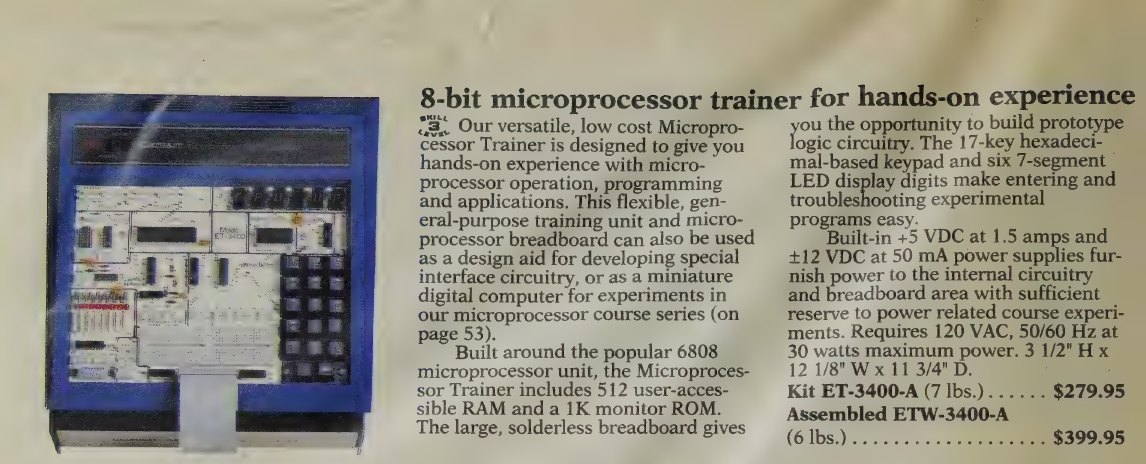
Three details of the A model need care. First, the catalogue copy did not change at once: Winter 1981–82 still describes “the MC6800 microprocessor” and 256 bytes “expandable to 512”, while the Christmas 1982 callouts say “MC6808 Central Processing Unit” and “512 bytes of memory” (Winter 1981–82, p. 76). Second, Heath’s own later textbook says that the ET-3400A “uses the 6808 MPU and has 1024 bytes of memory”, which disagrees with the catalogues’ 512; the two figures may both be right, since an owner’s ET-3400A has two 2114 RAMs, which hold 1024 bytes, while the catalogues, which repeat 512 into the 1990s, speak of “512 user-accessible RAM” (sebhc list, 2007) (Microprocessors, EB-6401A, Introduction; Winter 1991, p. 54). Third, the 6808 is a 6800 with its clock oscillator on the chip, driven by a crystal. The board photographed at the head of this volume has a 4.000 MHz crystal and an MC6802P (the 6808 with 128 bytes of internal RAM, which works in a 6808 socket), and Herb Johnson’s restoration notes describe his ET-3400A as having “a clock crystal and a 6802 or 6808” (Herb Johnson, retrotechnology.com). A 6802 or 6808 divides its crystal by four, so the A model probably runs at about 1 MHz, twice the original’s speed; no Heath document giving the A model’s clock rate was found.
1.6 The long tail
The ET-3400A outlived Heath’s own computer designs and the kit business. In Fall 1987 the ETA-3400 accessory was cut from $179.95 to $129.95, and its copy now recommended that students “complete experiments in EE-3401-A thru EE-3405 before adding the Accessory”, since five courses by then used the trainer (Fall 1987, p. 64). The Winter 1991 catalogue still sold the ET-3400-A as an “8-bit microprocessor trainer for hands-on experience”, “built around the popular 6808 microprocessor”, at $279.95 as a kit, on the same page as the newer 8085 courses that used the module-based ETW-3800 (Winter 1991, p. 54). Heathkit Educational Systems carried the ETW-3400-A into its 1993–94 catalogue, sixteen years after the launch (Education History, volume 4).
1.7 Headline specification
Table 3 — Headline specification
| Processor | Motorola MC6800, 8-bit, NMOS (MC6808 in the ET-3400A) |
| Clock | about 500 kHz from an MC6875 two-phase clock generator |
| ROM | 1024 bytes, mask-programmed MCM6830A, monitor at FC00–FFFF |
| RAM | 256 bytes (two 2112 256 × 4 chips) at 0000–00FF, sockets for 256 more at 0100–01FF; 59 bytes at the top of the first page reserved for the monitor |
| Display | six seven-segment LED digits (TIL312), each segment individually addressable |
| Keypad | 17 keys: 0–F (1 to F double as commands) and RESET |
| Breadboard facilities | eight LEDs with separate input terminals; eight DIP switches; solderless breadboard; buffered address, data and control lines on terminal blocks; line-frequency and 1 Hz square-wave outputs |
| Supplies | +5 V at 1.5 A (0.5 A available at the breadboard terminal); +12 V and −12 V at 50 mA at the terminals |
| Power | 105–130 or 210–260 V, 50–60 Hz, 30 W maximum; 3/8 A slow-blow fuse |
| Size, weight | 12⅛ in wide × 11¾ in deep × 3½ in high; 4 lb |
| Price at launch | $189.95 kit (Christmas 1977) |
Source: ET-3400 manual, 595-2021-03, Specifications (p. 107), Theory of Operation (pp. 108–109) and Memory Map (p. 87). Volume 7 gives the specification in full.
Sources
- Heath Company. Heathkit Manual for the Microprocessor Trainer, Model ET-3400, 595-2021-03, © 1977. Internet Archive (DLARC). https://archive.org/details/manualsplus_11737
- Heathkit catalogues: Fall 1977 (817), Christmas 1977 (818), Winter 1978, Spring 1978, Fall 1978, Christmas 1978 (842), Winter 1979, Fall 1979, Christmas 1979, 1980 (848), Christmas 1980, Winter 1981, Christmas 1981, Winter 1981–82, Christmas 1982, Spring 1984, Fall 1985, Fall 1986, Fall 1987, Winter 1991 (223). World Radio History. https://www.worldradiohistory.com/Archive-Catalogs/Heathkit_Catalogs.htm
- Heathkit Educational Systems. Microprocessors (Book 1/Book 2), EB-6401A, 595-3429-07, © 1978, 1985. Internet Archive. https://archive.org/details/6800-Microprocessors-Book-1and-2-Heathkit-1985
- Frenzel, Lou. “The History of Personal Computers, Part 2: The Heathkit Story.” Electronic Design, 2013. https://www.electronicdesign.com/technologies/communications/article/21799215/the-history-of-personal-computers-part-2-the-heathkit-story
- Johnson, Herb. “Heathkit ET-3400A 6800.” retrotechnology.com, revised April 2024. https://www.retrotechnology.com/restore/et3400A.html
- Centre for Computing History, “Heathkit ET-3400 Trainer.” https://www.computinghistory.org.uk/det/44383/Heathkit-ET-3400-Trainer/
- DigiBarn Computer Museum, “Heathkit Microprocessor Learning System (model ET-3400).” https://www.digibarn.com/collections/systems/heathkit-microprocessor-learning-kit/
- Heathkit history dive, volume 5; Education History, volumes 1–4; ET-3200 dive; KIM-1, Iconic Machines.
Comments (0)